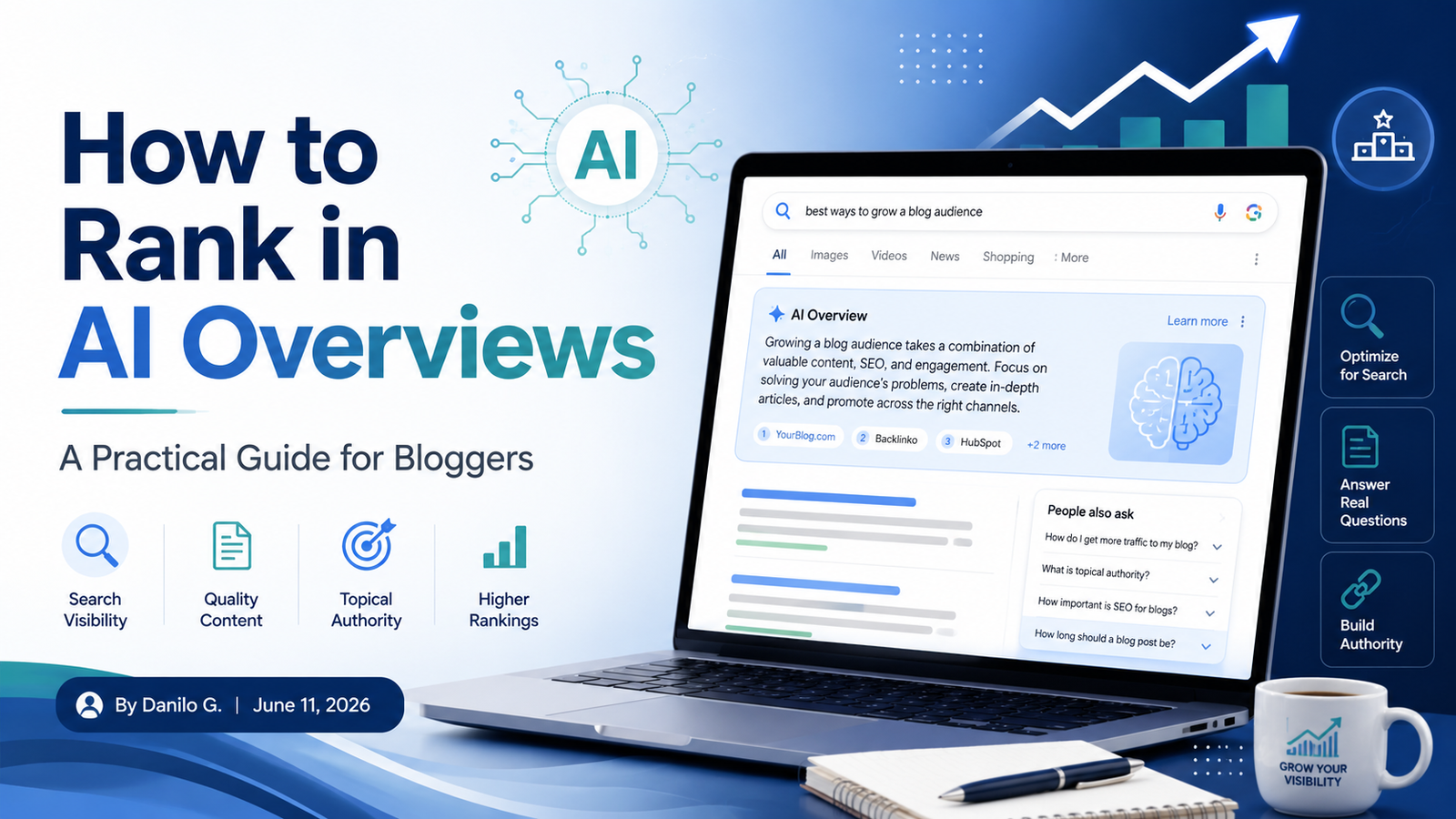
How to Rank in AI Overviews: A Practical Guide for Bloggers
Want the short answer? To rank in AI Overviews, write a clear, direct answer to a real question in the first few sentences of your post, structure the page with question-style headings and an FAQ section, and build enough trust signals that Google already ranks you somewhere near the top 10. That’s it. That’s the recipe. The rest of this guide just shows you how to actually cook it.
Let me guess how you got here. You searched something on Google, and instead of the familiar ten blue links, a big AI-written answer appeared at the top of the page like it owned the place. And somewhere between reading it and closing the tab, a slightly terrifying thought hit you: “Wait… if Google answers everything itself, who’s going to visit my blog?”
I had the same mini heart attack. I watched posts on this site sit in good positions while clicks got quieter, like a shop on a street where the city built a highway overpass. The traffic didn’t vanish. It just started flowing somewhere new. So I did what any stubborn blogger would do: I dug into the data, tested things on my own posts, and figured out how the new game works.
Good news: the new game is very winnable, even if you’re a complete beginner in the AI space. Let’s break it down in plain English.
What Is an AI Overview, Anyway?
An AI Overview is the AI-generated summary Google shows at the top of some search results. Google’s AI reads content from across the web, writes a short answer to your question, and then cites the websites it borrowed that information from, with clickable links right next to the answer.
Think of it like a book report. Google’s AI is the student, the internet is the library, and the citations are the bibliography at the end. Your job as a blogger is simple: become a book the student wants to quote.
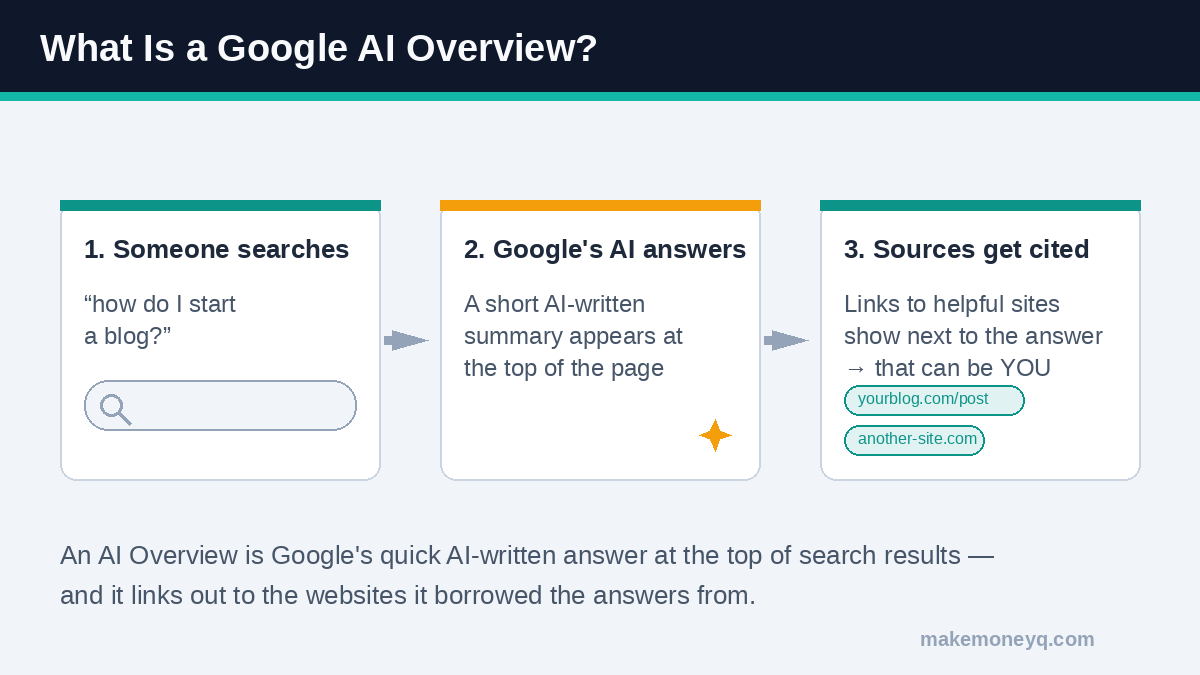
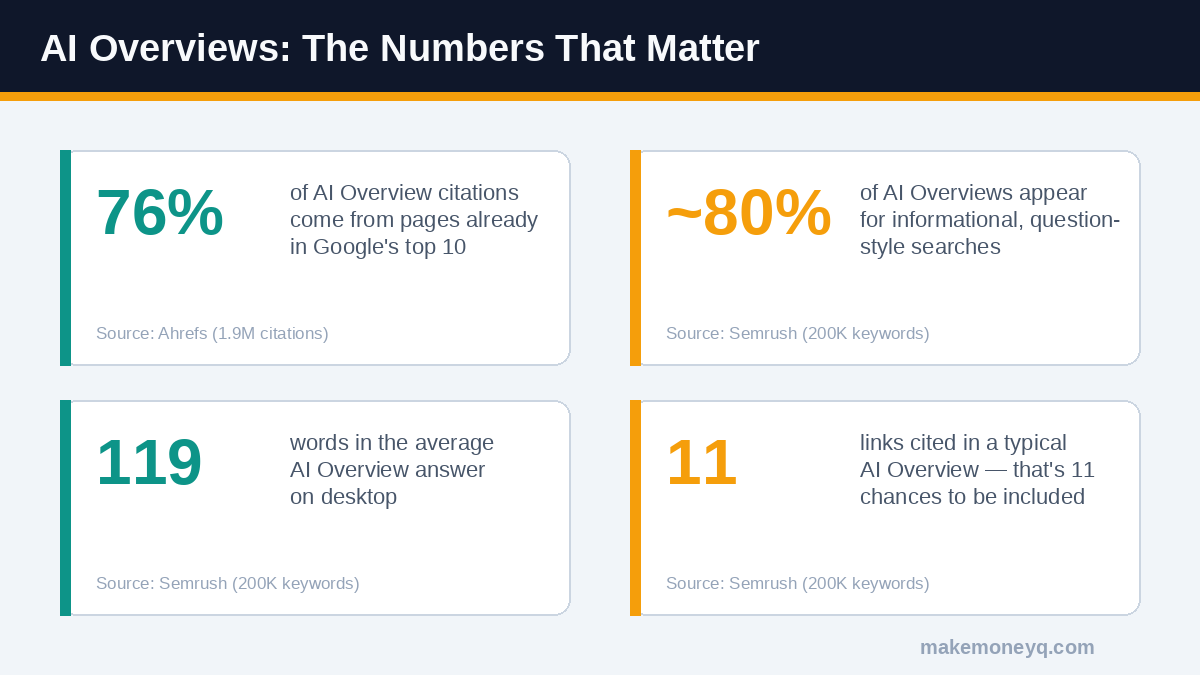
A few quick facts so you know what you’re dealing with. According to Semrush’s study of 200,000 AI Overviews, about 80% of them appear for informational searches, meaning questions like “how,” “what,” and “is.” The average Overview is only around 119 words long and cites roughly 11 links. Eleven links. That’s eleven open seats at the table, and one of them can have your name on it.
And here’s the part most beginners miss: Google itself says there are no special tricks, files, or secret code needed to appear in AI Overviews. The same SEO fundamentals that ranked blogs five years ago still decide who gets cited today. The fundamentals just got a new boss to impress.
Why Should Bloggers Care About AI Overviews?
Two reasons: one scary, one exciting. Let’s rip the band-aid off first.
The scary one: AI Overviews eat clicks. Ahrefs analyzed 300,000 keywords and found that when an AI Overview shows up, the top-ranking page loses about 34.5% of its clicks. Read that again. You could do everything right, hit position #1, and still lose a third of your traffic to a robot summarizing your own work. Rude, honestly.
Now the exciting one: getting cited inside the Overview is the new prime real estate. Your link appears above every traditional result, attached to the answer people are actually reading. And the visitors who do click through from an Overview tend to be warmer. They’ve already read the summary and they want more depth, which is exactly the kind of reader who signs up for your newsletter or clicks your affiliate link.
There’s a second piece of good news hiding in the data, too. Ahrefs studied 1.9 million AI Overview citations and found that 76% of cited pages already rank in Google’s top 10. But flip that around: 24% of citations come from pages that don’t. Some cited pages don’t even rank in the top 100. Translation? Even a newer, smaller blog can sneak into an AI Overview if the content answers the question better than the big guys. That almost never happened with old-school rankings.
How Do You Rank in AI Overviews? 7 Practical Steps
Here’s the playbook, in order of importance. None of this requires coding skills, a marketing degree, or sacrificing a keyboard under a full moon.
Step 1: Answer the Question Immediately
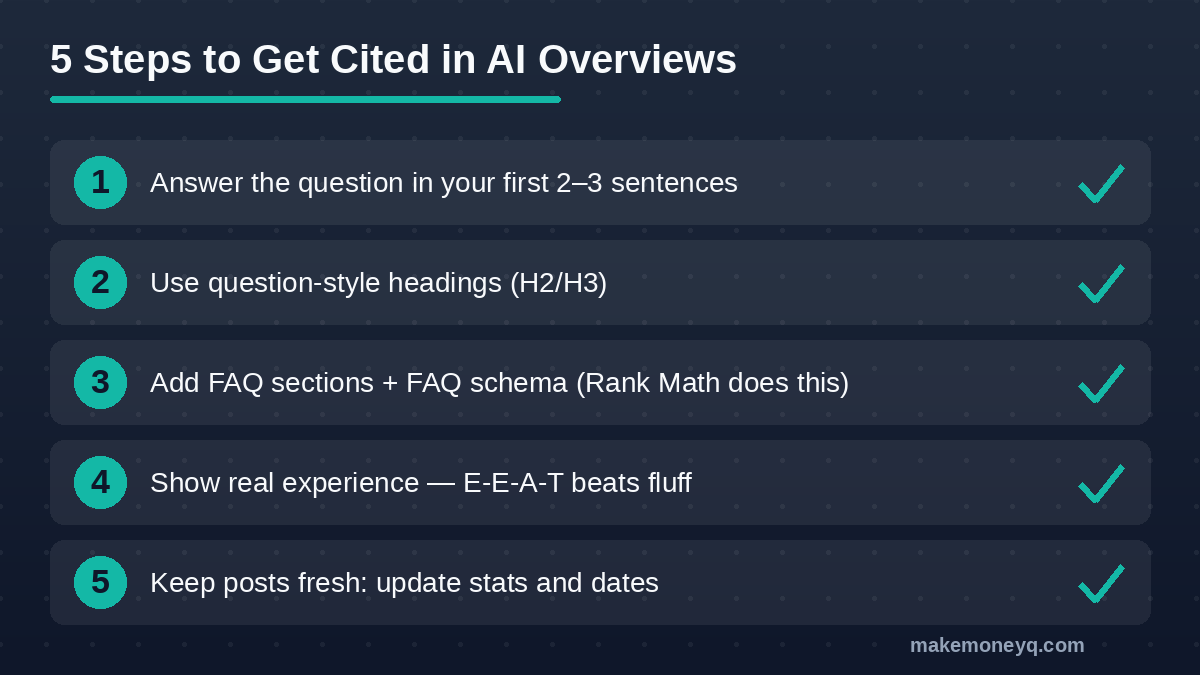
Google’s AI is looking for clean, quotable answers. So give it one. Whatever question your post targets, answer it in the first two or three sentences, in 40 to 60 words, before you tell your life story. Notice how this very article opened with the answer in bold? That wasn’t an accident. That’s the format AI Overviews love to lift.
A simple template: “[Question being asked]? [Direct answer in one or two sentences]. Here’s how it works.” Then expand below. Readers in a hurry get their answer, and Google gets a snippet it can quote without surgery.
Step 2: Use Question-Style Headings
Look at the H2s in this post: “What Is an AI Overview, Anyway?” and “Why Should Bloggers Care?” Those aren’t just stylistic choices. AI systems use headings to understand what each section answers. When your heading matches a real question people search, and the paragraph under it answers that question directly, you’ve basically gift-wrapped a citation for Google.
Free tool tip: type your topic into Google and check the “People also ask” boxes. Those are literal questions real humans ask. Steal them shamelessly for your headings.
Step 3: Add an FAQ Section With Schema
Schema (also called structured data) is a little label system that tells search engines “hey, this part of the page is a question and this part is the answer.” You don’t need to touch code for this. Since you’re using Rank Math, just use the “FAQ by Rank Math” block, type your questions and answers, and the plugin adds the schema behind the scenes automatically.
One honest caveat: Google says no special schema is required for AI Overviews. True. But FAQ blocks force you to write in the exact question-and-answer format the AI prefers to quote. So even if the schema itself isn’t magic, the writing habit it creates absolutely is.
Step 4: Show Real Experience (E-E-A-T)
E-E-A-T stands for Experience, Expertise, Authoritativeness, and Trustworthiness. It’s Google’s way of asking, “Should anyone actually believe this person?” The first E, Experience, is your superpower as a small blogger. Big corporate sites can hire writers, but they can’t fake the moment you actually tried the thing and it went sideways.
So include the stuff only you can write: your real results, your screenshots, the mistake that cost you a weekend. Generic AI-written mush all sounds identical, and Google’s systems have gotten scarily good at smelling it. If you want a full workflow for using AI tools without producing that mush, I wrote about exactly that in my guide to building an AI content workflow that doesn’t trash your SEO.
Step 5: Build Topic Clusters With Internal Links
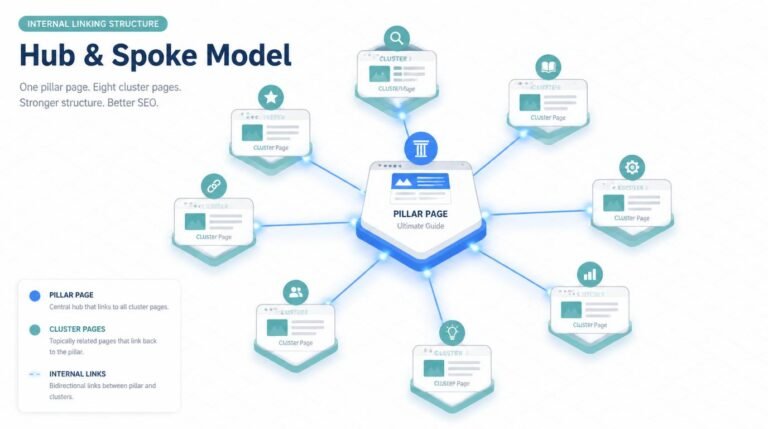
One great post is a business card. Ten connected posts on the same topic are a reputation. Write one big pillar guide on your main topic, then several focused posts answering specific sub-questions, and link them all together. This tells Google your site is a genuine resource on the subject, not a drive-by opinion.
Internal links are the glue here, and they’re also the most beginner-friendly SEO win that exists: free, instant, and entirely under your control. If you want the bigger picture on how search-focused content fits together, my SEO for affiliate marketing guide walks through the whole system.
Step 6: Keep Your Content Fresh
AI Overviews lean toward current information. A post titled “Best Strategies for 2023” might as well be wearing a powdered wig. Every few months, revisit your key posts: update the stats, refresh the examples, prune the dead advice, and let WordPress show the updated date. A 30-minute refresh often does more for AI visibility than a brand-new post.
Step 7: Nail the Boring Fundamentals
Remember: 76% of citations come from the top 10. So everything that always mattered still matters: a fast site, posts that actually get indexed, keywords you realistically can compete for, and content that helps a human being. AI Overviews are a layer on top of SEO, not a replacement for it. If your foundation is shaky, start there. And if you don’t even have the blog yet, start with my guide on how to start a blog that makes money and come back to this post once you’re live. It’ll be here. Freshly updated, obviously.
Watch This: Neil Patel on Winning in the Age of AI Overviews
If you’d rather hear all this from a guy who has been doing SEO since before some of you had email addresses, Neil Patel breaks down where the traffic actually went and how to win it back. Fun fact from his research: YouTube citations inside AI Overviews have grown by over 400% since launch, which is exactly why embedding relevant videos (like this one) is itself a smart AI Overview move. Yes, this embed is doing double duty. We practice what we preach around here.
3 Mistakes Beginners Make With AI Overviews
Mistake #1: Burying the answer. The classic recipe-blog move: 900 words about a trip to Tuscany before the actual recipe. Google’s AI will not wait around for your answer. Neither will humans. Answer first, story second.
Mistake #2: Writing for robots instead of people. Stuffing the keyword into every other sentence reads like a hostage note and ranks like one too. Google’s AI was literally trained on natural human writing. The more natural you sound, the more quotable you are. Write like you’re explaining it to a smart friend.
Mistake #3: Panicking and quitting. Some bloggers saw the click drop, declared “SEO is dead” for the fourteenth time, and walked away. Meanwhile, the bloggers who adapted are picking up those eleven citation seats with less competition than ever. Markets reward the people who stay calm and adjust.
FAQs About Ranking in AI Overviews
What is an AI Overview in simple terms?
It’s a short, AI-written answer that Google shows at the top of some search results. It summarizes information from several websites and links to them as sources. Getting your blog listed as one of those sources is the new version of “ranking.”
Do I need to rank #1 on Google to appear in AI Overviews?
No. Most cited pages rank in the top 10, but roughly a quarter of citations come from pages ranking lower, and some don’t rank in the top 100 at all. A clear, direct answer can beat a higher-ranking page that rambles.
Do I need a plugin or special code to show up in AI Overviews?
No. Google has confirmed there are no special technical requirements beyond normal SEO. That said, an SEO plugin like Rank Math makes the helpful stuff (FAQ schema, meta descriptions, sitemaps) much easier for beginners.
Will AI Overviews kill my blog traffic?
They reduce clicks on informational searches (about 34.5% for the top result, per Ahrefs), but they don’t kill traffic. Bloggers who get cited, target questions AI answers poorly, and build email lists are still growing. The traffic changed shape; it didn’t disappear.
How long does it take to get cited in an AI Overview?
There’s no fixed timeline. If a post already ranks well, a structural rewrite (answer-first intro, question headings, FAQ block) can get cited within weeks of being re-crawled. Brand-new blogs should expect months, because they’re building trust from zero. Normal, not broken.
Can I use AI tools to write content that ranks in AI Overviews?
Yes, as a helper, not a ghostwriter. Use AI for outlines, research, and drafts, then add your own experience, opinions, and proof. Pure copy-paste AI content sounds like everyone else’s and gives Google zero reason to cite you specifically.
Final Recommendation: Start Here, Beginner Friend
If you’re brand new to all of this AI stuff, here’s my honest advice: ignore 90% of the noise. You don’t need to understand how large language models work, you don’t need seventeen AI tools, and you definitely don’t need that $997 “AI SEO Secrets” course someone is yelling about on YouTube.
You need one habit: answer real questions clearly, near the top of the page, on a blog that shows real experience. That single habit covers most of what AI Overviews reward. Everything else in this guide is seasoning.
So here’s your homework, and I want you to actually do it. Pick your single best post. Rewrite the intro so it answers the main question in the first three sentences. Turn the headings into questions. Add an FAQ block with three real questions from Google’s “People also ask.” Update anything stale. Total time: about an hour. Then do the next post tomorrow. In a month, you’ll have a blog that’s dressed for the party Google’s AI is throwing, while your competitors are still arguing about whether the party is real.
The bloggers who win the next five years won’t be the ones with the most posts. They’ll be the ones whose posts are the easiest to trust and the easiest to quote. Be quotable, stay curious, and keep publishing. The robots are watching, and for once, that’s good news.