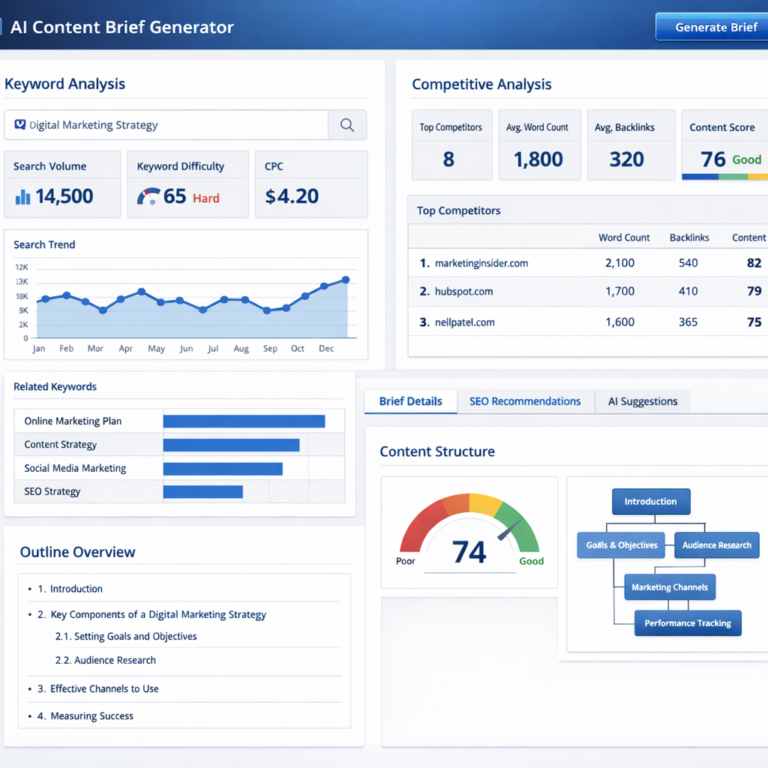

AI Content Workflow for Bloggers: 9 Proven Hacks
AI Content Workflow for Bloggers sounds easy until your draft reads like microwaved oatmeal. You ask AI for a blog post, it gives you something technically readable, then the real pain starts: weak structure, generic advice, no point of view, and zero reason for Google or readers to care. The fix is not “write better prompts.” The fix is a repeatable workflow that turns AI into a production assistant, not a fake expert wearing a plastic mustache.
I have used AI content creation across affiliate sites, SEO articles, product reviews, and content marketing workflows. The pattern stays the same: bloggers fail when they let AI start too early. They win when they give AI a job inside a system.
Table of Contents
- What an AI Content Workflow Actually Does
- Why Most AI Blogging Workflows Break After Draft One
- Hack 1: Start With Search Intent Before Any Prompt
- Hack 2: Build the Outline Like a Ranking Asset
- Hack 3: Use AI for Drafting, Not Thinking
- Hack 4: Add Human Proof, Experience, and Friction
- Hack 5: Add the SEO Layer After the Draft
- Hack 6: Use Visuals and Video to Increase Trust
- Hack 7: Build a Refresh Loop Before You Publish
- Hack 8: Keep Your AI Blogging Tool Stack Lean
- Hack 9: Turn the Workflow Into a Publishing System
- FAQ: AI Content Workflow for Bloggers
- My Top Recommended Gear
What an AI Content Workflow Actually Does
An AI content workflow for bloggers is a repeatable system for researching, outlining, drafting, editing, optimizing, publishing, and updating blog posts with AI support. It helps bloggers produce faster without sacrificing search intent, originality, accuracy, voice, or reader trust.
What should AI handle in a blogging workflow?
AI should handle the repeatable parts: topic clustering, outline variations, draft scaffolding, meta description options, FAQ ideas, semantic keyword expansion, and content repurposing. It should not decide your business angle, product recommendation logic, reader promise, or final opinion. Those parts need judgment.
Think of AI like a fast junior assistant. Useful? Absolutely. Dangerous when unsupervised? Also yes. TBH, most bad AI blogging comes from asking a junior assistant to act like an editor-in-chief, SEO strategist, fact-checker, conversion copywriter, and brand owner at the same time. That is not a workflow. That is a content casino.
A real workflow gives every step a purpose. Research tells you what to cover. The outline controls structure. The draft creates raw material. Editing adds credibility. SEO optimization improves discoverability. Internal links move authority through your site. Updates protect rankings after publishing.
For a broader hub on this topic, connect this article to your AI and automation resources so readers can move from basic AI blogging into practical systems.
Why Most AI Blogging Workflows Break After Draft One
Why does the first AI draft feel good but perform badly?
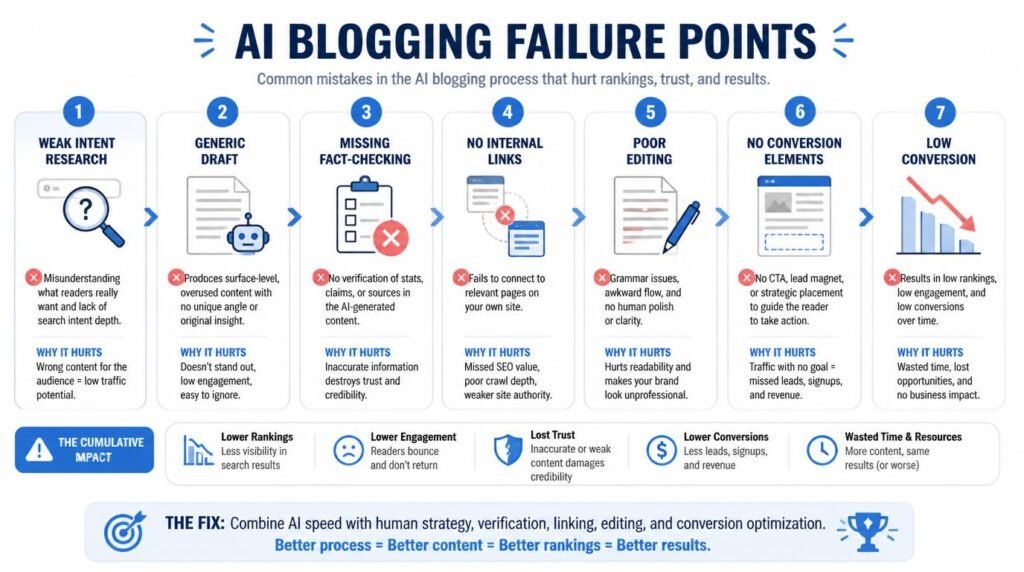
Because AI drafts often create the illusion of progress. You see 1,500 words appear in seconds and your brain says, “Great, article done.” Then the post gets no clicks, no backlinks, no comments, and no conversions. That is the trap.
The first draft usually lacks three things: strategic angle, lived experience, and usefulness density. Google’s own guidance on helpful content pushes creators toward people-first material that demonstrates real value, not content built mainly to attract visits from search engines. You can read that guidance directly from Google Search Central.
Here is the counterintuitive part: the draft is not the asset. The workflow is the asset. A mediocre blogger with a strong workflow beats a clever blogger who starts from scratch every time. The clever blogger burns energy reinventing the wheel. The workflow blogger ships, measures, improves, and compounds.
Hack 1: Start With Search Intent Before Any Prompt
What is the reader really trying to fix?
Before you ask AI to write anything, define the search intent in plain English. Not the keyword. The problem. A blogger searching for “AI Content Workflow for Bloggers” does not want a lecture on machine learning. They want a repeatable process that helps them publish faster without producing robotic sludge.
I like to split intent into three layers:
- Explicit intent: They want a workflow for AI blogging.
- Emotional intent: They feel overwhelmed, inconsistent, or disappointed by generic AI drafts.
- Business intent: They want traffic, rankings, affiliate clicks, email subscribers, or client-ready content.
That three-layer model changes the article. Instead of writing “what is AI content creation,” you write around the reader’s real bottleneck: they need a system they can repeat every week.
Use your AI prompt like this: “Analyze this keyword by explicit intent, emotional intent, commercial intent, likely objections, and required subtopics.” Now AI helps you think before it helps you write. Huge difference.
Hack 2: Build the Outline Like a Ranking Asset
How do you stop AI from writing a generic blog post?
You control the outline. That is where the battle happens. A weak outline gives you a weak article no matter how fancy your tool sounds. A strong outline forces the draft to cover entities, questions, examples, objections, and conversion moments.
Start with a search-driven structure. Then add a human-driven layer. I want every outline to include:
- The pain point: What frustrates the reader right now?
- The mistake: What bad advice caused the problem?
- The system: What should they do instead?
- The proof: What examples, data, or experience support it?
- The action: What should they do after reading?
This is where your AI content workflows hub should act as the parent page. Each supporting post can target a smaller workflow problem: AI outlines, AI editing, AI SEO briefs, AI content refreshes, AI affiliate reviews, and AI repurposing.
Also, keep headings conversational. “How do you stop AI from writing a generic blog post?” beats “Generic Output Prevention Strategy.” People search like humans, not boardroom robots.
Hack 3: Use AI for Drafting, Not Thinking
Should AI write the whole blog post for you?
AI can write the first draft, but you should never let it own the argument. Your argument drives the post. AI supplies the clay. You sculpt the final asset.
Here is my preferred drafting sequence:
- Prompt 1: Generate section-by-section talking points, not prose.
- Prompt 2: Expand one section at a time with examples.
- Prompt 3: Rewrite each section for clarity, rhythm, and search intent.
- Prompt 4: Identify missing objections and unanswered questions.
That sequence prevents the dreaded one-shot article. One-shot AI content often sounds polished but thin. It moves too smoothly, which ironically makes it less trustworthy. Real expertise has edges. It admits tradeoffs. It tells the reader when something works, when it does not, and where beginners waste time.
For example, do not write, “AI tools help bloggers save time.” Write, “AI tools save time only after you define the brief. Without the brief, they create more editing work than they remove.” See the difference? One sentence says something. The other just nods politely.
Hack 4: Add Human Proof, Experience, and Friction
How do you make AI content sound like a real expert wrote it?
Add friction. That means opinions, caveats, examples, mistakes, screenshots, mini case studies, and “here is what I would do” moments. AI loves smooth generic claims. Readers trust specific, earned claims.
At this stage, I edit for five signals:
- Specificity: Replace vague claims with concrete examples.
- Experience: Add what happened when I tried the tactic.
- Tradeoffs: Explain when the advice fails.
- Voice: Cut robotic transitions and filler.
- Usefulness: Add steps, checklists, templates, or decision rules.
This matters because content quality does not come from word count alone. The Nielsen Norman Group has long argued for scannable, useful web writing that helps users find answers fast, and that principle still applies to AI-assisted blog SEO. Their writing guidance at Nielsen Norman Group remains painfully relevant.
IMO, this is the section where most bloggers either become publishers or stay prompt hobbyists. The difference is ownership. If the article could appear on 500 other blogs with the author name swapped out, it is not finished.

Hack 5: Add the SEO Layer After the Draft
When should you optimize AI content for SEO?
Optimize after the draft has a clear argument. If you optimize too early, you risk stuffing the article with related terms before the content earns them. Good SEO writing supports the reader. Bad SEO writing makes the reader feel like they fell into a keyword blender.
Your SEO layer should include:
- Title refinement: Use the target keyword and a strong benefit.
- Meta description: Match the problem and promise the outcome.
- Internal links: Move readers into related hubs and money pages.
- External authority links: Support claims with credible sources.
- FAQ section: Capture long-tail questions and People Also Ask intent.
- Schema markup: Help machines understand the page structure.
Google’s SEO starter guide still gives a useful baseline for crawlable, understandable pages. You can review the official version at Google Search Central.
This is also where you connect the article to your traffic and SEO cluster. Do not just publish an AI workflow article as a lonely island. Link it to your SEO strategy, blogging systems, AI tools, and monetization pages.
Hack 6: Use Visuals and Video to Increase Trust
Do images and video actually help AI blog content perform?
Yes, when they clarify the idea. No, when they decorate weak content like parsley on a gas station sandwich. Visuals should reduce confusion, show process, compare options, or demonstrate proof.
For this topic, useful visuals include workflow diagrams, before-and-after draft examples, editorial checklists, prompt stacks, and content calendar screenshots. A video can help when it shows process in motion. That matters because many readers need to see how the workflow behaves, not just read the steps.
Expert Commentary: This type of Search Central guidance helps bloggers connect AI-assisted production with the fundamentals Google still rewards: useful content, clear structure, and pages built for people first.
Use multimedia as trust infrastructure. A good workflow diagram can make your post more linkable. A short embedded video can increase engagement. A custom image prompt under each visual can also help you create a consistent brand style across your blog.
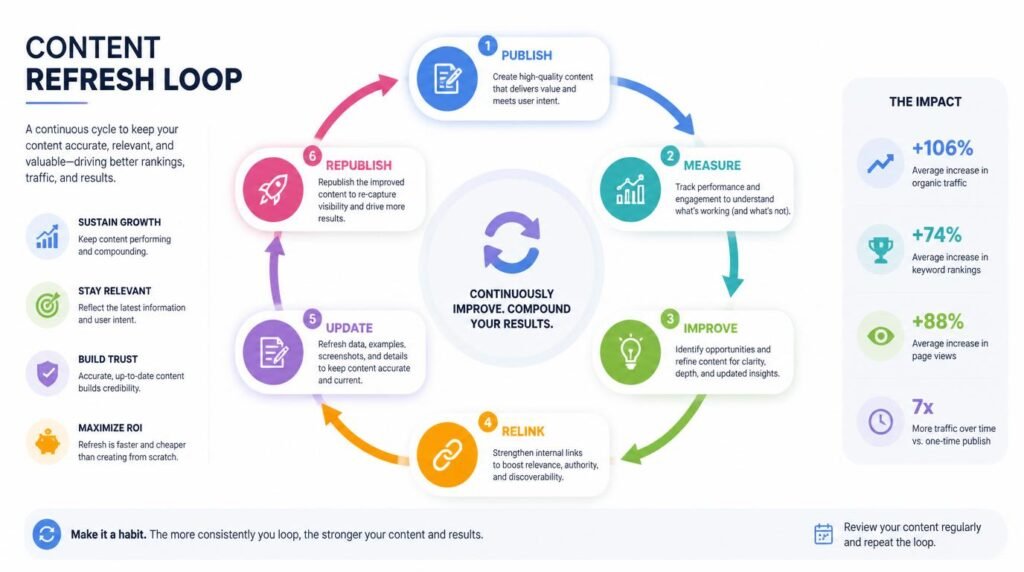
Hack 7: Build a Refresh Loop Before You Publish
Why should you plan updates before the article goes live?
Because publishing is not the finish line. It is the starting gun. AI blogging gets powerful when you build a refresh loop into the workflow from day one.
Before you publish, create a simple update note for the article:
- Primary keyword: AI Content Workflow for Bloggers
- Secondary terms: AI blogging, blog SEO, content workflow, AI content creation
- Update trigger: New AI tools, Google guidance changes, rankings drop, low CTR, stale examples
- Review date: 60 to 90 days after publishing
This small step prevents content decay. It also helps you build a more serious editorial operation. When you update old posts, you can improve examples, add new internal links, refresh screenshots, test stronger titles, and improve conversion blocks.
At the 70% mark, many readers skim. So here is the blunt truth: if your workflow ends at “publish,” you are leaving money on the table. The winners keep improving the asset after the first crawl. Ngl, that is where a lot of affiliate sites quietly beat prettier brands.
Hack 8: Keep Your AI Blogging Tool Stack Lean
How many blogging tools do you actually need?
You need fewer than you think. Tool overload creates fake productivity. Every new dashboard feels like progress until you realize you spent three hours comparing features instead of publishing.
A lean AI content workflow needs four categories:
- AI writing assistant: For briefs, outlines, drafts, rewrites, and repurposing.
- SEO research tool: For keyword data, SERP checks, and competitor gaps.
- Editing tool: For clarity, grammar, tone, and readability.
- Analytics source: For rankings, clicks, CTR, and conversions.
That is enough. Add more only when the workflow breaks at a specific point. For example, if your bottleneck is content planning, add an editorial calendar. If your bottleneck is topical mapping, add a keyword clustering tool. If your bottleneck is conversion, add heatmaps or better opt-in tracking.
Your best AI tools for content creators page should compare tools by workflow role, not by hype. Bloggers do not need “the best AI tool.” They need the right tool for the job causing friction.
Hack 9: Turn the Workflow Into a Publishing System
How do you make AI blogging consistent instead of chaotic?
Build a checklist. Boring? Maybe. Profitable? Often. A checklist turns random effort into repeatable output.
Use this publishing system for every AI-assisted post:
- Step 1: Define keyword, intent, audience, and monetization path.
- Step 2: Build a search-aligned outline with conversational H3 questions.
- Step 3: Draft one section at a time with AI.
- Step 4: Add examples, opinions, proof, and lived experience.
- Step 5: Add internal links, external references, metadata, images, and FAQ schema.
- Step 6: Publish, index, monitor, and schedule the refresh.
For stronger topical authority, group posts into clusters. One pillar page explains the full AI blogging system. Supporting posts answer smaller problems: AI outlines, AI prompts, AI editing, AI SEO briefs, AI content updates, and AI affiliate review workflows.
The business goal is simple: turn every article into a useful asset that can rank, convert, and support the next article. That is how a blog becomes a machine instead of a pile of posts.
FAQ: AI Content Workflow for Bloggers
What is the best AI content workflow for bloggers?
The best AI content workflow for bloggers starts with search intent research, then moves into outline planning, draft generation, human editing, SEO optimization, fact-checking, formatting, internal linking, and performance updates.
Can AI write blog posts that rank on Google?
AI can help create blog posts that rank, but only when you add original insight, accurate information, strong structure, human editing, useful examples, and clear search intent alignment.
Why do most AI blogging workflows fail?
Most AI blogging workflows fail because bloggers treat AI as the whole writer instead of using it as a research, outlining, drafting, editing, and optimization assistant.
How many AI tools does a blogger actually need?
Most bloggers only need one strong writing assistant, one SEO research tool, one editing tool, and one analytics source. Too many tools usually create noise instead of better content.
How do I make AI content sound more human?
Make AI content sound more human by adding personal experience, sharp opinions, real examples, specific tradeoffs, short sentences, varied rhythm, and edits that remove generic filler.
My Top Recommended Gear
Logitech MX Keys S Wireless Keyboard
I recommend this keyboard because serious content production gets easier when your typing setup feels fast, quiet, and comfortable for long editing sessions. View on Amazon.
Blue Yeti USB Microphone
I recommend this microphone for bloggers who repurpose articles into YouTube scripts, podcasts, tutorials, or short-form content without building a full studio. View on Amazon.
BenQ ScreenBar Monitor Light
I recommend this monitor light because eye comfort matters when you spend hours researching, editing, formatting, and optimizing blog posts. View on Amazon.
Disclaimer: This post contains affiliate links. As an Amazon Associate, I may earn a commission from qualifying purchases at no additional cost to you. I only recommend products I’ve personally tested or rigorously researched.