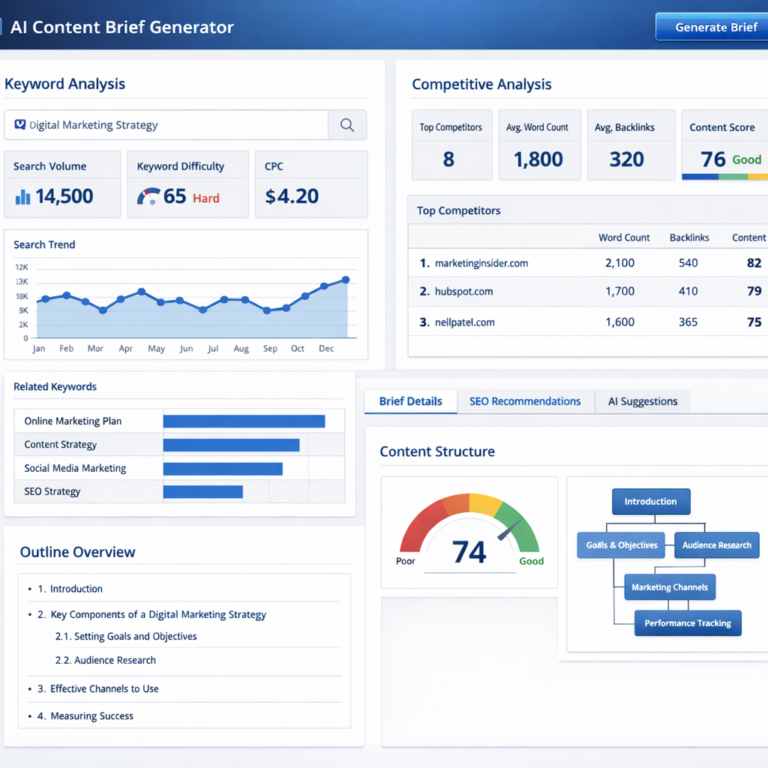

5 Steps Low Competition Keyword Research Process Made Easy
Here’s the uncomfortable truth about the low competition keyword research process: most bloggers skip it entirely — and then wonder why their posts sit on page four collecting digital dust. They publish. They wait. Nothing happens. Sound familiar?
The problem isn’t effort. It’s not even content quality. It’s that they’re targeting keywords controlled by sites with thousands of backlinks and decade-old domain authority. That’s not a content problem — that’s a strategy problem. And it’s completely fixable with the right workflow.
What I’m walking you through here is the exact five-step process I use to find keywords that a brand-new blog can realistically rank for — without a massive backlink budget, without a PR team, and without gambling on guesswork. Seed topic. SERP check. Weak competitor analysis. Intent match. Content angle. That’s the whole system. Let me show you how each piece works.
Table of Contents
- What Low Competition Keyword Research Actually Means
- Step 1 — Pick a Seed Topic That Has Room to Breathe
- Step 2 — Run the SERP Check That Exposes Weak Pages
- Step 3 — Identify and Dissect Weak Competitors
- Step 4 — Match Search Intent Before You Write a Single Word
- Step 5 — Lock In a Content Angle Nobody Else Is Using
- The Biggest Myth in Keyword Research (That’s Costing You Rankings)
- Frequently Asked Questions
- My Top Recommended Gear
What Low Competition Keyword Research Process Actually Means
Low competition keyword research is the process of identifying search terms where the pages currently ranking in Google’s top 10 are weak — low domain authority, thin content, few backlinks — giving a new or small blog a realistic path to ranking without needing massive SEO infrastructure. The goal is to find demand with beatable supply.
Let me be direct about something most SEO content glosses over: “low competition” doesn’t mean “low value.” Some of the most profitable keywords in any niche are low competition. Why? Because high-authority sites often ignore them — they’re chasing volume, not relevance. That leaves a gap you can walk right through.
According to research cited by Ahrefs, roughly 92% of all keywords get fewer than 10 searches per month. The internet is vast. The opportunity is in the specific, the niche, the precise — not the broad and heavily contested. That’s the mental shift that makes this entire process click.
If you’re just getting started with organic traffic strategy, I’d strongly recommend reading through keyword research for low authority sites first — it lays the foundational mindset you need before this workflow makes full sense.
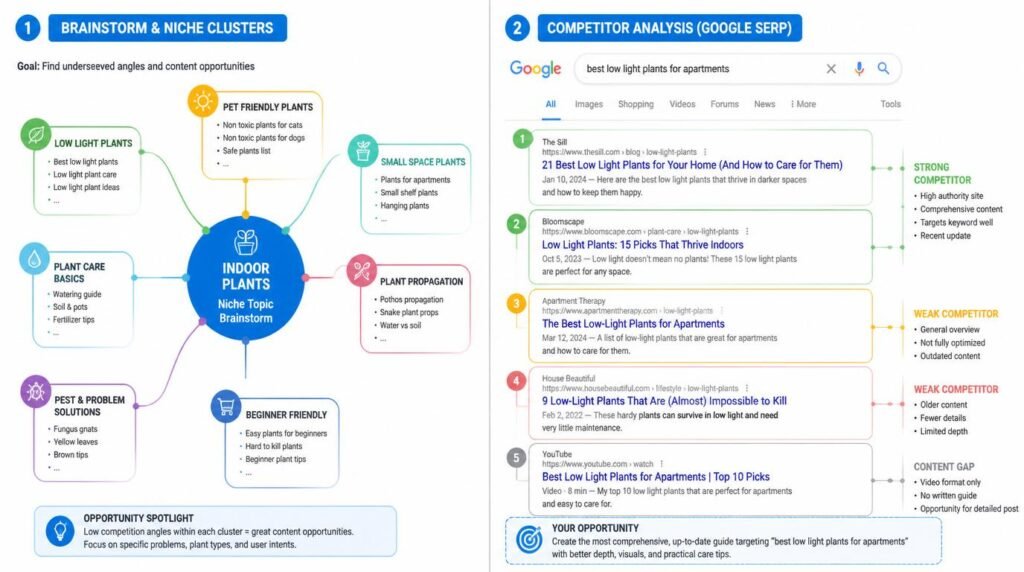
Step 1 — Pick a Seed Topic That Has Room to Breathe
How do I choose a seed topic that won’t put me in a dead end?
Your seed topic is the broad subject you want to write about — think “email marketing,” “home brewing,” or “budget travel Europe.” It’s not your keyword yet. It’s the universe you’re going to mine for keywords. The mistake I see constantly? People pick seeds that are either too broad (and saturated) or too narrow (and have zero search traffic).
The sweet spot is a seed topic tight enough to attract a specific audience, but wide enough to generate dozens of keyword variations. “Personal finance for freelancers” beats both “money” (too broad) and “Roth IRA withdrawal rules for self-employed photographers in Ohio” (too narrow to generate a keyword tree).
Start by listing 5–10 topics you know well, your target audience asks about, or your blog already covers. Then run them through Ubersuggest or Keywords Everywhere to see what keyword clusters naturally emerge. Don’t commit to a keyword yet — you’re just mapping the terrain at this stage. TBH, this step takes 20 minutes and most people skip it entirely, which is why their keyword lists are a mess.
You can also use Google’s autocomplete — type your seed topic and look at the suggestions that drop down. Those are real queries real people are typing right now. They’re not perfect keyword targets yet, but they tell you where the demand lives.
Step 2 — Run the SERP Check That Exposes Weak Pages
What exactly should I look at when I check the Google results page?
Here’s where most beginners go wrong — they type a keyword into Google, see a bunch of results from big sites, and immediately assume the keyword is impossible to rank for. That’s a critical error. The presence of a big site doesn’t mean the keyword is hard. What matters is whether that big site’s *specific page* is strong.
When you run your SERP check, you’re looking at four things for each of the top 10 results:
- Domain Authority (DA): Pages from sites with DA under 30 are often beatable, even for new blogs.
- Backlinks to that specific page: A site with DA 60 but zero backlinks to the ranking page? That’s an opening.
- Content quality: Is the ranking content thin, outdated, poorly structured, or written without real expertise? Those are the pages you can outwrite.
- Content format: Is Google rewarding listicles, how-to guides, or product roundups? Your format needs to match what’s already winning.
Install the Mangools browser extension or the Keywords Everywhere extension — both overlay SEO metrics directly onto the SERP so you can assess all 10 results without leaving Google. This turns a 30-minute manual process into a 90-second scan. For deeper analysis, pull the keyword into Ahrefs’ Keywords Explorer or Semrush’s Keyword Magic Tool and look at the Keyword Difficulty (KD) score. Anything under 20 on Ahrefs or under 30 on Semrush for a new blog is generally a green light.
For a broader view of how to build traffic from these opportunities, the traffic and SEO strategy guide on MakeMoneyQ connects this step to your larger content plan.
Step 3 — Identify and Dissect Weak Competitors
How do I tell if a competing page is actually weak enough for me to beat?
This is where the process gets genuinely interesting — and where the real opportunity hides. A “weak competitor” isn’t just a site with low authority. It’s a page that’s ranking *despite* having real weaknesses in its content, structure, or backlink profile. Finding those pages is like finding cracks in a wall you thought was solid.
Use Ahrefs’ Site Explorer or Semrush to pull the data on each competing URL. What you’re hunting for:
- Referring domains under 10: A page with fewer than 10 referring domains is often vulnerable, especially on a low-DA site.
- Content older than 3 years with no updates: Stale content loses ground. Fresh, well-structured content beats it consistently.
- Poor on-page optimization: Missing H2 structure, no internal linking, thin word count (under 600 words for a topic that warrants depth) — these are all signals the page is underperforming its position.
- Low engagement signals: Check if the page has comments, shares, or any community interaction. A ranking page with zero engagement is sitting on borrowed time.
Here’s something most guides won’t tell you: forum threads, Reddit posts, and Quora answers ranking in the top 10 are the single strongest signal that a keyword has weak competition. Google puts user-generated content there because nothing better exists. That means you — with one well-researched article — can take that spot.
According to Search Engine Land, Google’s ranking systems increasingly reward experience-based content, not just technically optimized pages. So a weak competitor ranking on DA alone — without lived expertise in the content — is absolutely displaceable. That’s your lane.
Step 4 — Match Search Intent Before You Write a Single Word
Why does search intent matter more than keyword volume for new blogs?
Search intent is the reason someone typed that query. Google has gotten extraordinarily good at understanding intent — and if your content doesn’t match what the SERP is already rewarding, you won’t rank. Period. It doesn’t matter how optimized your page is. A how-to guide won’t outrank product comparison pages for a transactional keyword, no matter how good it is.
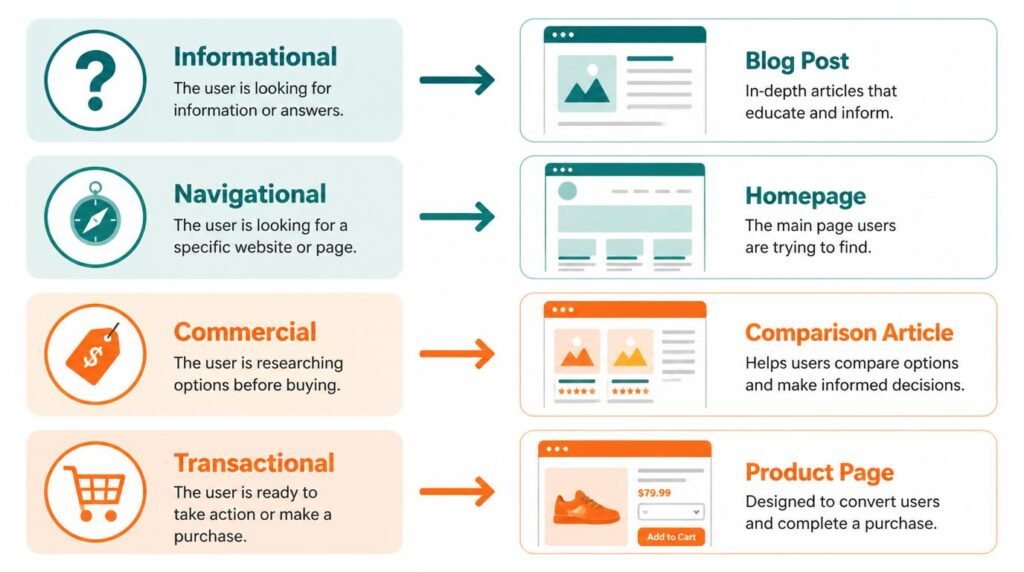
The four intent categories you need to know cold:
- Informational: The searcher wants to learn something. (“how to do keyword research”) → Blog posts, guides, tutorials.
- Navigational: The searcher is looking for a specific site or page. Not useful for new content targeting.
- Commercial investigation: The searcher is comparing options before buying. (“best keyword research tools”) → Comparison posts, roundups, reviews.
- Transactional: The searcher is ready to buy or sign up. (“buy Ahrefs plan”) → Landing pages, product pages.
The way to identify intent for any keyword is embarrassingly simple: Google it and look at what’s ranking. If the top 10 results are all listicles, write a listicle. If they’re all step-by-step tutorials with numbered headings, that’s your format. Google is literally showing you the answer. Use Google Search Console to cross-reference the intent signals on keywords you’re already ranking for — it tells you which queries are driving clicks, which often reveals intent patterns you didn’t expect.
Getting the intent wrong is the most common reason a technically solid article fails to rank. I’d stack this alongside proper internal linking strategy for small websites as the two most underrated ranking factors new bloggers ignore.
Expert Commentary: This is Brian Dean’s (Backlinko) keyword research tutorial — and it’s worth every minute specifically because he walks through the SERP evaluation process in real time, showing you exactly how to read a results page the way a senior SEO would. His visual breakdown of keyword difficulty signals maps directly to steps 2 and 3 of the workflow above.
Step 5 — Lock In a Content Angle Nobody Else Is Using
How do I find the content angle that makes my post different from the ten pages already ranking?
You’ve got a low competition keyword. You’ve confirmed the SERP is beatable. You’ve matched the intent. Now comes the move that separates content that gets clicks from content that gets buried: the angle. And this is where I see even experienced bloggers leave serious traffic on the table. 🙂
Your content angle is the specific lens through which you cover the topic. It’s not just “write a better version of what’s ranking.” It’s finding the gap — the thing the top-ranking pages don’t address, explain poorly, or assume the reader already knows. Here’s how I find it:
- Read the top 5 ranking articles end to end. Note every section, every H2, every claim. Build a mental map of what they all cover.
- Look at the comments and Reddit threads around the topic. The questions people ask after reading those articles are your content gaps.
- Check the “People Also Ask” boxes in the SERP. Every PAA question is a micro-angle you can address directly — and Google is already telling you people want that answer.
- Add a unique frame: “For beginners with zero budget,” “without expensive tools,” “in under 48 hours,” “for a local service business.” Specificity wins.
According to Search Engine Journal, content differentiation — not just technical SEO — is one of the most reliable ways to break into competitive SERPs even with low domain authority. Your angle is your differentiation. Treat it like the most important editorial decision you make.
Once you’ve nailed your angle, run your final content plan through the SEO audit checklist for new blogs before publishing — it catches the on-page issues that kill rankings before they start.

The Biggest Myth in Keyword Research (That’s Costing You Rankings)
Here’s the belief I want to burn down: “If a keyword has low search volume, it’s not worth targeting.”
IMO, this is the single most damaging piece of conventional wisdom in the SEO content space. A keyword with 200 monthly searches that you actually rank for — in position 1 or 2 — will send you more traffic, more reliably, than a keyword with 10,000 monthly searches that you rank for at position 47. Position matters more than volume. Every time.
Think about what a #1 ranking on a 200-search/month keyword actually means. At an average CTR of roughly 28% for position 1 (per Backlinko’s CTR research), that’s about 56 visits per month. From one post. Now multiply that by 50 posts targeting similar keywords. That’s 2,800 monthly visits from low-competition content alone — and those visitors are highly targeted because the queries are specific.
New blogs don’t lose the SEO game because they write bad content. They lose because they aim at the wrong targets. Fix the targeting, and the content almost doesn’t matter as much anymore. Almost. The right keyword plus mediocre content will outperform brilliant content targeting the wrong keyword, every single time.
Frequently Asked Questions
What is a low competition keyword and how do I find one?
A low competition keyword is a search term with meaningful monthly search volume but weak-authority pages currently ranking for it. You find them by checking the top 10 SERP results for domain authority below 30, thin content, and poor backlink profiles using tools like Mangools, Ubersuggest, or Ahrefs.
How do I check if a keyword has weak competition?
Type the keyword into Google and examine the top 10 results. Use a tool like Mangools KWFinder or Ahrefs to check each ranking page’s domain authority, backlink count, and content quality. If you see DA under 30 and thin pages ranking, that keyword likely has weak competition.
Can I rank for low competition keywords without backlinks?
Yes — for genuinely low competition keywords, strong on-page optimization, correct search intent matching, and well-structured content can be enough to rank without any backlinks, especially for new or low-authority blogs.
What tools are best for low competition keyword research?
The best tools for finding low competition keywords include Mangools KWFinder, Ubersuggest, Keywords Everywhere, Google Search Console, Ahrefs, and Semrush. Beginners can start with Ubersuggest or Mangools for affordability; advanced users will get the deepest data from Ahrefs or Semrush.
How many low competition keywords should I target per blog post?
Focus on one primary low competition keyword per post and naturally incorporate 3–5 semantically related secondary keywords throughout the content. Targeting multiple competing primary keywords in one post dilutes your topical focus and hurts rankings.
What search volume should low competition keywords have?
For new blogs, target low competition keywords with 100–1,000 monthly searches. These volumes are achievable and can drive real traffic. Avoid chasing high-volume keywords early — the competition at that level will crush a site with no authority.
My Top Recommended Gear
These are the tools and resources I’d hand to anyone serious about making the low competition keyword research process a repeatable system — not a one-time experiment.
- The Art of SEO by Eric Enge, Stephan Spencer & Jessie Stricchiola — The most complete and authoritative SEO reference book in print. I recommend it because it covers keyword strategy, intent mapping, and competitive analysis at a depth no blog post ever will. It’s the reference I return to.
- Keywords Everywhere Browser Extension (Credit Pack) — The most affordable way to get real-time keyword data directly on Google, YouTube, and Amazon SERPs without switching between tools. I use it every single time I do a SERP check.
- Content Strategy for the Web by Kristina Halvorson — This one sits at the intersection of content angle development and audience strategy. It’s what I’d give to any blogger who can execute the keyword research process but still struggles to find angles that resonate.
Disclaimer: This post contains affiliate links. As an Amazon Associate, I may earn a commission from qualifying purchases at no additional cost to you. I only recommend products I’ve personally tested or rigorously researched.

Written by
Danilo G.
Danilo G. is the creator of MakeMoneyQ, where he helps beginners build practical online income systems using affiliate marketing, blogging, SEO, AI tools, and simple traffic strategies without guru hype or fake success stories.