
Zero-Click Search: 10 Questions Every SEO Must Answer
Zero-click search is the reason your organic traffic is down, and there is no algorithm recovery coming to save it. In the first four months of 2026, 68.01% of US Google searches ended without a single click to any website — up from 60.45% two years earlier, according to Rand Fishkin’s analysis of Similarweb clickstream data at SparkToro. Ten years ago that number was around 45%.
Table of Contents
Zero-Click Search and the Skeptic in the Room
Before I make the case, let me describe you.
You’ve run SEO for eight years. You’ve seen every “SEO is dead” headline since 2011. You remember when Panda was going to end everything. Then mobile-first. Then voice search. None of it killed your traffic. You adapted. You ranked. You won.
So when someone says zero-click search changes everything, you hear noise. Another consultant selling a new framework.
Your objections are specific:
- Traffic down? That’s an algorithm update. It’ll recover.
- AI Overviews? Google still needs to send clicks somewhere.
- “Optimize for AI”? Nobody can prove that works.
- This smells like a solution looking for a problem.
Fair. All of it. So I’m not going to argue with you. I’m going to ask you ten questions. Answer them honestly in your head. Then decide for yourself.
If you want the groundwork first, our traffic and SEO fundamentals guide covers how targeted search traffic is supposed to work. This article is about what happens when that machine starts running dry.
10 Zero-Click Search Questions to Answer Before Your Next Content Plan
1. When Did You Last Click a Search Result to Find Store Hours?
Think about it. You typed “Trader Joe’s hours.” Google showed you the hours. You closed the tab.
You didn’t visit the store’s website. You didn’t see their homepage. You got what you needed and left.
Now — that store spent money on that website. Someone built that hours page. Someone optimized it. And you never saw it.
2. How Many Zero-Click Searches Did You Run This Week Without Noticing?
Weather. Conversions. A definition. An actor’s age. A sports score.
Each time, you had a question. Each time, Google answered it directly. You weren’t avoiding websites. You just didn’t need them.
Here’s what matters: you can’t remember most of these. The behavior is invisible to you. It’s automatic.
If zero-click search is invisible to you as a user, what makes you think it’s visible to you as a marketer?
3. Why Would Google Send You the Click if AI Overviews Can Answer?
Be honest about the business here.
Google makes money when people search. Not when people leave. Every click that goes to your site is a user leaving Google’s property. Every answer Google gives directly is a user staying.
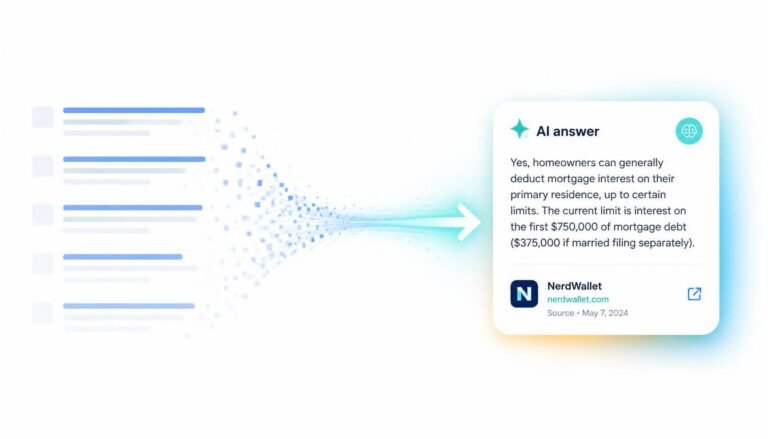
The data backs this up. Pew Research Center tracked 68,879 real Google searches from 900 US adults and found that when an AI summary appeared, users clicked a traditional result just 8% of the time — versus 15% when no summary appeared. Clicks on the sources cited inside the AI answer? About 1%.
Search Engine Land’s coverage of the same study notes something sharper still: users ended their browsing session entirely far more often when an AI summary was present.
You’ve always assumed Google needs publishers. It does. It needs your words. But needing your words and sending you traffic are two different things. Only one of them pays Google. Guess which.
4. Could an AI Overview Replace Your Top-Ranking Page From 2023?
Pull it up. Really.
Most high-traffic pages from 2022–2023 answered a specific question. “How long to boil an egg.” “What is a 401k rollover.” “Best time to post on Instagram.”
They ranked because they answered clearly. If that describes most of your library, our keyword research guide is worth revisiting — the intent categories you targeted in 2023 are exactly the ones Google now answers in-house.
Now ask yourself: could an AI Overview summarize that page in three sentences? If yes — it already has.
5. What Happens to Content That’s Easy for AI to Summarize?
Follow the logic.
A page that answers a question cleanly is a page that gets copied cleanly. The better you wrote it, the easier it was to lift. Clear headings made it easy. Structured data made it easier. A tight answer made it easiest of all.
That’s the same work that used to win you featured snippets. You optimized yourself into invisibility.
Sit with that for a second. The skill that made you win is the same skill that’s costing you now.
6. What Kind of Content Survives Zero-Click Search?
Now we’re getting somewhere.
Content that survives zero-click search can’t be compressed into an AI answer. It includes:
- Interactive tools and calculators that use the reader’s own numbers
- Original research and proprietary data
- Expert judgment applied to one specific situation
- Communities and forums
- Personalized experiences that require a visit
Think about what survives extraction:
- A recipe for banana bread? Summarizable.
- A tool that calculates your mortgage based on your actual numbers? Not summarizable.
- A definition of “content marketing”? Summarizable.
- A twelve-part case study with your proprietary data? Not really.
- A list of “best CRM software”? Summarizable.
- A community of 4,000 people arguing about CRMs in your forum? Impossible.
What’s the common thread?

7. Is the Information Valuable, or the Experience of Getting It?
Here’s the split.
Information is now a commodity. Any AI can produce a competent explanation of anything.
But experiences aren’t commodities. Interaction. Personalization. Trust. Original data. Human judgment applied to a specific situation. Community. Tools that do something.
These can’t be lifted into a summary box. They have to be visited.
So when you build content — are you building information, or are you building a reason to show up?
8. What Is Your SEO Content Actually For Without the Click?
This one stings a little.
For fifteen years, content had one job: earn the click. Everything else followed from that.
But if fewer clicks are coming, what’s left?
Consider: your content still gets read — inside the AI answer. Your brand still gets named. Your position still gets cited. You’re still being consumed. You’re just not being visited.
So is the goal organic traffic? Or is the goal being the source every answer gets built from?
This question hits affiliate publishers hardest, because their entire revenue model assumed the visit. If that’s you, our breakdown of SEO for affiliate marketing covers how to restructure pages around trust and decision-making rather than raw traffic volume.
9. Does AI Search Mention Your Brand When Someone Asks About Your Category?
Go test it right now. Ask an AI about your category.
Three things happen. It gives an answer. That answer comes from somewhere. It may or may not name a brand.
Now — is your brand in that answer?
If it is, you’re winning something your traffic dashboard can’t see. If it isn’t, you’re losing something it can’t see either.
That’s the uncomfortable part. Your analytics may no longer measure the thing that matters most. AI search visibility doesn’t show up in Search Console. Nobody sends you a report when an AI names your competitor instead of you.
Watch: Rand Fishkin on AI Visibility vs. Google Ranking
Rand Fishkin joins Greg Sterling, Mike Blumenthal and David Mihm on Near Memo to break down brand visibility in AI search and why measurement has to change. It’s the clearest 40 minutes you’ll spend on this topic.
Video: AI Visibility vs Google Ranking: Rand Fishkin & the Future of Search, Zero Click & Brand Measurement
10. What If You Measured AI Search Visibility Instead of Clicks?
Answer honestly. If the metric changed, what would you stop doing?
- Would you still publish twenty thin posts a month?
- Would you still chase keywords Google answers in a box?
- Would you still avoid original research because it’s expensive?
- Would you still treat your email list as a side project?
Or would you build fewer things, deeper — things worth citing, worth returning to, worth signing up for?
You already know the answer. You’ve known it since question 5.
What Zero-Click Search Actually Changes About SEO Strategy
Nobody told you what to think here. You reasoned through it.
You noticed your own behavior. You followed Google’s incentives. You saw how good SEO made content extractable. You separated information from experience. And you landed where the evidence pointed.
The click was never the point. It was the delivery mechanism. The mechanism is changing. The point isn’t.
Your job now is to be the source — the one that gets cited, quoted, named, and returned to. Organic traffic becomes one signal among several, not the only one. Similarweb makes the same argument from the data side: appearing in an AI Overview or a cited AI answer still builds recognition at the exact moment someone is deciding, even when nobody visits.
How to Optimize for Zero-Click Search: Your Monday Morning Checklist
Start here. It takes an hour.
Audit Your Top Pages for AI Extractability
List your top 20 pages. Mark each one: could an AI Overview replace this in three sentences? Those are your at-risk pages. In most audits I’ve run, it’s twelve to fifteen of the twenty — and they’re usually the ones that used to perform best.
Run an AI Search Visibility Test
Ask three AI tools ten questions in your category. Write down whether your brand appears. That’s your baseline, and it’s the only zero-click search metric that currently means anything.
Build One Asset That Can’t Be Summarized
A calculator. A survey of your customers. A tool. Something that requires a visit.
Create a Direct Channel That Doesn’t Depend on Google
Email, community, app — anything that doesn’t depend on a search engine’s mood. If you’re starting from zero here, our blogging and audience-building guide walks through building a readership you own rather than rent.
Do those four things and you’ll be ahead of most of your competitors, who are still refreshing Search Console and hoping.
Recommended Tools and Reading
These are the resources I hand to teams who are rebuilding around visibility instead of clicks. As an Amazon Associate, we earn from qualifying purchases.
The Art of SEO — Enge, Spencer and Stricchiola. Still the most thorough technical foundation in print. Read it for the architecture and internal linking chapters, which matter more, not less, when you’re optimizing to be cited rather than clicked.
Lost and Founder — Rand Fishkin. Not an SEO manual. It’s the honest account of building a business from the person whose clickstream research produced the 68% figure at the top of this article. Useful context for why he’s been right about this since 2019.
They Ask, You Answer — Marcus Sheridan. The whole book is about becoming the definitive answer in your category. That premise aged extremely well.
Email Marketing Rules — Chad S. White. If your fourth action item is building a direct channel, this is the reference for doing it properly instead of bolting a signup box onto a sidebar.
Traffic Secrets — Russell Brunson. Aggressive in tone, and not everyone’s style. But the core argument — own your traffic sources, never rent them — is exactly the lesson zero-click search is teaching the hard way. Pairs well with our affiliate marketing guide if monetization is the end goal.
Frequently Asked Questions About Zero-Click Search
What is zero-click search?
A zero-click search is a Google query that ends without the user clicking through to any website. The answer is resolved on the results page itself — by a featured snippet, a knowledge panel, a local pack, or an AI Overview. In the first four months of 2026, 68.01% of US Google searches ended this way.
Is zero-click search the same as AI Overviews?
No. Zero-click search predates AI by more than a decade — weather boxes, calculators and instant answers were doing it as far back as 2011. AI Overviews accelerated an existing trend rather than starting it. They now appear on more than 20% of searches and roughly halve click-through rates when they do.
Is my traffic drop an algorithm update or zero-click search?
Check the shape of the decline. Algorithm updates hit specific pages or clusters and often partially recover within a few months. Zero-click erosion is gradual, broad, and hits informational pages hardest while impressions stay flat or rise. If impressions hold and clicks fall, that’s zero-click search, not a penalty.
How do I check whether AI search mentions my brand?
Pick ten questions a customer would ask about your category. Run all ten through three different AI tools. Record whether your brand is named and whether your site is cited. Repeat monthly. That gives you a visibility baseline no analytics platform currently provides.
Does SEO still matter in 2026?
Yes, and arguably more. AI answers are assembled from indexed, crawlable, well-structured pages. If you don’t rank, you don’t get cited. The difference is that ranking is now the entry ticket rather than the payoff — the payoff is being the source the answer is built from.
What kind of content still earns clicks?
Content an AI can’t hand over for free: interactive tools and calculators, original research and proprietary data, expert judgment applied to one specific situation, active communities, and anything personalized to the individual reader.
Will Google reverse this?
Very unlikely. Zero-click search increases Google’s ad revenue and session time. SparkToro’s tracking shows the rate has climbed steadily from roughly 45% in 2016 to 68% in 2026, with the steepest jump in the last two years. Nothing about the business model suggests a reversal.
Here’s what I’d bet on. A year from now, the teams still arguing about whether zero-click search is real will be the ones explaining another flat quarter to their CMO. The ones who ran the test in fifteen minutes will already know which answers name them and which don’t — and they’ll have spent the year building the one thing on their site that nobody can hand out for free.
You don’t need a strategy deck for this. Open three AI tools, ask ten questions about your category, and write down every time your brand shows up. Do it before you close this tab.