Content Calendar Planning Strategy for Huge Results
Table of Contents
- What Is a Content Calendar Planning Strategy (And Why Most Get It Wrong)
- Why You Actually Need a Content Calendar — The Real Reasons
- How to Build a Content Calendar That Drives Real Traffic
- Integrating SEO Planning Into Every Calendar Entry
- The Content Workflow System That Eliminates Bottlenecks
- Advanced Content Calendar Tactics Most Bloggers Never Use
- The Biggest Content Calendar Myth That’s Costing You Traffic
- Frequently Asked Questions
- My Top Recommended Gear
What Is a Content Calendar Planning Strategy (And Why Most Get It Wrong)
A solid content calendar planning strategy sounds boring — until you realize it’s the single thing separating bloggers who earn six figures from those stuck at 200 pageviews a month. Here’s the problem: most people treat their blog like a journal. They wake up, feel inspired (or don’t), write something random, hit publish, and wonder why nothing grows. That inconsistency isn’t just frustrating — it’s actively telling Google your site isn’t worth crawling regularly. The agitation? Every week you publish without a plan, you’re burying yourself deeper in algorithmic irrelevance. The fix isn’t working harder. It’s building a content strategy system that makes every single post count before you type a word.
Quick Answer: A content calendar planning strategy is a documented system that maps what content you’ll publish, when you’ll publish it, which keywords each piece targets, and how every post connects to your broader content marketing goals. It transforms random blogging into a structured editorial operation that compounds traffic over time.
I spent my first two years blogging without any real editorial calendar. I published when I felt like it, chased trending topics that had nothing to do with my niche, and constantly battled the anxiety of “what do I write next?” It wasn’t until I sat down and built an actual blog planning system — mapping keywords to dates, clustering topics into pillars, and batching my production workflow — that traffic started compounding. Within four months of following a structured calendar, my organic sessions tripled. Not because I wrote more. Because I wrote smarter.
Why You Actually Need a Content Calendar — The Real Reasons
Ever notice how the blogs that dominate SERPs seem to publish with eerie consistency? That’s not coincidence — it’s architecture. But the benefits of an editorial calendar go way deeper than “staying consistent.” Let me break down what actually happens beneath the surface when you plan your content systematically.
First, Google’s crawl budget becomes your friend. When you publish on a predictable schedule, Googlebot learns your pattern and adjusts crawl frequency accordingly. Research from Google’s own documentation on crawl budget management confirms that consistent publishing signals site vitality. Second, a calendar forces you to think in content clusters rather than isolated posts. This is how you build topical authority — the thing Google’s Helpful Content system cares most about right now.
Third — and this is the one nobody talks about — a content calendar protects your mental health. I’m serious. The cognitive load of deciding what to write, researching keywords on the fly, and scrambling for ideas while staring at a blank screen is genuinely exhausting. A calendar removes that decision fatigue entirely. You sit down, open your calendar, and the work is already defined. That’s freedom disguised as structure.
If you’re still figuring out the foundations of building a profitable blog, I wrote a thorough walkthrough on how to start a blog that makes money — it pairs perfectly with what we’re covering here.
How to Build a Content Calendar That Drives Real Traffic
How do you go from “I should probably plan my content” to actually having a working system? Here’s the exact framework I use and teach — and it works whether you’re a solo blogger or managing a small team.
Step 1: Define Your Content Pillars First
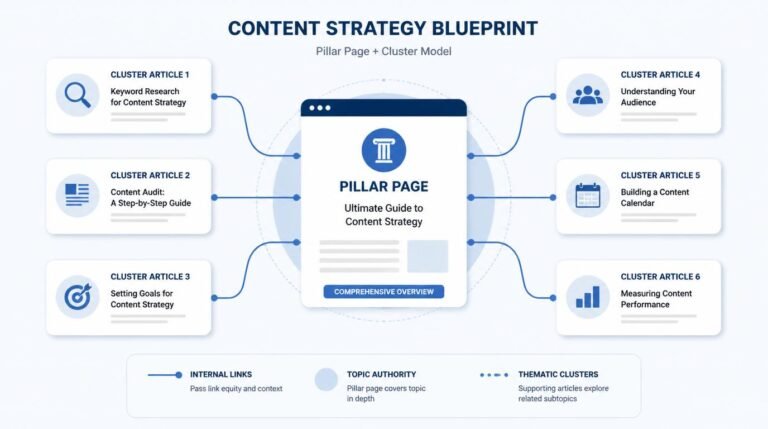
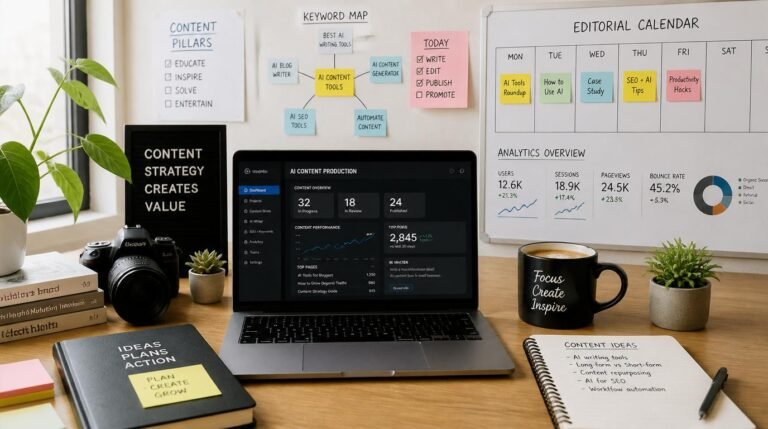
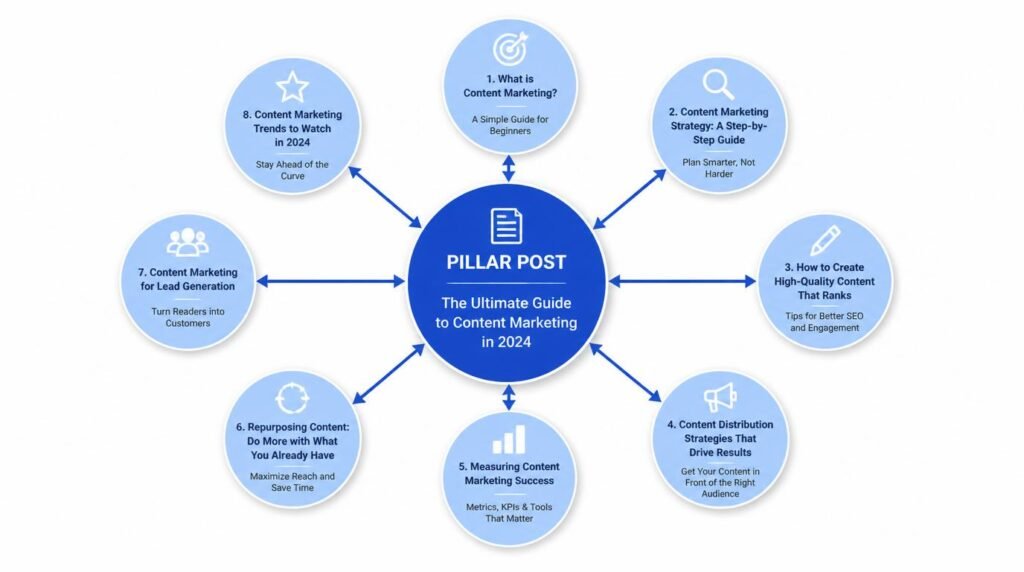
Before you open any spreadsheet, you need to identify 3–5 core topic pillars that your entire blog will orbit around. These aren’t random categories — they’re strategic territory claims. Each pillar should represent a cluster of related keywords you want to own in search. For example, if you run a blogging tips site, your pillars might be: Content Strategy, SEO Fundamentals, Monetization, and Email Marketing. Every post you plan in your calendar must map to one of these pillars. No exceptions. No “random thought” posts that don’t fit anywhere.
Step 2: Run Keyword Research in Batches
I batch my keyword research once per month. I pull up Ahrefs, Semrush, or even free tools like Ubersuggest and Google’s Keyword Planner, and I generate 20–30 keyword opportunities across my pillars. Each keyword gets scored on three criteria: search volume, keyword difficulty, and business relevance. That last one is critical — I’ve ranked #1 for keywords that drove zero revenue because I never asked “does this keyword attract someone who might eventually buy something from me?”
Step 3: Map Keywords to Calendar Dates
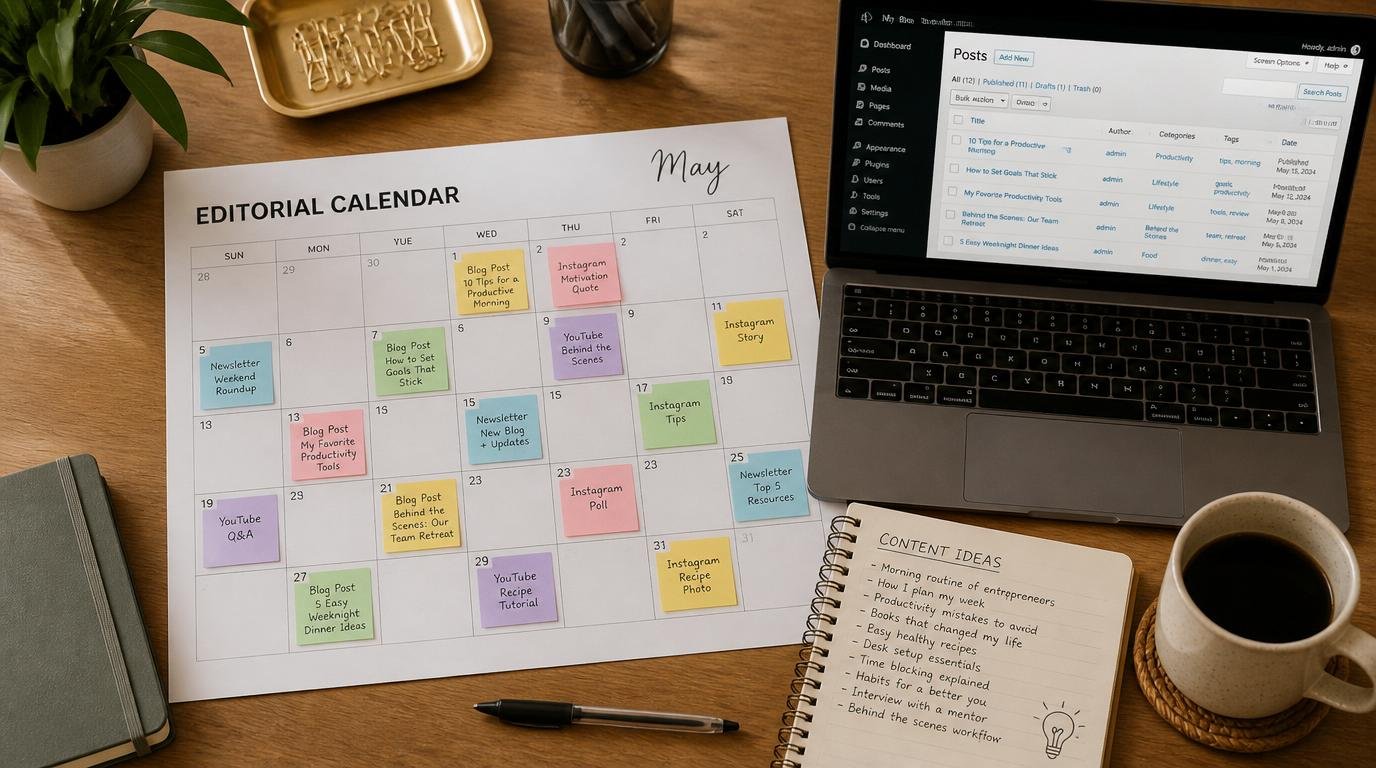
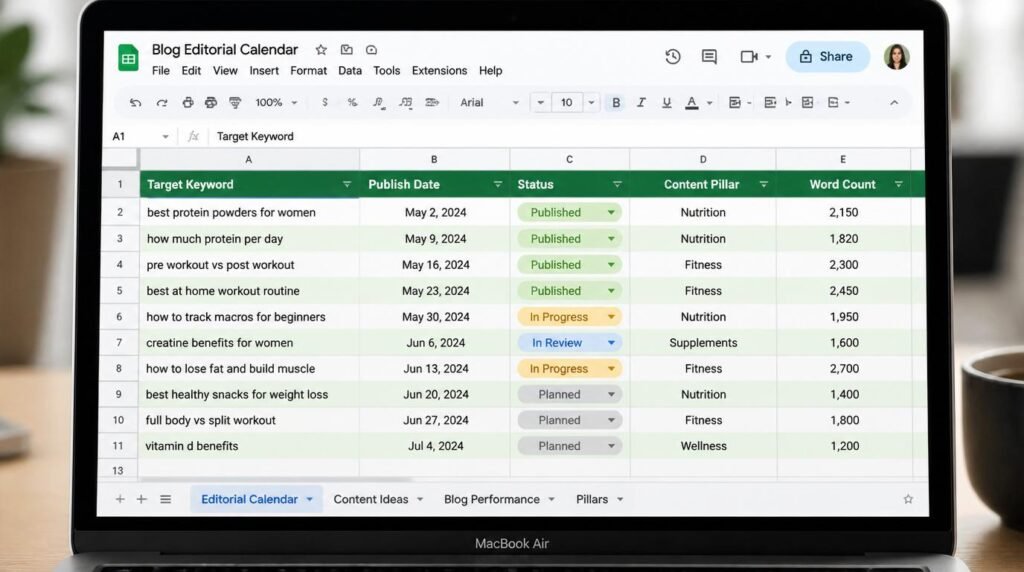
Now I take those vetted keywords and assign them to specific publish dates in my editorial calendar. I use a simple Google Sheet with these columns: Publish Date, Target Keyword, Working Title, Content Pillar, Word Count Target, Internal Link Targets, Status, and CTA. I stagger my pillars so I’m never publishing three posts on the same topic back-to-back — variety keeps readers engaged and signals breadth to search engines.
For a deeper system on content planning for bloggers, I’ve broken down my full pillar-to-post mapping process in a separate guide.
Step 4: Build in Seasonal and Trend Windows
Here’s something I learned the hard way: if you plan your calendar without checking seasonal search trends, you’ll publish your “best holiday gift guide” in January when nobody cares. I use Google Trends to identify when search interest peaks for my target keywords, then I backdate my production timeline so the post is live and indexed before the surge. According to data from Google Trends, many informational queries have predictable annual cycles — use them.
Integrating SEO Planning Into Every Calendar Entry
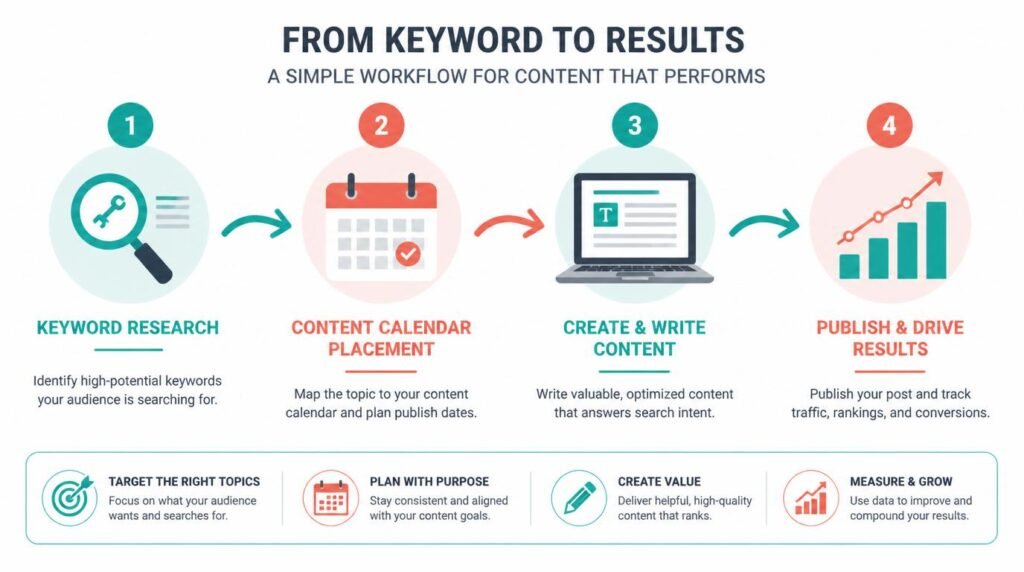
What separates a basic blog schedule from a true content calendar planning strategy? SEO integration at the entry level. Every single post in your calendar should have its search optimization pre-defined — not bolted on after you’ve already written 2,000 words.
Here’s what I include in each calendar entry’s SEO brief:
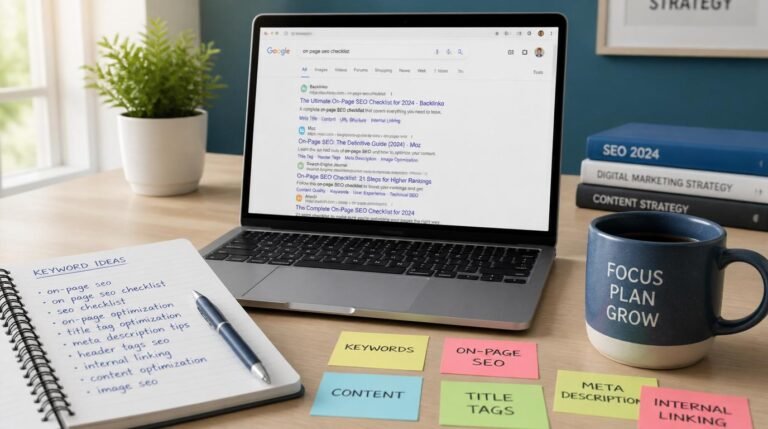
- Primary keyword and 3–5 secondary keywords
- Search intent classification (informational, commercial, navigational, transactional)
- SERP analysis notes — what currently ranks, what format Google prefers (listicle, how-to, comparison)
- Internal linking targets — which existing posts should link TO this new post, and which posts this new piece should link OUT to
- Featured snippet opportunity — is there a snippet to capture? If yes, what format (paragraph, list, table)?
This pre-work takes me about 15 minutes per entry. But it saves hours during the writing phase because I’m never guessing what to optimize for. TBH, this single habit improved my content quality more than any writing course I’ve ever taken.
A study from Moz showed that blogs with documented content strategies receive 3x more traffic than those without one. That’s not a marginal improvement — that’s the difference between a hobby and a business.
The Content Workflow System That Eliminates Bottlenecks
Your calendar is only as good as the content workflow behind it. I’ve seen bloggers build beautiful editorial calendars, then miss every single deadline because they had no production system to back it up. Let me walk you through mine.
I break every post into five discrete phases, each with its own deadline:
- Phase 1 — Research & Brief (Day 1–2): Keyword research, SERP analysis, outline creation, internal link mapping
- Phase 2 — Draft (Day 3–5): First draft written from the outline. No editing during this phase — just momentum
- Phase 3 — Edit & Optimize (Day 6): Self-edit for clarity, embed keywords naturally, add internal and external links, format headings
- Phase 4 — Media & Formatting (Day 7): Add images, create graphics, embed videos, write meta title and description
- Phase 5 — Publish & Distribute (Day 8): Final proofread, schedule or publish, share on social channels, submit URL to Google Search Console
This system means I’m never doing everything in one frantic sitting. Each phase has a clear output, and if something goes wrong (life happens), I know exactly where I left off. For more on building a sustainable content and blogging workflow, check out my expanded framework.
Expert Commentary: This walkthrough from a seasoned content strategist covers the exact mechanics of mapping topics to dates with keyword intent baked in — particularly useful at the 4:30 mark where they demonstrate how to cluster posts within a single pillar to build topical authority over a 90-day cycle.
Advanced Content Calendar Tactics Most Bloggers Never Use
Ready for the stuff that actually separates the top 1% of bloggers from everyone else? These are tactics I’ve tested extensively, and they consistently produce outsized results.
How Do You Use Content Velocity to Outrank Competitors?
Content velocity — the rate at which you publish and index new topically relevant content — is a ranking signal that flies under most people’s radar. Here’s the counterintuitive part: publishing 20 mediocre posts in a month will hurt you, but publishing 8 deeply researched posts on a tightly clustered topic can catapult you past competitors who’ve been around for years. I’ve done this repeatedly with new sites. I pick a single content pillar, map 8–12 keywords within that cluster, and publish all of them within 30 days. The result? Google identifies the site as an emerging authority on that specific topic and starts surfacing it aggressively in SERPs. IMO, this is the most underused tactic in content marketing right now.
What Is the “Content Decay” Audit and Why Should It Be on Your Calendar?
Every quarter, I block off a week in my calendar specifically for content decay audits. These are posts that ranked well 6–12 months ago but have slowly slipped. I pull the data from Google Search Console — filtering for pages that lost more than 20% of their clicks over the past 90 days — and I add those pages to my calendar as “refresh” entries. Updating old content with fresh data, new internal links, and expanded sections is consistently the highest-ROI activity on my entire calendar. Search Engine Land’s research on evolving SERP features confirms that freshness signals remain a core ranking factor, especially for informational queries.
The “Pillar Interlink Burst” Technique
When I finish publishing all posts within a content cluster, I do something I call the Pillar Interlink Burst. I go back through every post in the cluster and add 2–3 contextual internal links to the other posts in the same cluster. Then I resubmit all URLs to Google Search Console within a 24-hour window. This sends a concentrated signal that these pieces are semantically connected, and I’ve consistently seen ranking improvements within 2–3 weeks of doing this. It’s one of those blogging tips that sounds too simple to work — but the data backs it up every time.
The Biggest Content Calendar Myth That’s Costing You Traffic
Here’s the myth I hear constantly: “You need to post every single day to grow.” Wrong. Dangerously wrong. And this belief has killed more blogs than writer’s block ever has.
The truth? Publishing frequency matters far less than publishing consistency and topical relevance. A blog that publishes two deeply researched, SEO-optimized posts per week — every week, for a year — will demolish a blog that posts daily but scatters content across unrelated topics with no strategic through-line. I’ve run this experiment on my own sites. The site with three posts per week (strategically planned) overtook the daily-publishing site in total organic traffic within five months. The daily site had more content. The strategic site had more authority.
The key insight: your content calendar planning strategy should optimize for sustainable cadence, not maximum output. Plan what you can execute at a high quality level without burning out — then protect that cadence like it’s non-negotiable. Because it is. 🙂
Frequently Asked Questions
How far in advance should I plan my content calendar?
I recommend planning your content calendar 30 to 90 days in advance. A 30-day rolling plan keeps you agile enough to respond to trends, while a 90-day strategic outline ensures you maintain thematic consistency and hit seasonal opportunities without scrambling at the last minute.
What is the best tool for creating a content calendar?
The best tool depends on your workflow and team size. For solo bloggers, a simple Google Sheets spreadsheet works incredibly well. For teams, Notion, Trello, or Asana offer more collaborative features. The tool matters far less than the system and consistency you build around it.
How many blog posts per week should a content calendar include?
Quality always beats quantity. For most bloggers and small teams, two to three well-researched posts per week outperform daily thin content. Focus on publishing frequency you can sustain for six months or more without burnout, and prioritize depth over volume.
Can a content calendar improve my SEO rankings?
Absolutely. A structured content calendar ensures you cover topics systematically, build internal linking clusters, maintain consistent publishing frequency, and avoid keyword cannibalization. Google rewards topical authority, and a content calendar is the single best tool for building it methodically.
What should I include in each content calendar entry?
Each entry should include the target keyword, working title, content format, target publish date, assigned author, current status, internal linking targets, the primary call to action, and the content cluster or pillar it belongs to. This level of detail eliminates guesswork and keeps your content workflow tight.
How do I align my content calendar with my overall content strategy?
Start by mapping your content pillars to your business goals. Every piece in your calendar should tie back to a core topic cluster that supports a specific revenue or traffic objective. Review your calendar monthly against your analytics to ensure each post moves the needle toward your strategic targets.
My Top Recommended Gear
These are the exact tools and resources I use daily to run my content calendar and blog planning system. I’ve tried dozens — these are the ones that stuck.
- Moleskine Pro Project Planner — I use this physical planner alongside my digital calendar for quarterly strategic planning. There’s something about writing content pillars and goals on paper that makes the strategy stick in my brain differently than a screen.
Find it on Amazon - Logitech MX Keys Wireless Keyboard — When you’re batching 3–4 posts per week, a quality keyboard matters more than you think. This one is ergonomic, backlit, and switches between devices instantly — perfect for my drafting workflow.
Find it on Amazon - Content Strategy Planning Workbook by Meghan Casey — This book shaped how I think about mapping business goals to content pillars. If you want to understand the “why” behind the calendar, not just the “how,” start here.
Find it on Amazon
Disclaimer: This post contains affiliate links. As an Amazon Associate, I may earn a commission from qualifying purchases at no additional cost to you. I only recommend products I’ve personally tested or rigorously researched.