
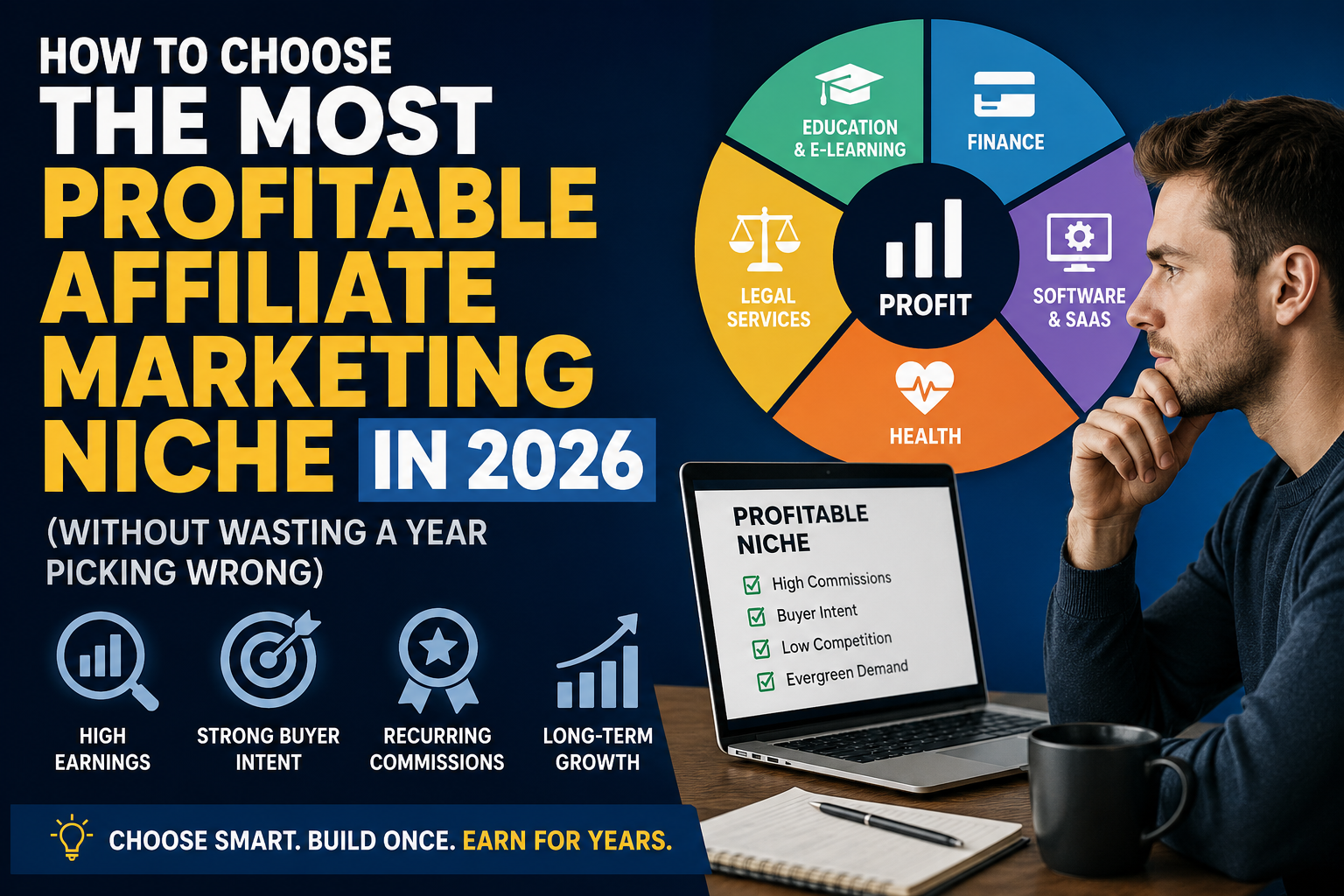
How to Choose the Most Profitable Affiliate Marketing Niche in 2026 (Without Wasting a Year Picking Wrong)
If you want to know how to choose the most profitable affiliate marketing niche, start with this: affiliates in the Education and E-learning space earn an average of $15,551 per month, while someone grinding away in the wrong niche on the same traffic volume might clear a few hundred dollars. That gap is not about effort. It is about the niche decision made on day one. Most people starting out in affiliate marketing pick something they like and hope it pays. That is the wrong order of operations.

Table of Contents

Key Takeaways
| Question | Short Answer |
|---|---|
| What makes a niche “profitable” for affiliate marketing? | High commission rates, recurring offers, strong buyer intent, and consistent demand over time. |
| Which niches pay the most in 2026? | Education, finance, software/SaaS, health, and legal services consistently top the earnings charts. |
| Should beginners pick a broad or narrow niche? | Narrow. Niche authority drives conversion rates double the industry average. Broad is a trap. |
| How do you validate a niche before committing? | Check affiliate program availability, commission structure, buyer intent traffic volume, and competition depth. |
| Can you make money blogging in a low-competition niche? | Yes, but only if the niche has real commercial intent. Low competition means nothing if nobody is buying. |
| How long does niche affiliate income take to compound? | Typically 6 to 18 months before traffic and commissions build meaningfully, depending on content output and niche demand. |
| Where should beginners start learning about niche selection? | Start with a clear understanding of business models. Compare models first, then match a niche to the right one. |
What “Profitable” Actually Means in Affiliate Marketing (It Is Not What Gurus Tell You)
The word “profitable” gets thrown around like confetti in the make money online space. Nobody defines it. So here is the actual definition: a profitable affiliate niche is one where the revenue per visitor is high enough to justify the cost of acquiring that visitor through content, time, and tools.
That is it. Revenue per visitor. Everything else is noise.
A niche can have millions of monthly searches and still be a dead end for blog monetization if the products barely pay, the programs have short cookies, or buyers are just browsing with no intent to purchase. Popularity is not profitability.
When you start affiliate marketing with this filter in place, the entire niche selection process changes. You stop asking “what do I like?” and start asking “what do buyers in this space actually spend money on, how often, and how much does the affiliate earn per transaction?”
How to Choose the Most Profitable Affiliate Marketing Niche: The 5 Core Filters
There is no magic formula. But there is a repeatable process. Run every candidate niche through these five filters before you commit a single hour of work.
- Commission Rate and Structure: Does the niche have programs paying 20%+ recurring commissions, or flat one-time payouts under $5? SaaS and digital products are often the best here.
- Buyer Intent Demand: Are people in this niche searching to solve a problem with money in hand? “Best project management software for small teams” signals purchase intent. “What is project management” does not.
- Program Availability: Are there multiple reputable affiliate programs to promote, or is the space dominated by one brand with a weak program? Single-program dependency is a real bottleneck.
- Competition Depth: Heavy competition from established authority sites is not automatically bad. It confirms the niche makes money. The question is whether you can carve out a specific angle or sub-niche.
- Content Longevity: Does content in this niche stay relevant, or does it expire in 90 days? Passive income ideas built on evergreen content compound. Trending-topic niches do not.
If a niche passes all five, it belongs on your shortlist. If it fails two or more, move on. No sentiment. No attachment.

This infographic highlights five critical factors to identify a profitable affiliate marketing niche and guide your niche selection. Use these metrics to assess demand, competition, and earnings potential before committing.
The Niche Earning Gap Is Enormous: Data That Should Change Your Decision
Most people choosing a niche do not look at the actual revenue data. They pick something familiar and start writing. That is how you end up six months in with a content site that earns $80 a month and no clear path forward.
The earning spread between niches in 2026 is not marginal. It is dramatic. And it directly affects how viable any online income systems you build on top of that niche actually become.
That stat is not an edge case. It is the norm. Passion-driven niches like pets, hobbies, and lifestyle content are saturated with low-commission physical products and audiences who are browsing, not buying.
Technical and digital-focused niches, by contrast, attract buyers with specific problems, larger budgets, and willingness to act fast. That is what drives blogging for profit from a hobby income to a real asset. The niche is the foundation. Build it wrong and everything on top of it is fighting an uphill battle.
Best Niches for How to Choose the Most Profitable Affiliate Marketing Path in 2026
Here is the current short list of niches that consistently perform well for affiliate marketing for beginners and experienced publishers alike. These are not random picks. They are based on commission structures, buyer intent, and program depth.
- Software and SaaS: Recurring commissions. High average order values. Buyers are businesses with budgets. Affiliate SEO content here compounds hard.
- Personal Finance and Investing: Lead generation pays well. Credit cards, trading platforms, and robo-advisors all have serious affiliate programs.
- Online Education and Courses: High ticket. Strong buyer intent. Works exceptionally well paired with content marketing strategies.
- Health and Wellness (sub-niched): Supplements, fitness equipment, and mental health tools perform, but only when sub-niched tightly. “Health” alone is too broad.
- Web Hosting and WordPress Tools: The classic entry point for make money blogging sites. Competitive but proven. Recurring programs exist at every tier.
- Legal and Insurance: CPA payouts are among the highest in any vertical. Difficult to create content for, which means less competition if you can do it properly.
Notice what is not on this list: general lifestyle, recipe sites, entertainment, travel blogs with no monetization angle, and broad “reviews of everything” sites. Those are the traps the gurus sell. Do not fall for them.
How to Validate Your Niche Before You Write a Single Word
Choosing the most profitable affiliate marketing niche is not a gut call. It is a research step with a clear output: a go or no-go decision, backed by actual data.
Here is the practical validation checklist for affiliate marketing for beginners approaching this for the first time.
- Search for affiliate programs directly: Go to Google and type “[niche] + affiliate program.” If nothing comes up with meaningful commissions, the niche is dead before it starts.
- Check commission structures: Recurring pays better than one-time. 30% recurring on a $100/month SaaS is $360/year per customer. A $5 flat rate on a book is $5. That math is the whole game.
- Analyze existing content sites: Find three to five sites already monetizing in the niche. Are they old, established, and clearly earning? Good. That means money exists. Can you differentiate? That is your next question.
- Look at buyer-intent keyword volume: Use any keyword tool and filter for commercial intent terms (“best,” “vs,” “review,” “alternative”). If the volume is there, the buyers are there.
- Estimate traffic revenue with real benchmarks: Use the RPM (revenue per 1,000 visitors) data from reputable sources. If the niche pays $28 per 1,000 visitors, you need enormous traffic to make meaningful income. If it pays $274, you need far less.
This validation process is the filter that separates real website monetization plans from wishful thinking. Skip it and you are essentially guessing.
Blogging for Profit Versus Blogging for Passion: Stop Confusing Them
You can absolutely build a content site around something you enjoy. But if your goal is make money blogging, the niche has to be commercially viable first. Enjoyment is a secondary filter, not the primary one.
Here is how to think about it practically: if you are choosing between two niches you find equally interesting, and one pays $274 per 1,000 visitors while the other pays $28, the choice is obvious. The passion argument only matters when you are trying to decide between two equally profitable options.
The reason gurus push the “follow your passion” angle is that it is an easy sell. It makes people feel good about starting. But it does not help anyone build a real income. Blogging for profit requires treating content like an asset, not a creative outlet. Those two things can overlap, but when they conflict, the asset side has to win.
If you are new to this, the Start Here page lays out the full practical path without any of the fluff about passion projects and overnight success.

The Sub-Niche Advantage: Why Smaller Audiences Convert Better
One of the most consistent patterns in profitable affiliate marketing is this: publishers who go narrow outperform publishers who go broad. Not sometimes. Almost always.
“Personal finance” is a category. “Debt payoff strategies for single-income households” is a niche. “Best budgeting apps for freelancers” is a monetizable content angle within a sub-niche. Each step down the specificity ladder brings you closer to a reader who is ready to act.
This is also why side hustles for beginners and hyper-specific tutorial content consistently outperform general “how to make money online” roundups. The more specific the problem you solve, the higher the trust, the better the conversion, and the more your content marketing actually works as a system rather than just producing traffic noise.
The affiliate marketing for beginners guide covers exactly how to build this kind of trust-first content structure from the ground up.
How AI Automation Tools and Online Income Systems Change Niche Strategy
In 2026, the toolkit available to a one-person affiliate site is genuinely powerful. AI automation tools can handle content outlines, keyword clustering, internal linking audits, and email sequences. That changes the economics of how many niches you can realistically run or how fast you can build authority in one.
But here is the honest caveat: AI automation tools do not fix a bad niche decision. A faster content workflow in a niche with $28 RPM is still a $28 RPM niche. The tools compress timelines. They do not change the underlying monetization math.
What they do change is the ability to execute online income systems that would otherwise require a team. You can now run a well-structured content site, maintain an email list, and manage affiliate tracking with a small stack of tools and a clear workflow. You do not need 37 subscriptions and a dashboard addiction. You need a small stack that solves real bottlenecks.
The AI and automation category covers which tools are actually worth it and which ones are just expensive distractions.
SEO Traffic Strategies That Work Best for Profitable Niches
Every profitable niche has a traffic strategy that fits it better than others. Getting this pairing right is the difference between content that compounds and content that dies after a week.
SEO traffic strategies built around buyer-intent keywords are the backbone of most long-term affiliate income. Comparison content (“X vs Y”), best-of lists, and review pages targeting specific product names consistently drive the highest-converting traffic in almost every niche.
For affiliate SEO specifically, the architecture matters: clean internal linking, clear topical coverage, and a cluster of supporting content around your core monetized pages. That is what builds the topical authority that doubles your conversion rates compared to scattered, disconnected content.
The SEO for affiliate marketing guide breaks this down practically, including how to structure content clusters and build site architecture that supports commission-driving pages.
SEO traffic strategies are not just about finding keywords. They are about building a content system where each piece reinforces the others. That is the compounding part. It takes time to kick in, but once it does, the traffic keeps working after you have moved on to the next piece.
Common Mistakes When Choosing How to Find the Most Profitable Affiliate Marketing Niche
These are the moves that waste months. Some are obvious in hindsight. Most people only recognize them after making them.
- Picking based on trend articles from 3 years ago: “Hot niches for 2023” posts are still circulating in 2026. The landscape has shifted. Verify data yourself before committing.
- Confusing traffic potential with revenue potential: A niche can have massive search volume and terrible monetization. Volume without buyer intent is just numbers.
- Choosing a niche with no recurring revenue path: One-time commissions force you to keep acquiring new customers forever. Recurring affiliate programs build compounding income. The structure matters enormously.
- Going too broad because it “feels safer”: It is not safer. It is harder. Broad sites have no authority. Narrow sites win the trust game and the conversion rate game simultaneously.
- Skipping program research: Some niches sound profitable but have terrible affiliate programs, short cookie windows, or payment thresholds that make it impractical to earn. Check the programs before the niche.
- Treating niche selection as permanent: It is not. If six months of data shows the niche is a dead end, pivoting early costs less than grinding for two years on a broken foundation.
If you want a structured approach to make money online without repeating these mistakes, the free blueprint walks through the full system in plain language. No upsells. No fluff.
Building the System Around Your Chosen Niche
Once you have validated a niche, the work shifts from research to execution. But the niche choice shapes every subsequent decision: the content types you produce, the affiliate programs you join, the blog monetization model you build, and the tools you need in your stack.
A high-ticket SaaS niche needs in-depth comparison content, a clean funnel, and a small email list of engaged buyers. A personal finance niche built around passive income ideas needs trust-heavy editorial content, clear disclosure practices, and consistent publishing cadence.
The niche is not just a category. It is the blueprint for your entire content and monetization architecture. That is why getting the selection right upfront matters more than almost any other decision you will make as an affiliate publisher.
Tools reviews, program research, and content planning all become easier once the niche is locked in. The best affiliate marketing tools breakdown helps you identify exactly what fits your workflow without building an unnecessary stack that drains budget and attention.
Conclusion
Knowing how to choose the most profitable affiliate marketing niche is not about gut instinct, trend-chasing, or picking what the gurus recommend in their YouTube thumbnails. It is a research and filtering process with a clear output: a niche that has real buyer intent, strong affiliate programs, viable content angles, and earnings potential that justifies the effort.
The gap between a $28 RPM niche and a $274 RPM niche is not a small detail. It is the difference between a grind and a functioning asset. Get the niche right and everything else in your affiliate marketing system becomes easier to build and faster to compound.
Start with the five filters. Validate before you write. Sub-niche aggressively. Build content that solves specific problems for specific buyers. Use AI automation tools to speed up the workflow without sacrificing trust. And treat the whole thing like a system, not a lottery ticket.
If you are at the starting line and want a clear map, MakeMoneyQ is built for exactly this: practical systems for turning content, clicks, and focused niche positioning into long-term income. No fake guru fluff. No recycled hype. Just what actually works.
Frequently Asked Questions
How do I choose the most profitable affiliate marketing niche as a complete beginner?
Start by running candidate niches through a commercial viability filter: check commission rates, affiliate program availability, and buyer-intent keyword volume before picking anything. The most common beginner mistake is choosing based on personal interest without verifying that real money moves through the niche. The affiliate marketing for beginners guide covers this step-by-step.
What are the highest-paying affiliate marketing niches in 2026?
Education and e-learning, software and SaaS, personal finance, online business tools, and legal services consistently produce the highest earnings per visitor in 2026. These niches combine high commission rates, strong buyer intent, and recurring revenue structures that allow income to compound over time.
Is it better to pick a broad niche or a narrow sub-niche for affiliate marketing?
Narrow wins almost every time. Publishers with niche authority see conversion rates nearly double the industry average compared to broad lifestyle sites. A specific sub-niche builds trust faster, ranks for more targeted buyer-intent content, and converts at a higher rate with the same traffic volume.
How long does it take to make money in affiliate marketing once I choose a niche?
Realistically, 6 to 18 months before meaningful, compounding income develops, depending on content output, niche competition, and how strong the underlying affiliate programs are. Anyone promising faster results with less work is selling something. The system works, but it takes time to build.
Can I change my affiliate marketing niche if it is not working?
Yes, and pivoting early is always cheaper than grinding for years on a broken foundation. If your niche fails the validation filters after 3 to 6 months of real data, use what you have learned and redirect the effort. The content, systems, and skills transfer to the next niche faster than the first one built them.
Do I need a blog to succeed in affiliate marketing, or are there other methods?
A content site or blog remains one of the strongest long-term vehicles for affiliate marketing because the traffic compounds after publishing and does not require constant ad spend. Other methods like email lists, YouTube, and social channels work, but they add dependency on third-party platforms. A content site you own is a proper asset. Read more on comparing models at the online business models page.
What role do AI automation tools play in affiliate marketing niche strategy in 2026?
AI automation tools speed up content production, keyword research, internal linking, and email workflows, which lets a solo publisher operate at a scale that previously required a team. They do not replace niche validation or good judgment, but they eliminate the manual bottlenecks that slow down execution once a profitable niche is confirmed.