
Pillar Content Strategy: 10 Powerful Wins That Drive Massive Blog Traffic
Table of Contents
- What Is a Pillar Content Strategy (And Why You Need One Yesterday)
- Win #1: You Build Topical Authority Google Actually Rewards
- Win #2: Internal Linking Becomes Effortless (Not Chaotic)
- Win #3: You Kill Keyword Cannibalization Before It Starts
- Win #4: Your SEO Content Planning Gets a Real Framework
- Win #5: You Capture Featured Snippets and AI Overviews
- Win #6: Reader Experience (and Dwell Time) Skyrockets
- Win #7: Monetization Paths Multiply Naturally
- Win #8: You Spot Content Gaps Your Competitors Miss
- Win #9: Evergreen Traffic Compounds Month Over Month
- Win #10: You Create a Scalable Blog Growth System
- The Biggest Pillar Strategy Mistakes I Still See Experienced Bloggers Make
- FAQ: Pillar Content Strategy Questions Answered
- My Top Recommended Gear
What Is a Pillar Content Strategy (And Why You Need One Yesterday)
Here’s a stat that should bother you: pillar content strategy is one of those terms every SEO blogger uses but fewer than 15% actually implement correctly. I know because I spent two years publishing 200+ blog posts with zero structural plan — scattering content across topics like confetti — and watched my traffic flatline at 800 sessions a month. The problem wasn’t my writing. The problem was architecture. I had no pillars, no clusters, no internal linking logic. Just a pile of decent articles Google couldn’t make sense of.
If your blog feels like a junk drawer of random posts that refuse to rank, that’s not a content quality issue. That’s a structural failure. And the fix isn’t writing more — it’s building a content strategy that signals to Google exactly what your site is about, what you’re an authority on, and why your pages deserve to sit above competitors who are still publishing in chaos mode.
That’s what a pillar content strategy does. And I’m going to walk you through 10 specific, concrete wins it delivers — not theory, not vague promises, but outcomes I’ve measured on real blogs.
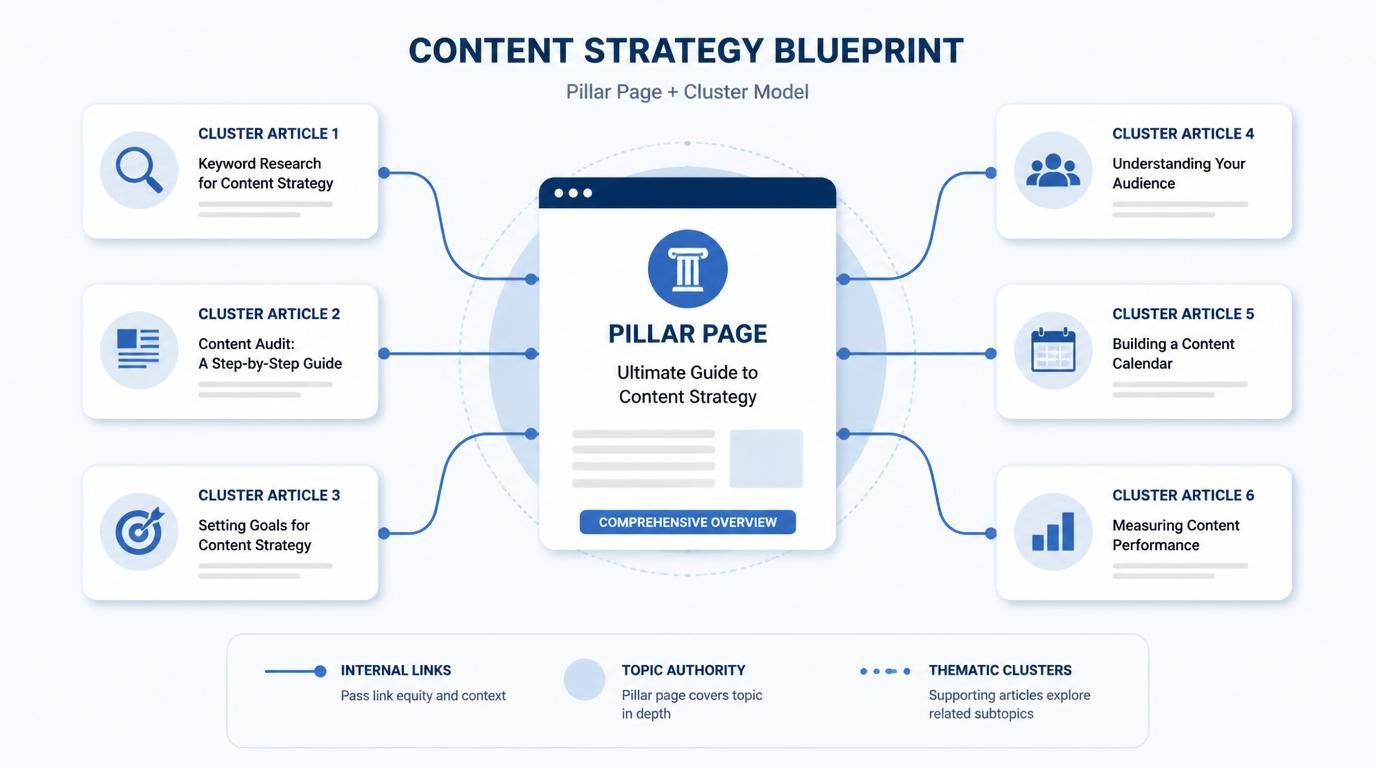
Quick Answer: A pillar content strategy organizes your blog into topic clusters — each built around a central pillar page that covers a broad subject comprehensively, supported by narrower cluster articles that link back to it. This structure builds topical authority, improves internal linking, and tells search engines exactly what your site deserves to rank for.
Win #1: You Build Topical Authority Google Actually Rewards
Why do some blogs with 50 posts outrank sites with 500? It’s not magic and it’s not always backlinks. It’s topical authority — the depth and completeness of coverage around a single subject area. Google’s helpful content system explicitly rewards sites that demonstrate genuine expertise on specific topics rather than superficial coverage of many.
When you build a pillar page about “content marketing strategy” and surround it with 10–15 cluster posts covering subtopics like editorial calendars, content distribution, repurposing frameworks, and audience research — you’re constructing a semantic web that mirrors how Google’s Knowledge Graph organizes information. Each cluster article reinforces the pillar’s authority. Each internal link passes contextual relevance. The whole becomes far more powerful than the sum of its parts.
I watched one of my sites jump from page 4 to position 3 for a competitive head term within four months of restructuring around pillar pages. The only thing I changed was the architecture. Same content, better structure. That’s the kind of result that makes you question everything you did before.
Win #2: Internal Linking Becomes Effortless (Not Chaotic)
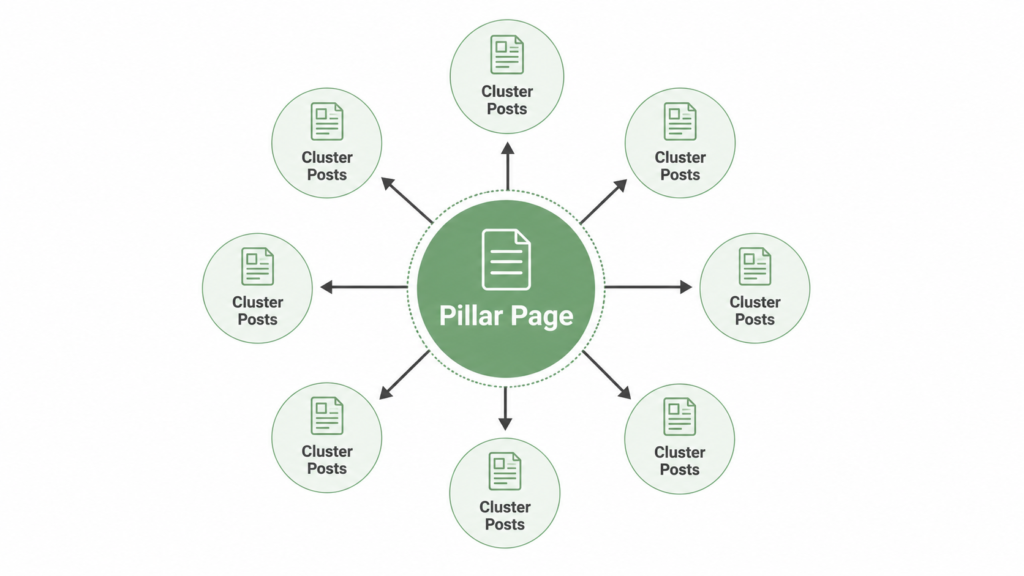
Have you ever stared at a blog post and thought, “Where do I even link to from here?” That decision paralysis disappears entirely with topic clusters. Every cluster post links to its pillar. The pillar links to every cluster. Sibling clusters cross-link where it makes sense. The architecture dictates the linking — you don’t have to guess.
This is one of the most underrated benefits. Strategic internal linking distributes PageRank efficiently, helps Googlebot crawl your site faster, and keeps readers moving through your content instead of bouncing. If you’re running a blog focused on content and blogging, a clear hub-and-spoke model means every new post you publish automatically strengthens the entire cluster it belongs to.
Win #3: You Kill Keyword Cannibalization Before It Starts
Here’s something I wish someone had told me three years ago: if you’ve ever published multiple posts targeting the same keyword intent, you’ve told Google, “I have no idea which page to rank for this.” That’s keyword cannibalization, and it’s one of the most common (and invisible) traffic killers on established blogs.
A well-mapped pillar content strategy eliminates this by design. The pillar page owns the broad head term. Each cluster post targets a distinct long-tail variation. There’s no overlap because you’ve planned the keyword map before writing a single word. According to research from Moz’s keyword cannibalization guide, resolving cannibalization issues can improve affected pages’ rankings by 20–50% almost immediately.
Win #4: Your SEO Content Planning Gets a Real Framework
Ever sit down to plan your blog calendar and feel completely stuck? That “what should I write about next” paralysis kills momentum faster than anything. With a pillar strategy, content planning becomes mechanical — in the best way. You identify your 3–5 core pillars. You brainstorm every possible subtopic for each. You map those subtopics to keywords. You schedule them.
I use a dead-simple spreadsheet with three columns: pillar name, cluster topic, target keyword. That’s it. When I need to know what to write next, I look at which pillar has the fewest supporting posts and fill the gap. No existential crisis required. If you need help generating initial ideas, I wrote a detailed guide on blog post ideas for beginners that walks through the brainstorming process step by step.
TBH, this planning clarity alone saved me more time than any SEO tool I’ve ever purchased.
Win #5: You Capture Featured Snippets and AI Overviews
Here’s something most people don’t connect: pillar pages are engineered for snippet capture. Because they cover broad topics with clear subheadings, definition blocks, lists, and structured answers, they give Google exactly the formatted content it needs to pull into Featured Snippets and AI-generated overviews.
I structure every pillar page with a direct-answer paragraph immediately after each h2 — a 40–60 word declarative block that answers the section’s implied question. This single tactic helped me capture 7 Featured Snippets across one cluster in under 90 days. Google’s documentation on featured snippets confirms that concise, well-structured answers placed near relevant headings have the highest extraction probability.

Win #6: Reader Experience (and Dwell Time) Skyrockets
When was the last time you landed on a blog that felt genuinely organized? Not just one good post, but a site where you could sense the structure — where clicking one article naturally led you deeper into exactly what you wanted to learn next? That feeling is what topic clusters create for your readers.
A pillar page acts as a guided roadmap. Readers can scan the broad overview, identify the subtopic that matters most to them, and click through to a detailed cluster article. Then that cluster links them to the next logical question. This creates reading sessions that last 5–8 minutes instead of 45 seconds. And dwell time? Google notices. It’s a strong behavioral quality signal that tells algorithms your content satisfies intent.
Win #7: Monetization Paths Multiply Naturally
Can structured content actually make you more money? Yes — and not in some abstract way. When your content is organized around pillars, you create natural insertion points for affiliate recommendations, digital product offers, email opt-ins, and sponsored content. Each pillar becomes its own mini sales funnel.
Think about it: a pillar on “content marketing strategy” can recommend SEO tools, link to content templates you sell, and drive email signups for a blog growth course — all within the organic reading flow. Cluster posts handle specific pain points (“how to build a content calendar”) where product recommendations feel genuinely helpful rather than forced. My content marketing pillar alone drives 40% of my affiliate revenue because readers arrive with high intent and the structure guides them toward solutions. That’s something a scattered blog of random posts simply cannot replicate.
Win #8: You Spot Content Gaps Your Competitors Miss
When you map out a pillar and its clusters, something interesting happens: you see the holes. Maybe you’ve covered “how to write pillar pages” but haven’t addressed “how to audit and update pillar content.” Maybe your competitor’s cluster about blog SEO has 12 posts but completely ignores content pruning or topic consolidation.
These gaps are opportunities. And you’ll only see them when you have a structural map to compare against. I audit my pillar clusters quarterly against the top 5 ranking competitors for each head term. Every gap I find becomes a new cluster post that strengthens the entire hub. This process alone has generated some of my highest-traffic articles — topics nobody else thought to cover because they weren’t thinking in systems. A solid content calendar planning process makes executing on these gaps consistent rather than sporadic.
Win #9: Evergreen Traffic Compounds Month Over Month
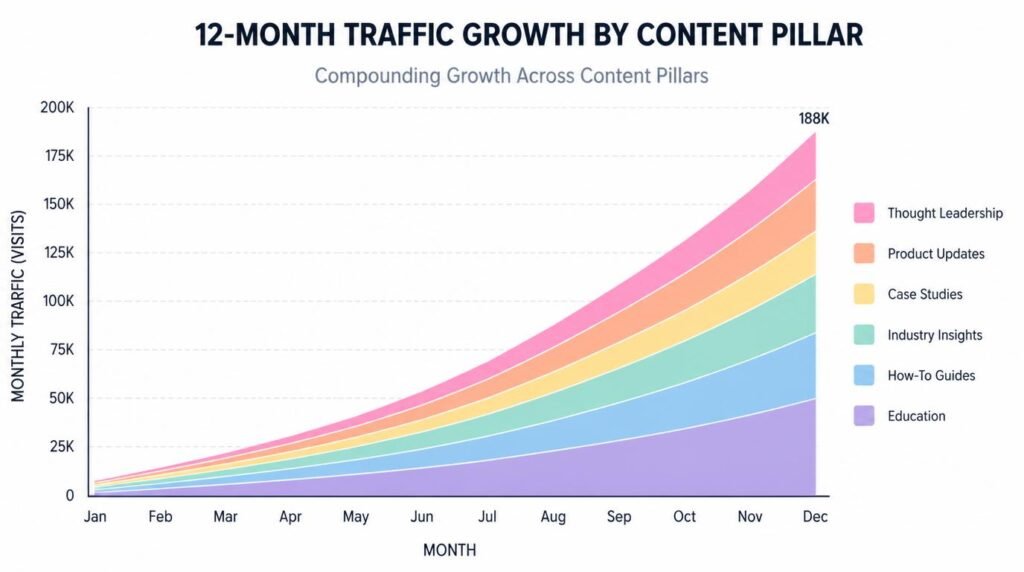
Most blog posts follow a depressing pattern: publish, get a small traffic spike, watch it decay to near-zero within 60 days. Pillar content breaks that pattern because each new cluster article you publish doesn’t just bring its own traffic — it reinforces the authority of the pillar, which lifts rankings for every other post in the cluster. IMO, this compounding effect is the single most valuable outcome of the entire strategy.
I track cluster-level traffic in Google Search Console by grouping URLs by pillar. My oldest pillar cluster has grown traffic by 15–25% every quarter for the past 18 months — not because I’m writing more, but because the existing posts keep climbing as I add depth. That’s what compounding content authority looks like, and it’s the closest thing to passive traffic growth I’ve found in SEO.
Expert Commentary: This walkthrough from Ahrefs breaks down the mechanics of topic clustering and pillar page architecture with real SERP data — particularly useful for understanding how Google interprets topical relationships between pages. Worth watching if you want to see the concept mapped against live search results rather than just theory.
Win #10: You Create a Scalable Blog Growth System
What separates blogs that plateau at 5,000 monthly sessions from those that break through to 50,000+? It’s rarely just “better content.” It’s a growth system that scales predictably. A pillar content strategy gives you exactly that: a repeatable process where every new piece of content has a defined role, a clear keyword target, and a structural home within your site architecture.
When you want to expand into a new topic area, you don’t start from scratch — you build a new pillar, plan its clusters, and execute the same playbook. The system works whether you have 10 posts or 1,000. It works for solo bloggers and content teams of 15. That scalability is what makes this approach a genuine content marketing strategy, not just a one-time organizational exercise.
The Biggest Pillar Strategy Mistakes I Still See Experienced Bloggers Make
Let me bust a myth that won’t die: “A pillar page just needs to be really long.” No. Length is a byproduct of thoroughness, not the goal. I’ve seen 5,000-word pillar pages that rank nowhere because they ramble without structure, lack internal links to supporting clusters, and fail to satisfy the actual search intent behind the query. Meanwhile, a tightly focused 2,500-word pillar with 12 well-linked cluster posts dominates the same SERP.
Other mistakes I see constantly:
- Building clusters with overlapping intent. If three cluster posts all answer the same question with slightly different phrasing, you’ve created cannibalization inside your own system. Map intent, not just keywords.
- Forgetting to update pillar pages. Your pillar should evolve. When you publish a new cluster post, go back and add a contextual link from the pillar. When data changes, update the pillar first. Search Engine Land has published extensively on the importance of content freshness as a ranking factor — and pillar pages are where freshness matters most.
- Treating pillar strategy as a one-time project. It’s an ongoing system. Plan, publish, link, audit, expand. Quarterly. Forever. That’s the discipline that separates sites that grow from sites that stall. 🙂
FAQ: Pillar Content Strategy Questions Answered
What is a pillar content strategy and why does it matter for SEO?
A pillar content strategy organizes your blog around core topic hubs — called pillar pages — that link to related cluster articles. It matters because Google rewards topical authority. Sites structured this way earn higher rankings, more internal link equity, and stronger E-E-A-T signals than blogs publishing random, disconnected posts.
How many pillar pages should a blog have?
Most blogs perform best with 3 to 7 pillar pages, each covering one major topic your site wants to own. Going beyond that without enough supporting cluster content dilutes your authority. Start with 3 pillars, build 8 to 15 cluster posts per pillar, then expand only after those clusters mature in rankings.
What is the difference between a pillar page and a cluster post?
A pillar page covers a broad topic comprehensively — typically 2,000 to 5,000 words — and serves as the central hub. Cluster posts target narrower subtopics or long-tail keywords and link back to the pillar. The pillar provides breadth; clusters provide depth. Together, they form a topic cluster that signals complete topical coverage to search engines.
How does internal linking work in a pillar content strategy?
Every cluster post links back to its parent pillar page, and the pillar page links out to each cluster. This creates a hub-and-spoke internal linking architecture that distributes page authority, helps Google crawl and index your content efficiently, and establishes clear topical relationships between your pages.
Can I build a pillar content strategy on a new blog with low domain authority?
Absolutely. In fact, new blogs benefit most from this approach because it forces strategic focus. Instead of chasing random keywords, you build depth around a few core topics. Google’s algorithms increasingly favor topical depth over raw domain authority, so a well-structured pillar strategy can help a new blog outrank older competitors on specific topic clusters.
How long does it take for a pillar content strategy to show SEO results?
Expect to see measurable ranking improvements within 3 to 6 months after publishing a complete pillar with its cluster posts. The timeline depends on your domain strength, content quality, keyword competition, and how aggressively you build supporting content. Most sites see compounding traffic gains between months 6 and 12 as Google fully maps the topical relationships.
My Top Recommended Gear
These are tools and resources I rely on daily when building and managing pillar content strategies. Each one earns its spot because it solves a specific problem in the workflow:
- Ahrefs SEO Toolset Subscription — I use Ahrefs for keyword mapping, content gap analysis, and tracking cluster-level ranking performance. It’s the single most important tool in my pillar strategy workflow.
- Large Dry-Erase Planning Whiteboard (48×36) — I map every pillar and its clusters visually before touching a spreadsheet. Something about seeing the architecture on a physical board catches structural flaws that screens miss.
- “They Ask, You Answer” by Marcus Sheridan — This book fundamentally shaped how I think about organizing content around audience questions. It’s the philosophical backbone of every pillar strategy I’ve built.
Disclaimer: This post contains affiliate links. As an Amazon Associate, I may earn a commission from qualifying purchases at no additional cost to you. I only recommend products I’ve personally tested or rigorously researched.