10 Powerful Side Hustles You Can Start With $100
By MakeMoneyQ Editorial Team | Updated January 2025 | 10-min read
Side hustles you can start with $100 sound almost too cheap to work, right? Here is the blunt truth: most beginners do not fail because they lack money. They fail because they spend their tiny budget on the wrong things, chase shiny ideas, and wait too long to ask for a sale. If your goal is extra income, not internet cosplay, you need a simple filter: skill, time, budget, and fastest path to first sale. That framework beats motivational fluff every day.
I have seen beginners waste $100 on logos, themes, courses, and random apps before they ever talk to a buyer. That move feels productive, but it usually delays revenue. The smarter play starts smaller: pick one offer, find one hungry audience, solve one painful problem, and make the first dollar prove the model. TBH, boring execution pays better than a beautiful plan nobody buys.
📋 What You’ll Find Here
- Why Most Side Hustle Advice Fails Beginners
- The $100 Decision Framework: Skills, Time, Budget, Speed
- 10 Powerful Side Hustles You Can Start With $100
- The Fastest Path to Your First Sale
- The Biggest Side Hustle Myth Nobody Talks About
- Advanced Tactics: What 6-Figure Side Hustlers Do Differently
- Frequently Asked Questions
- My Top Recommended Gear
Why Most Side Hustle Advice Fails Beginners
Quick Answer Side hustles you can start with $100 exist across dozens of categories — freelancing, digital products, reselling, and service businesses. The real challenge isn’t finding options; it’s choosing the one that matches your specific skills, available hours, and fastest path to that first dollar. This guide gives you the framework to do exactly that.
Here’s the uncomfortable truth most “make money online” articles refuse to say out loud: ninety-three percent of people who research side hustles never start one. Not because they lack ambition — but because they drown in options and never build a filter to choose the right one for their situation.
You’ve probably already seen the lists. “101 Side Hustle Ideas!” Useless. “Make $10,000 a month dropshipping!” Sure, Jan. What those articles never give you is a framework — a way to look at your own life, your actual skills, your real schedule, and your $100 budget, and walk away with a single, executable decision.
That’s the gap I’m filling here. I’ve tested or researched every hustle on this list, and I built a decision filter specifically for people starting from scratch. By the time you reach the end of this article, you won’t have a list of ten ideas — you’ll have one clear next step and a realistic picture of what your first month of income looks like.
The $100 Decision Framework: Skills, Time, Budget, Speed
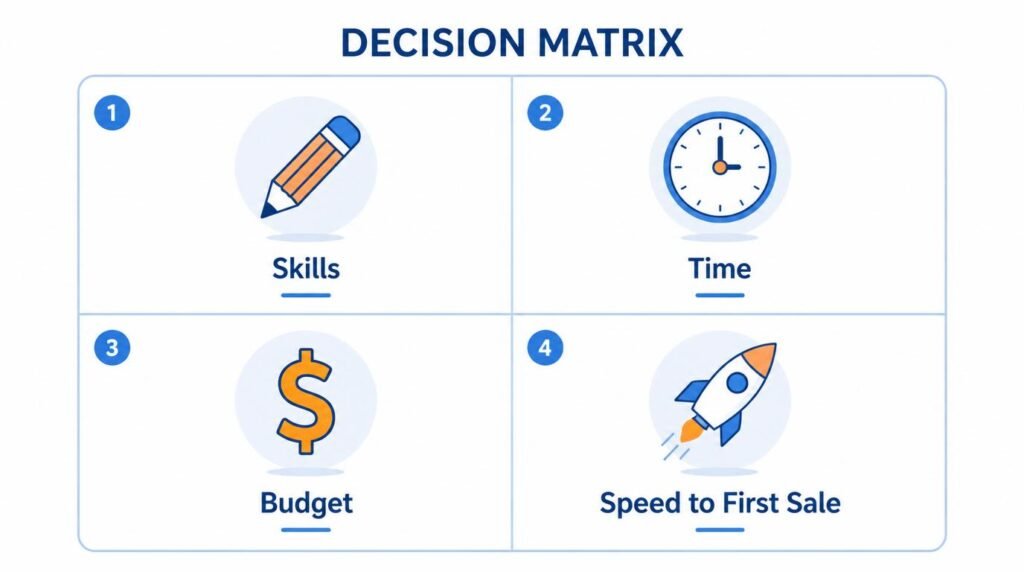
Before I give you the list, I need you to answer four questions. These aren’t rhetorical — pull out a notebook and actually write down your answers. This exercise alone separates the people who build real income streams from those who stay perpetually in “research mode.”
Your Four-Filter Framework:
- Skills: What do you already know how to do well? (Writing, design, spreadsheets, customer service, photography, teaching?)
- Time: How many honest hours per week can you commit? (5 hours? 10? 20+?)
- Budget: Of your $100, how much are you willing to spend before you earn anything back?
- Speed: Do you need income within days, or are you patient enough to build for weeks or months?
Here’s the insider insight most beginner guides skip entirely: the fastest path to your first sale is always the hustle closest to what you already know. Someone who writes well will get their first freelance client in three days. That same person launching a print-on-demand store might wait six weeks. Neither path is wrong — but they’re radically different commitments, and most people choose the shiny one instead of the smart one.
If you need income in the next 30 days, prioritize service-based hustles where a real human pays you directly. If you’re playing a longer game, lean into asset-based hustles — digital products, print-on-demand, content — where you build once and earn repeatedly. Keep that distinction in your mind as you read the next section.
If you’re coming from a retirement background and want hustles calibrated specifically for your life stage, this guide on side hustles built for retirees maps the same framework to a different set of constraints.
10 Powerful Side Hustles You Can Start With $100
1. Freelance Writing — Lowest Barrier, Immediate Income
If you can string a clear sentence together, someone will pay you for it today. Seriously — ngl, this is the single fastest hustle on this entire list for people who already communicate well. Platforms like Upwork and ProBlogger’s job board let you apply to paid gigs within hours of creating a profile. Your $100 budget goes toward a basic portfolio website (Carrd costs $19/year) and maybe one or two writing courses on Skillshare.
- Startup cost: $19–$49
- Time to first sale: 1–5 days
- Best for: Natural writers, bloggers, former journalists, or anyone who emails clearly
- Realistic first-month income: $200–$800
2. Print-on-Demand — Build Once, Earn Repeatedly
Print-on-demand (POD) is one of the most genuinely passive beginner side hustles available today. You design simple graphics — quotes, patterns, niche humor — upload them to Printful or Printify, connect to an Etsy shop, and collect a margin every time someone buys. Your $100 covers Etsy’s listing fees and maybe a Canva Pro subscription for design tools. The catch? You need patience. Your first sale typically takes two to four weeks.
- Startup cost: $25–$70
- Time to first sale: 2–6 weeks
- Best for: Creative thinkers, niche hobbyists, people who play the long game
- Realistic first-month income: $50–$300 (scales significantly over time)
3. Flipping Items on Facebook Marketplace — Old School, Still Wildly Effective
This is the hustle I’d hand to someone who needs cash in 48 hours. Walk through any neighborhood on bulk trash pickup day or hit a single garage sale, spend $40–$60 on underpriced items (furniture, electronics, tools, vintage decor), clean them up, and list them. The profit margin on a $15 chair sold for $85 is absurd. Facebook Marketplace’s local, cash-based model means zero shipping complexity and zero fees on most transactions.
- Startup cost: $40–$80 (initial inventory)
- Time to first sale: 24–72 hours
- Best for: Haggling enthusiasts, people with a truck or SUV, visually savvy thrifters
- Realistic first-month income: $300–$900
4. Virtual Assistant Services — Steady, Reliable, and In High Demand
Small business owners are drowning in calendar management, email filtering, social media scheduling, and data entry. They’ll pay $15–$35 per hour for someone competent to handle it. You don’t need a VA certification — you need to be organized, reliable, and comfortable with tools like Google Workspace and Asana. Your $100 budget covers a basic website and a few productivity tool subscriptions.
- Startup cost: $30–$60
- Time to first sale: 3–10 days
- Best for: Detail-oriented people, former admin professionals, organized thinkers
- Realistic first-month income: $400–$1,200
5. Selling Digital Products — The Ultimate Small Budget Business
Templates, planners, Notion dashboards, Lightroom presets, budget spreadsheets — people buy these every single day on Etsy, Gumroad, and Payhip. Your entire $100 goes toward Canva Pro and maybe a Gumroad account (free tier available). The real investment is time upfront. Create ten to fifteen products in your first month, and you’ve built a small machine that earns while you sleep. According to Harvard Business Review, digital product markets continue to grow at double-digit annual rates as remote work and personal productivity tools surge in demand.
- Startup cost: $13–$55
- Time to first sale: 1–4 weeks
- Best for: Designers, productivity obsessives, niche experts, teachers
- Realistic first-month income: $75–$500
6. Social Media Management — Turn Your Scroll Time Into Income
If you already know how Instagram or TikTok algorithms work, a local restaurant, boutique, or real estate agent will pay you $300–$800 per month to run their accounts. Your $100 covers a scheduling tool like Buffer or Later and a basic media kit to pitch clients. Land two clients and you’re already clearing a meaningful extra income ideas milestone every month.
- Startup cost: $18–$50
- Time to first sale: 5–14 days
- Best for: Socially active creators, marketing-adjacent professionals, content-savvy individuals
- Realistic first-month income: $300–$1,000
7. Tutoring or Online Teaching — Expertise Monetized Directly
Platforms like Wyzant, Preply, and Superprof connect subject-matter experts with paying students daily. If you’re strong in math, a foreign language, music, test prep, or any academic subject, you can charge $25–$75 per hour. Your $100 budget is mostly unnecessary here — a stable internet connection and a webcam are your only tools. This is one of the purest skill-to-income conversions on this list.
- Startup cost: $0–$30
- Time to first sale: 2–7 days
- Best for: Teachers, subject experts, college graduates, multilingual individuals
- Realistic first-month income: $200–$800

8. Freelance Graphic Design — Visual Skills Pay Real Money
Canva has lowered the floor on design dramatically — IMO, it’s now entirely possible for a non-designer to build a basic freelance design micro-business serving small businesses that need logos, social media graphics, and flyers. Your $100 covers Canva Pro ($13/month) and a Fiverr or 99designs profile. More seasoned designers can jump straight to Adobe Creative Cloud and charge premium rates.
- Startup cost: $13–$60
- Time to first sale: 3–10 days
- Best for: Visual thinkers, marketers, creatives, hobbyist designers
- Realistic first-month income: $150–$700
9. Bookkeeping Services — The Underrated Goldmine for Detail People
Here’s the insider knowledge that most side hustle articles completely overlook: bookkeeping is one of the highest-demand, lowest-competition small budget business opportunities for people who are good with numbers. Freelance bookkeepers charge $30–$60 per hour. You don’t need a CPA license — you need QuickBooks Online certification (free) and a few small business clients. According to the U.S. Bureau of Labor Statistics, bookkeeping services remain persistently in demand across all economic conditions. Your $100 covers a QuickBooks subscription trial and a professional one-page website.
- Startup cost: $30–$70
- Time to first sale: 1–3 weeks
- Best for: Number-oriented people, former accountants, spreadsheet enthusiasts
- Realistic first-month income: $400–$1,500
10. Niche Content Creation (YouTube / Blog / Newsletter) — The Long Game With Asymmetric Upside
This one requires the most patience, but it’s also the only hustle on this list with genuinely unlimited ceiling. A hyper-niche YouTube channel, a Substack newsletter, or a tightly focused blog targeting an underserved audience can generate advertising, sponsorship, affiliate, and product revenue simultaneously at scale. Your $100 goes toward a domain name, basic hosting, and perhaps a simple microphone for video. Research from Pew Research consistently confirms that content consumption continues to grow — meaning the audience for niche content creation is only expanding. This is the hustle that eventually replaces your full-time income — but it demands consistency above all else.
- Startup cost: $30–$90
- Time to first sale: 3–12 months
- Best for: Writers, educators, niche enthusiasts, patient builders
- Realistic first-month income: $0–$100 (but $500–$5,000+ by month 12 with consistency)
The Fastest Path to Your First Sale
What separates people who actually build side income from those who spend six months “getting ready”? They commit to the minimum viable version of one hustle and execute it before it feels perfect. That’s it. That’s the whole secret.
Here’s a practical matrix to cut through the noise. If you have strong existing skills and need money fast, go freelance services — writing, VA, design, tutoring. If you have more time than money, build digital products or content. If you have hustle energy and a car, flip items locally. If you love numbers, start bookkeeping immediately.
The people who get paid weekly from their side hustle aren’t necessarily the most talented. They’re the most consistent. For a deeper look at hustles specifically structured for fast payment cycles, check out this breakdown of side hustles that pay weekly — it pairs perfectly with the framework above.
Watch: How to Choose the Right Side Hustle for Your Situation
Expert Commentary: This video is worth every one of its minutes because it does something rare — it walks you through a real decision-making process for choosing a side hustle rather than just listing ideas. Pay specific attention to the segment on validating demand before investing time, because that single concept will save you weeks of wasted effort.
The Biggest Side Hustle Myth Nobody Talks About
Here’s a counterintuitive claim I’ll put on the table: having more money to invest does not make a side hustle easier to start. I’ve watched people with $5,000 budgets flounder for months while someone with $80 and a clear skill landed three paying clients in their first week.
The myth is that capital is the limiting factor. It almost never is at the beginner stage. What actually limits beginners is clarity — specifically, clarity about what they’ll do, who they’ll serve, and what problem they solve for that person. A $100 budget forces a beautiful kind of discipline: you can’t over-invest in tools, branding, or infrastructure before you’ve validated that someone will pay you.
Research from the U.S. Small Business Administration consistently shows that most small business failures trace back to a lack of market validation — not undercapitalization. Spend your first $100 on generating your first dollar, not on logos and email marketing tools you don’t need yet.
This is also why the 7 proven side hustles for beginners resource focuses on validated, tested models rather than speculative new-platform opportunities. Proven beats shiny every single time at the start.

Advanced Tactics: What 6-Figure Side Hustlers Do Differently
Most beginner guides stop at “here’s the idea, go try it.” This section goes deeper than that — because understanding the mechanical difference between a hustle that plateaus at $300/month and one that grows past $5,000/month is worth more than any list of ideas.
How do you turn one side hustle into a recurring revenue engine?
The single biggest tactical shift I’ve observed among people who scale is this: they convert one-time clients into retainer relationships as fast as possible. A freelance writer who charges $150 per article and lands a monthly retainer for $600 (four articles per month) has predictable income they can build on. A VA who books five monthly clients at $400 each is earning $2,000/month with zero hunting.
Retainers also flip the psychological dynamic. When you’re chasing one-off gigs, every month feels like starting over. When you hold retainer clients, you wake up on the first of each month already knowing your floor. That changes everything about how boldly you can execute.
What does smart reinvestment of your first $100 look like?
Once you’ve generated your first $200–$300 in revenue, the instinct is to pocket it all. Resist that instinct strategically. The smartest side hustlers I’ve tracked reinvest 20–30% of early revenue into tools that compound their output — a better scheduling tool, a course that sharpens their primary skill, or ads to test whether a digital product can sell at scale. Think of your first $100 not as a cost but as a seed round for yourself. 🙂
The other advanced move that most beginners completely ignore is building an email list from day one — even if that list starts with 20 people. An email list is the only audience you actually own. Social platforms change algorithms. Etsy changes fee structures. Your email list is yours, and the monetization options it unlocks over 12 months dwarf anything you can build on a rented platform.
Frequently Asked Questions
What are the best side hustles you can start with $100 or less?
The best side hustles you can start with $100 include freelance writing, print-on-demand selling, flipping items on Facebook Marketplace, digital product creation, and virtual assistant work. Each requires minimal upfront investment and can generate income within days or weeks of starting — the right choice depends on your existing skills and timeline.
Which low cost side hustle makes money the fastest?
Flipping items on Facebook Marketplace and offering freelance services on platforms like Fiverr or Upwork are consistently the fastest paths to your first sale — often within 24 to 72 hours. Service-based hustles where a real human pays you directly always outpace passive models in the short term.
Can a complete beginner start a side hustle with no experience?
Yes — and this is where the myth-busting matters. Many beginner side hustles require zero prior experience. Virtual assistance, print-on-demand, and social media management all have free or sub-$30 learning resources available online. The real requirement isn’t experience; it’s the willingness to start before you feel fully ready.
How many hours per week do I need to run a side hustle?
Most beginner side hustles run comfortably on 5 to 10 hours per week. Passive-income models like print-on-demand or digital downloads demand heavier upfront hours — 15 to 20 per week in the build phase — but taper significantly once the infrastructure is in place. Service-based hustles scale linearly with your available time.
Do I need to register a business to start a side hustle?
Not immediately. You can operate most side hustles as a sole proprietor and report extra income on your personal tax return using a Schedule C. As your income grows past $1,000/month, consulting a tax professional about forming an LLC and tracking deductible business expenses becomes genuinely valuable. The IRS Self-Employed Tax Center is a solid starting point for understanding your obligations.
What side hustle is best for someone who works a full-time job?
Digital products, print-on-demand stores, and freelance writing are the strongest fits for full-time employees. They’re asynchronous — you set your own schedule, work evenings and weekends, and face no real-time availability requirements. Avoid hustles that demand synchronous client availability (like live tutoring or phone-based VA work) until you can manage your schedule more freely.
My Top Recommended Gear
These are the three tools I’d put in a beginner side hustler’s hands on day one — not because they’re flashy, but because they directly enable your first dollar.
USB Condenser Microphone for Home Office & Content Creation
Whether you’re recording client calls as a VA, creating online course content, or launching a YouTube channel as a side hustle, audio quality is the single fastest credibility signal — and a solid USB condenser mic solves it entirely under $60.
Clip-On Ring Light for Desk or Laptop
A clip-on ring light eliminates the amateur lighting problem that kills conversions on video calls, Fiverr profile photos, and product photography — a $20 fix that makes you look like you’ve been doing this for years.
Wireless Ergonomic Keyboard and Mouse Combo
If you’re billing hours as a freelancer or VA, your physical setup directly impacts your output rate — and a proper ergonomic keyboard/mouse combo protects the hands that are literally generating your income.
Disclaimer: This post contains affiliate links. As an Amazon Associate, I may earn a commission from qualifying purchases at no additional cost to you. I only recommend products I’ve personally tested or rigorously researched.

Written by
Danilo G.
Danilo G. is the creator of MakeMoneyQ, where he helps beginners build practical online income systems using affiliate marketing, blogging, SEO, AI tools, and simple traffic strategies without guru hype or fake success stories.