

Affiliate Niche Selection: 7 Powerful Profit Rules That Separate Earners from Dreamers
Table of Contents
- Why Affiliate Niche Selection Is the Single Decision That Determines Everything
- Rule 1: Follow the Money Trail, Not Your Mood
- Rule 2: Demand Buyer Intent, Not Just Search Volume
- Rule 3: Read the Competition Like a Poker Player
- Rule 4: Engineer Your Commission Architecture
- Rule 5: Apply the Evergreen Durability Test
- Rule 6: Choose a Niche You Can Go Deep On
- Rule 7: Sub-Niche Until You Own the Conversation
- The Niche Selection Myth That Costs Beginners Thousands
- Frequently Asked Questions
- My Top Recommended Gear
Why Affiliate Niche Selection Is the Single Decision That Determines Everything
Here’s a stat that should make you uncomfortable: affiliate niche selection determines roughly 80% of whether your site will ever earn a dollar — and most people spend less than an afternoon making that decision. I watched a friend build 147 articles in a niche with zero commercial intent. Beautiful writing, strong SEO, consistent publishing schedule. Fourteen months later? $23.41 in total commissions. The content wasn’t the problem. The niche was dead on arrival.
Affiliate niche selection is the strategic process of identifying a specific market segment where audience demand, available affiliate programs, and your ability to create authoritative content intersect — forming the foundation of a profitable affiliate marketing business.
That’s the clean definition. But let me tell you what it actually feels like in practice: it feels like standing at a fork with seventeen roads, knowing that six lead to money, three lead to moderate success, and eight lead to a graveyard of abandoned WordPress sites. The problem isn’t information — there’s plenty of that. The problem is decision architecture. You need a framework, not a feeling.
I’ve built affiliate sites across nine different niches over the past decade. Three became genuinely profitable. Two broke even. Four were expensive lessons. And every single failure traced back to a niche selection mistake I could have caught with the rules I’m about to hand you. These seven rules aren’t theoretical. I extracted them from real revenue reports, real traffic data, and real conversations with affiliate managers who told me exactly what separates their top earners from everyone else.
If you’re just starting your beginner affiliate marketing journey, this is the most important page you’ll read this month. Not because I’m a genius — but because the mistakes I’ve already made cost me years you don’t have to waste.
Rule 1: Follow the Money Trail, Not Your Mood
What if I told you that “pick a niche you’re passionate about” is the single most destructive piece of advice in affiliate marketing?
I know — that sounds heretical. Every guru on YouTube says passion is the secret ingredient. And they’re not entirely wrong. But here’s what they leave out: passion without purchasing behavior is a hobby blog. I’m passionate about vintage synthesizers. There’s a thriving community. Loads of content ideas. But the affiliate commission structure? Abysmal. Most high-value synths sell through specialty dealers without affiliate programs, and the ones on Amazon pay 1-4% on electronics.
The money trail means something specific. Open Google Ads Keyword Planner and look at the cost-per-click for your candidate niche keywords. When advertisers pay $8-$25 per click on terms like “best project management software” or “top rated home security system,” they’re telling you something critical: there’s enough margin in those products to justify expensive traffic. That margin flows directly to affiliate commissions.
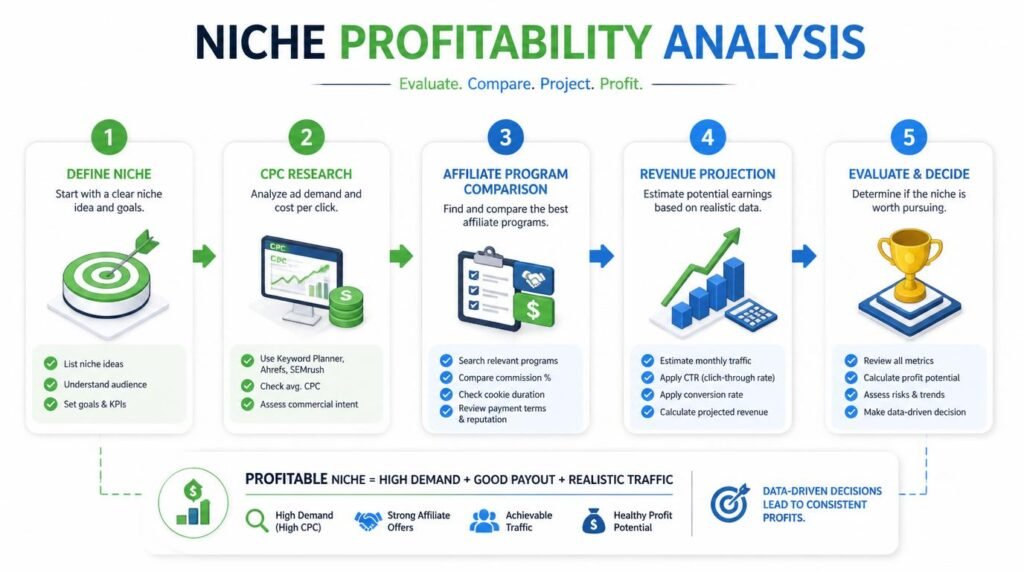
Cross-reference that CPC data with affiliate network directories — ShareASale, CJ Affiliate, Impact, and Amazon Associates. Count how many programs exist in your candidate niche. Count the commission percentages. Calculate the average order value. If the math doesn’t work at 100 visitors per day, it won’t magically work at 1,000.
A practical filter I use: any niche where the top 3 affiliate programs pay less than $20 per conversion gets eliminated immediately. Life’s too short to optimize for $3 commissions. TBH, I learned this the hard way after spending six months building out a camping gear site that generated solid traffic but couldn’t break $400/month because average commissions hovered around $1.80.
Rule 2: Demand Buyer Intent, Not Just Search Volume
Here’s where most niche research goes sideways. Someone fires up Ahrefs, finds a keyword with 50,000 monthly searches, and thinks they’ve struck gold. But search volume without buyer intent is like foot traffic past a store with locked doors — people are walking by, but nobody’s buying.
Buyer intent lives in the language people use. “What is affiliate marketing” is informational. “Best affiliate marketing course for beginners” is commercial. “ClickFunnels vs Kartra pricing” is transactional. Your niche needs a thick layer of commercial and transactional keywords — not just informational ones.
I run every candidate niche through what I call the “best + review + vs” test. Search for “[niche product] best,” “[niche product] review,” and “[niche product A] vs [niche product B].” If Google returns fewer than 5 pages of dedicated results for each modifier, the niche probably doesn’t have enough active buyers to sustain an affiliate site. According to a Search Engine Journal analysis, commercial intent keywords convert at 2-5x the rate of informational queries.
The FTC’s endorsement guidelines also matter here. Niches with strong buyer intent naturally lend themselves to honest product reviews and comparisons — the exact content format the FTC encourages affiliates to create transparently. When your niche aligns with genuinely helpful purchase guidance, you build sustainable trust instead of chasing tricks.
Rule 3: Read the Competition Like a Poker Player
Why do so many people either pick niches with zero competition (because nobody’s buying) or niches dominated by billion-dollar publishers (where they’ll never rank)?
Competition analysis for affiliate niche selection isn’t about finding “low competition keywords.” That phrase has been so overused it’s practically meaningless. What you actually want to identify is beatable competition at the page level. Pull up the top 10 results for your target commercial keywords. Ask these questions:
- Are the ranking pages from dedicated niche sites or massive authority domains? If NerdWallet, Healthline, and Wirecutter own every position, you’re fighting a war you cannot win.
- What’s the Domain Rating (DR) of the sites on page one? If most sit below DR 40, you have a legitimate shot.
- How good is the actual content? I frequently find page-one articles that are thin, outdated, or clearly written by someone who’s never touched the product. That’s your opening.
- Are there forum results, Reddit threads, or Quora answers ranking? Google only shows those when it can’t find better dedicated content. That’s a neon sign saying “build something here.”
I recently passed on a niche I loved — home espresso machines — because every money keyword was dominated by sites with DR 70+ and editorial teams of 15 people. Instead, I pivoted to a sub-niche within coffee (more on sub-niching in Rule 7) and found a cluster of keywords where the top results were genuinely mediocre. Smart SEO for affiliate marketing means picking fights you can win.
Rule 4: Engineer Your Commission Architecture
Not all commissions are created equal, and this is something I wish someone had drilled into my head on day one. There are four commission models in affiliate marketing, and the one your niche supports will determine your income ceiling:
- One-time flat fee: You earn once per sale. Common in physical products. Predictable but requires constant new traffic.
- Percentage-based one-time: You earn a percentage of sale price. Better for high-ticket items.
- Recurring commissions: You earn monthly as long as the customer stays subscribed. SaaS and subscription box niches dominate here. This is where real wealth builds.
- Tiered/hybrid models: Programs that increase your rate as you drive more volume, or combine upfront + recurring payouts.
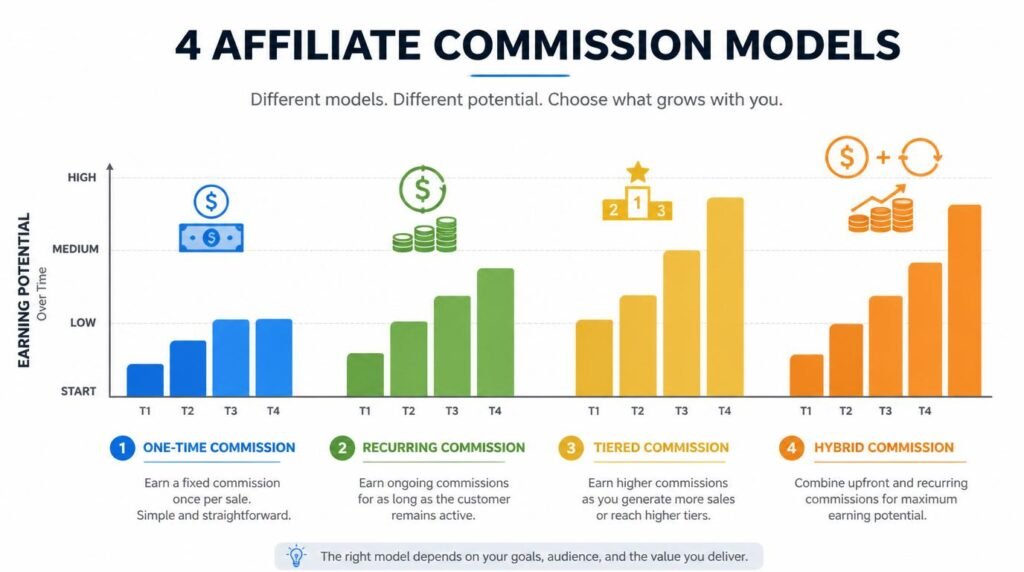
My personal rule: I heavily favor niches where at least 30% of my commission sources offer recurring revenue. A site earning $2,000/month from one-time commissions requires you to generate $2,000 in new sales every single month. A site earning $2,000/month from recurring commissions keeps paying even if you take two weeks off. The math changes your life. IMO, this is the most underrated factor in profitable niche selection.
Check multiple affiliate networks to compare program terms for your candidate niche. The best affiliate marketing tools include network comparison features that save you hours of manual research.
Rule 5: Apply the Evergreen Durability Test
Will people still search for this niche’s products two years from now? Five years? This question eliminates more bad niches than any other filter.
Pull up Google Trends and examine the 5-year trend line for your core niche keywords. You want to see one of two patterns: a flat horizontal line (stable demand) or a gradual upward slope (growing demand). Anything that looks like a mountain peak followed by a cliff is a fad — fidget spinners, specific crypto tokens, most diet trends.
I personally got burned by this in 2019 when I built content around a specific meal kit delivery brand that was surging in popularity. The brand pivoted its business model, cut its affiliate program, and my revenue dropped 70% in a single month. Evergreen niches — personal finance, health and fitness fundamentals, home improvement, software tools — absorb individual brand changes because the underlying demand persists regardless of which companies serve it.
The U.S. Bureau of Labor Statistics’ Consumer Expenditure Surveys provide fascinating data on where Americans consistently spend money year after year. I cross-reference these reports with my niche research to confirm that real household spending supports the niche — not just internet hype.
Rule 6: Choose a Niche You Can Go Deep On
Can you write 100 articles in this niche without repeating yourself? If the answer is no, walk away.
Google’s Helpful Content system rewards topical authority — sites that demonstrate comprehensive expertise across an entire subject area. A niche that only supports 25-30 unique article topics will hit a ceiling fast. You need a niche with enough subtopics, product categories, buyer personas, and seasonal angles to fuel 12-18 months of consistent content production.
Here’s my depth test: I open AnswerThePublic, plug in my core niche term, and count the unique content ideas I can extract. Then I check “People Also Ask” boxes across 20 different niche keywords and catalog every question. Finally, I browse the top 5 subreddits and forums in the niche and note the questions real people ask repeatedly. If that combined list hits 80+ unique topics, the niche passes.
Expert Commentary: This walkthrough demonstrates live niche research using free tools — particularly the CPC-to-commission ratio analysis at the 4:22 mark, which mirrors exactly how I validate profitability before committing to any new niche. Worth watching the full breakdown of the “competition gap” technique starting at 7:15.
This rule also connects directly to E-E-A-T. Google’s Search Quality Rater Guidelines explicitly ask evaluators whether content creators demonstrate depth of expertise. A niche you can go deep on is a niche where you can build the kind of authority that both algorithms and human readers recognize as genuine.
Rule 7: Sub-Niche Until You Own the Conversation
This is the advanced move that most affiliate strategy guides skip entirely, and it’s the one that made the biggest difference in my own results.
“Fitness” isn’t a niche — it’s a continent. “Home fitness” is a country. “Home fitness equipment for small apartments” is a city you can actually govern. The more specific your niche positioning, the faster you build topical authority, the more targeted your traffic, and the higher your conversion rates.
I call this the “Wikipedia test.” Go to Wikipedia and look up your broad niche topic. Scroll to the table of contents. Each major section and subsection represents a potential sub-niche. Your goal is to find a subsection-level topic that still has enough commercial products and search volume to sustain a full site.
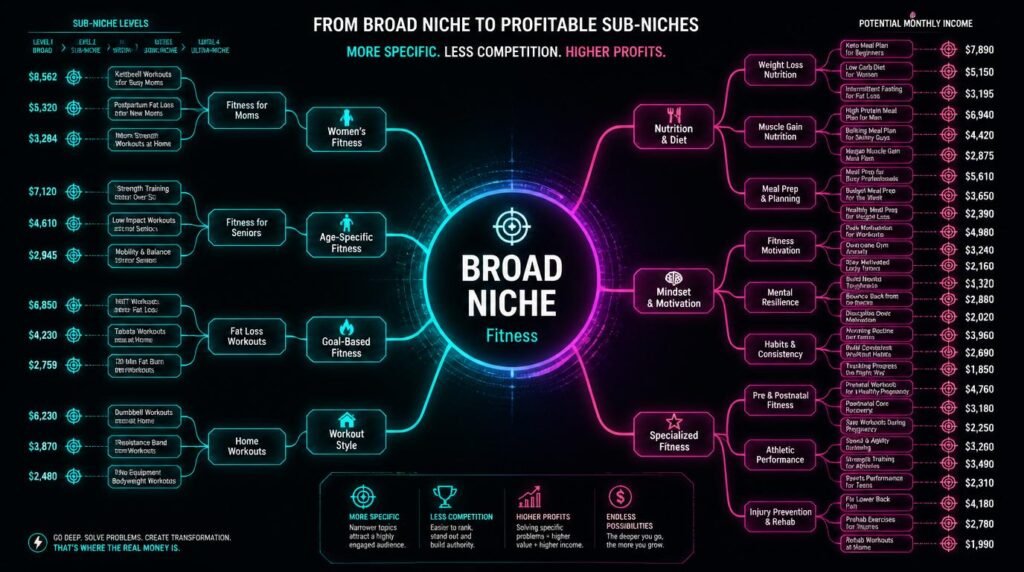
Some of the most profitable affiliate sites I know operate in ridiculously specific sub-niches: standing desk accessories for programmers, organic skincare for eczema-prone skin, noise-cancelling headphones for open-office workers. These sites rank faster, convert better, and build loyal audiences who trust them as the definitive resource. When you own a sub-niche, you set the terms of the conversation instead of fighting for scraps at the broad-niche table.
The key constraint: your sub-niche must still support at least 50 viable content topics and have a minimum of 5 affiliate programs worth promoting. Go too narrow, and you’ll exhaust your content runway within months. 🙂
The Niche Selection Myth That Costs Beginners Thousands
Let me dismantle the biggest myth I encounter in beginner affiliate marketing communities: “Saturated niches are dead — find something nobody else is doing.”
This sounds logical. It’s also catastrophically wrong in most cases. Here’s why: saturation signals demand. When you see dozens of affiliate sites in a niche, that means dozens of affiliates are making enough money to justify their time. The real question isn’t “is this niche saturated?” — it’s “can I create content that’s meaningfully better than what currently ranks?”
I entered the VPN review niche in 2021 — a niche that literally every affiliate marketing forum called “impossibly saturated.” Within 8 months, I had articles ranking on page one for mid-tail commercial keywords because I did something most VPN review sites didn’t: I actually tested each VPN’s speed across 14 server locations, documented everything with screenshots, and published the raw data. The content was better. Period. Competition didn’t matter because I brought something the existing players weren’t offering.
The niches you should genuinely avoid aren’t “saturated” — they’re niches with no buyer intent, no viable affiliate programs, or no content depth. Those are the three death signals. Everything else is a solvable problem if you’re willing to create content that genuinely helps people make better purchasing decisions.
Remember: the goal of affiliate niche selection isn’t to avoid competition. It’s to find a market where money flows, buyers search, and you can establish yourself as the most trustworthy voice in the room. When those three conditions align, you’ve found your niche.
Frequently Asked Questions
What is the best niche for affiliate marketing beginners?
The best niche for affiliate marketing beginners sits at the intersection of personal interest, proven buyer demand, and available affiliate programs paying recurring or high-ticket commissions. Niches like personal finance software, home fitness equipment, and online education tools consistently perform well for newcomers because they combine evergreen demand with strong commission structures.
How do I know if an affiliate niche is profitable?
A profitable affiliate niche shows three clear signals: advertisers actively spending money on Google Ads for related keywords, multiple affiliate programs offering commissions above 15%, and steady or rising search volume trends over the past 24 months. Use Google Trends, SEMrush, and affiliate network directories to validate all three signals before committing.
How many niches should I focus on as an affiliate marketer?
Focus on one single niche for your first 12 months. Spreading across multiple niches dilutes your topical authority, slows your SEO progress, and fragments your audience trust. Once your first niche site generates consistent revenue, you can expand into a closely related sub-niche or launch a second project.
Should I pick a niche I’m passionate about or one that makes the most money?
Pick a niche where your interest overlaps with proven profitability. Pure passion without buyer intent leads to traffic that never converts. Pure profit-chasing without genuine interest leads to burnout within six months. The sweet spot is a topic you can write about consistently for two years that also has products people actively purchase.
What are the most profitable affiliate niches in 2024?
The most profitable affiliate niches in 2024 include SaaS and software tools (recurring commissions of 20-40%), personal finance and investing platforms, health and wellness supplements, online education and course platforms, and home security and smart home technology. These niches combine high average order values with strong repeat purchase behavior.
How long does it take to make money in a new affiliate niche?
Most affiliate sites in a well-chosen niche take 6 to 12 months to generate meaningful income. The first 3 months focus on building content and indexing. Months 4-8 typically show initial organic traffic gains. Consistent revenue usually kicks in between months 8 and 14, assuming you publish at least 3-4 quality articles per week and build relevant backlinks.
My Top Recommended Gear
These are the tools I personally use during every niche research and validation phase. They’ve saved me from bad niches more times than I can count.
- Ahrefs Subscription (SEO & Keyword Research) — The single most valuable tool for validating niche competition levels, analyzing keyword difficulty, and reverse-engineering competitor traffic. I use it daily and consider it non-negotiable for serious affiliate niche selection.
- Content Strategy Planning Workbook — I use a physical planner alongside digital tools to map out niche content calendars, track commission structures, and sketch sub-niche hierarchies. Writing things by hand forces clearer thinking during the research phase.
- Dual Monitor Setup for Research Productivity — Running keyword research on one screen while analyzing competitor content on the other cut my niche validation time in half. A quality second monitor pays for itself within the first week of serious research.
Disclaimer: This post contains affiliate links. As an Amazon Associate, I may earn a commission from qualifying purchases at no additional cost to you. I only recommend products I’ve personally tested or rigorously researched.