
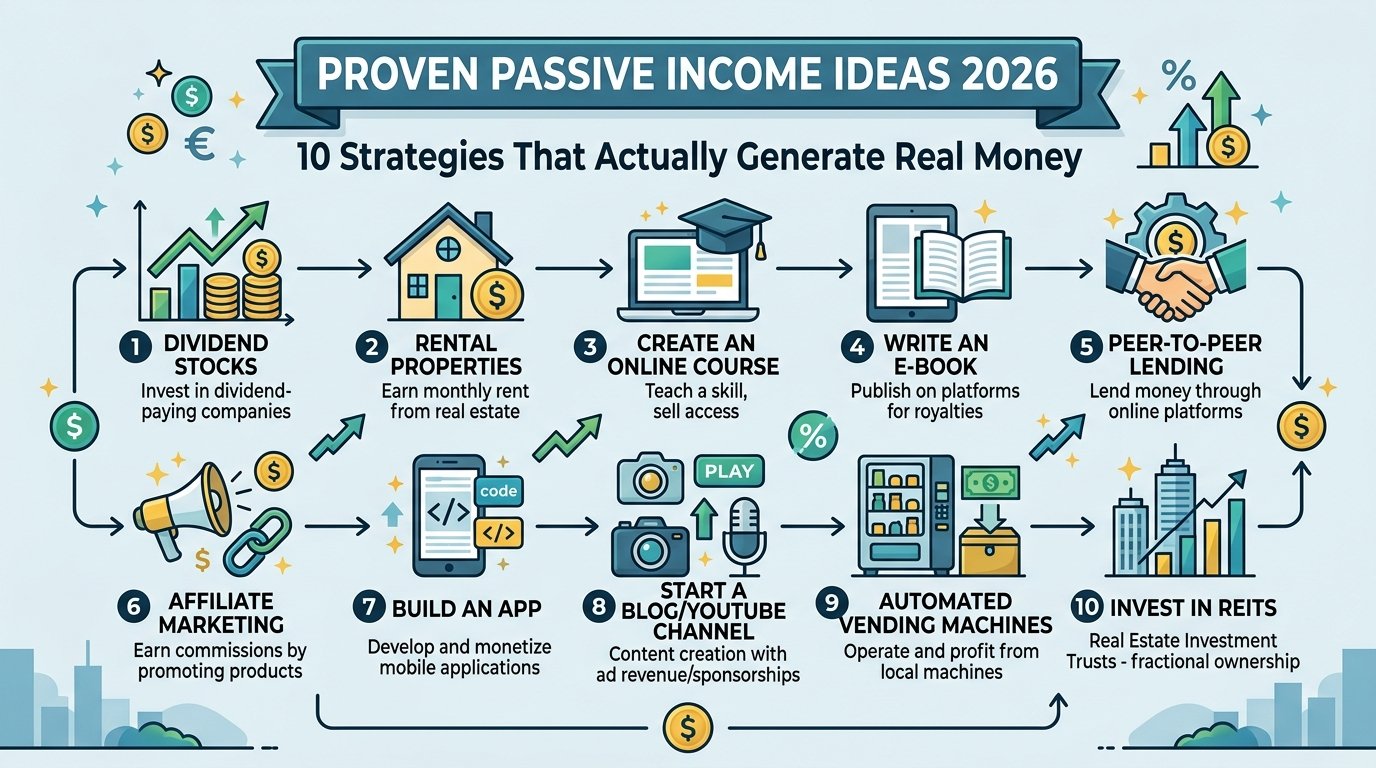
Proven Passive Income Ideas 2026: 10 Strategies That Actually Generate Real Money
Let’s be honest — the idea of making money while you sleep sounds almost too good to be true. But here’s the thing: passive income is real, it works, and in 2026, there are more legitimate ways to build it than ever before. The key word, though, is legitimate. Not every shiny opportunity you see on social media is worth your time or money.
I’ve spent years testing, researching, and actually doing the things on this list — not just writing about them. Some of these income streams took months to gain traction. Others surprised me with how quickly they paid off. What they all have in common? They require real effort upfront, but reward you with recurring income over time.
Whether you’re looking to supplement your 9-to-5, build financial freedom, or eventually replace your salary altogether, this list has something for every situation and budget. Let’s dive into the 10 best passive income ideas in 2026 that actually work — no fluff, no hype, just real strategies.
1. Dividend Stock Investing
If you want your money to literally work for you, dividend investing is one of the most time-tested strategies out there. You buy shares in companies that regularly pay out a portion of their profits to shareholders — and those payments land in your account like clockwork, whether you’re working or on vacation.
In 2026, platforms like Fidelity, Charles Schwab, and M1 Finance make it easier than ever to build a dividend portfolio with even a modest budget. Focus on Dividend Aristocrats — companies that have raised their dividends for 25+ consecutive years — for reliable, growing income.
- Start with as little as $100–$500 to buy fractional shares
- Reinvest dividends automatically using a DRIP plan
- Aim for a diversified portfolio across sectors like utilities, consumer staples, and healthcare
- Typical dividend yields range from 2% to 6% annually
It won’t make you rich overnight, but over 10–20 years, compounding dividends can build serious wealth.
2. Selling Digital Products
Here’s a passive income model that’s absolutely exploding in 2026: creating and selling digital products. Think eBooks, Notion templates, Canva design packs, Excel spreadsheets, recipe guides, or financial planners. You create it once and sell it an unlimited number of times — with zero inventory, zero shipping, and nearly 100% profit margins.
Platforms like Etsy, Gumroad, Payhip, and Stan Store make setting up your digital storefront incredibly simple. A well-designed Notion template or a niche-specific eBook can generate hundreds of dollars per month on autopilot once it gains traction.
- Identify a specific problem your target audience has
- Use free tools like Canva or Google Docs to create your product
- Price strategically — between $7 and $47 tends to convert well
- Drive traffic through Pinterest, TikTok, or Instagram Reels
The best part? Your store works 24/7, even when you don’t.
3. Affiliate Marketing
Affiliate marketing remains one of the most powerful passive income engines available — and it’s far from dead in 2026. The concept is simple: you recommend products or services, someone makes a purchase through your unique link, and you earn a commission. No product creation, no customer service, no inventory.
The secret sauce is choosing a profitable niche and building a platform — a blog, YouTube channel, or social media presence — that attracts an engaged audience. High-ticket affiliate programs in finance, software, and education can pay anywhere from $50 to $500+ per referral.
- Join programs like Amazon Associates, ShareASale, Impact, or ClickBank
- Focus on evergreen content that ranks on Google long-term
- Be transparent with your audience — trust drives conversions
- Combine with AI-powered side hustles to scale your content output faster
Done right, a single well-ranking blog post can earn commissions for years with minimal upkeep.
4. Print-on-Demand Stores
If you have even a basic sense of design or a knack for funny slogans, print-on-demand (POD) could be your golden ticket. You upload your designs to products like t-shirts, mugs, tote bags, and phone cases. When someone orders, a third-party company prints and ships it for you — you never touch inventory or deal with logistics.
Platforms like Redbubble, Merch by Amazon, Printful + Etsy, and Printify have made POD incredibly accessible. Niche-specific designs — think funny nurse gifts, dog breed shirts, or hobby-related art — consistently outperform generic designs.
- Use Canva, Adobe Express, or Kittl to create professional-looking designs
- Research trending niches using tools like Merch Informer or EverBee
- Upload consistently — more designs mean more chances to be discovered
- Profit margins typically range from $3 to $15 per sale
The upfront investment? Mostly your time. The potential? Essentially unlimited.
5. YouTube Automation Channels
YouTube automation — also called faceless YouTube channels — has taken off as one of the hottest passive income models in recent years. The idea is to build a YouTube channel without ever appearing on camera. Topics like true crime, finance tips, motivational content, and documentary-style history videos are massive on the platform right now.
You use a combination of tools — AI voiceovers, stock footage, and scripted content — to produce videos at scale. Once a video ranks and gains traction, it can earn AdSense revenue, affiliate commissions, and sponsorship deals month after month.
- Choose a niche with high CPM rates like finance, health, or business
- Use tools like ElevenLabs, Pictory, or InVideo for production
- Monetize through AdSense once you hit 1,000 subscribers and 4,000 watch hours
- Outsource scripting and editing as your revenue grows to stay truly passive
It takes 3–6 months to see real traction, but the long-term payoff makes it well worth the initial grind.
6. Real Estate Rental Income
Real estate has been a wealth-building staple for centuries, and it’s still one of the most reliable passive income streams you can build in 2026. The classic approach is buying a rental property and collecting monthly rent, but that’s not the only way in. Platforms like Fundrise and RealtyMogul let you invest in real estate with as little as $10 to $500, making it accessible even if you can’t afford a down payment on a full property.
If you already own a home, consider renting out a spare room on Airbnb or VRBO. Short-term rentals in the right markets can generate significantly more than traditional long-term leases. Yes, there’s some upfront effort involved in managing tenants or listings, but once your systems are in place, the income flows with minimal daily involvement.
- Best for: People with capital to invest or existing property
- Startup cost: $10 (REITs) to $50,000+ (physical property)
- Time to first income: 1–6 months
7. Creating and Selling Online Courses
If you have a skill, a profession, or even a hobby you’ve mastered, you can package that knowledge into an online course and sell it over and over again. Platforms like Teachable, Thinkific, and Udemy host your content and handle payments, so your main job is creating the course once and marketing it consistently.
The e-learning industry is exploding, projected to exceed $400 billion globally by 2026. Topics that sell well include coding, digital marketing, fitness, cooking, personal finance, and even niche crafts. A well-structured course priced between $97 and $497 can generate thousands of dollars per month on autopilot. Pair it with an email list or a social media presence and you’ve got a genuinely powerful passive income engine that compounds over time.
- Best for: Teachers, coaches, and skilled professionals
- Startup cost: $0–$500 (recording equipment and platform fees)
- Time to first income: 1–3 months
8. High-Yield Savings Accounts and CDs
It might not be the most glamorous strategy on this list, but high-yield savings accounts and certificates of deposit (CDs) are hands-down the lowest-risk passive income option available. With interest rates remaining competitive in 2026, many online banks are offering APYs between 4% and 5.5% — a massive upgrade from the 0.01% you’d get at a traditional brick-and-mortar bank.
The strategy is simple: park your emergency fund or short-term savings in a high-yield account at institutions like Marcus by Goldman Sachs, Ally Bank, or SoFi. For money you won’t need for 6–24 months, lock it into a CD for an even higher guaranteed return. It’s completely passive, FDIC insured up to $250,000, and requires zero maintenance. Think of this as the financial foundation underneath your more aggressive income streams.
- Best for: Conservative investors and beginners
- Startup cost: $1+
- Time to first income: Immediate (first interest payment within 30 days)
9. Licensing Your Photography or Art
Got a camera or a creative eye? Your photos, illustrations, and digital artwork can earn money for years after you create them. Stock photography platforms like Shutterstock, Adobe Stock, and Getty Images pay you a royalty every time someone licenses your image. Upload your portfolio once, and those assets can generate passive income indefinitely.
In 2026, the demand for authentic, diverse, and high-quality visuals is stronger than ever, driven by content creators, marketers, and businesses hungry for fresh imagery. Beyond photography, digital illustrators and graphic designers are licensing vector art, patterns, and design assets on Creative Market and Etsy. If you’re more into AI-generated art, some platforms are beginning to accept properly disclosed AI artwork too. The key is volume — the more quality assets you upload, the more earning potential you create.
- Best for: Photographers, illustrators, and visual artists
- Startup cost: $0 (using existing work) to $1,000 (camera gear)
- Time to first income: 2–8 weeks after approval
10. Peer-to-Peer Lending
Peer-to-peer (P2P) lending lets you act as the bank by lending money directly to individuals or small businesses through platforms like Prosper, LendingClub, or Funding Circle. In return, you earn interest payments that often range from 5% to 12% annually — far outpacing what traditional savings accounts offer.
The concept is straightforward: you fund a portion of multiple loans, spreading your risk across many borrowers. As borrowers repay their loans with interest, that money flows back to you. The key to success in P2P lending is diversification — never put all your funds into a single loan. Spread smaller amounts across dozens of loans to minimize the impact of any defaults. While P2P lending carries more risk than a savings account, the returns can be substantially higher, making it a solid middle-ground passive income strategy for 2026.
- Best for: Investors comfortable with moderate risk
- Startup cost: $25–$1,000 to start
- Time to first income: 1–3 months
Start Building Your Passive Income Stack Today
There you have it — 10 passive income ideas that actually work in 2026, not just in theory but in real practice for real people. The truth is, passive income isn’t a myth. It’s just misunderstood. It requires upfront effort, smart decisions, and consistency — but once the wheels are turning, the rewards keep coming even when you’re sleeping, traveling, or spending time with the people you love.
The biggest mistake most people make? Trying to do everything at once and ending up doing nothing well. Instead, pick just one idea from this list that matches your current skills, budget, and schedule. Commit to it for the next 90 days. Build it, learn it, and scale it before moving on to the next stream.
If you’re drawn to using modern technology to speed things up, don’t miss our guide on the best AI side hustles of 2026 — it covers how artificial intelligence is opening up brand-new income opportunities that simply didn’t exist a few years ago.
Your future self will thank you for starting today. So what are you waiting for? Pick your idea and take that first step right now.