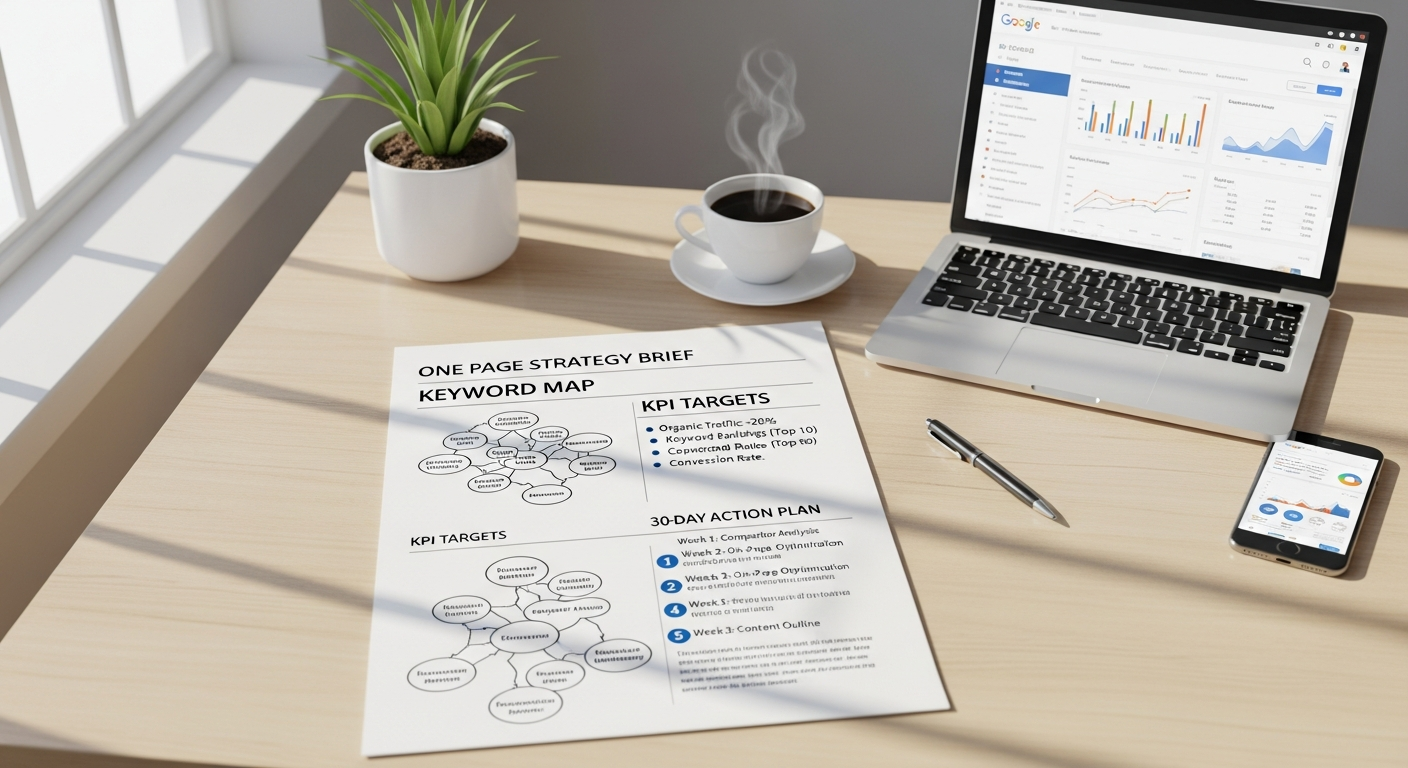
One-Page SEO Strategy Brief: Steal My 30-Day SEO Plan
The truth: most “SEO strategies” die as soon as they hit a shared drive. A one-page SEO strategy brief fixes that by forcing clarity—what you’re building, why it should rank, and what you’ll ship next week (not next quarter). If your current plan is a 40-slide deck, you’re not planning. You’re procrastinating with charts.
And yes, this works even if you’re solo. Especially if you’re solo.
Table of Contents
- What a One-Page Brief Is (and Why It Works)
- The Non-Negotiables Your Brief Must Include
- How to Build It in 90 Minutes
- Execution: Your 30-Day Shipping Plan
- Mistakes That Kill a One-Page Brief
- Tools & Templates That Make This Painless
- Frequently Asked Questions
- Closing Thought
What a One-Page Brief Is (and Why It Works)
A one-page SEO strategy brief is a single-page operating plan that defines the target query set, intent, content architecture, internal linking, KPIs, and a short execution roadmap. It exists to drive decisions and shipping. If your “strategy” can’t fit on one page, you don’t have strategy—you have anxiety.
Here’s the problem: SEO teams (or solo operators) keep confusing documentation with direction. Documentation is comforting. Direction is uncomfortable because it forces trade-offs.
A one-page brief forces the trade-offs on purpose:
- It prioritizes outcomes over activities. “Publish more” is not an outcome. “Increase organic leads from X page by 30%” is.
- It aligns execution across content + technical + analytics. SEO fails at the seams. A one-page brief stitches seams.
- It’s reviewable in five minutes. If stakeholders can’t review it quickly, they won’t. Then they’ll “circle back” forever.
Also, reality check: most pages never get meaningful search traffic. Ahrefs has published research showing a large majority of pages get no organic traffic from Google, largely due to weak topic selection and intent mismatch. :contentReference[oaicite:0]{index=0}
So yeah—tight planning matters.
The Non-Negotiables Your Brief Must Include
If your one-page brief is missing any of these, it’s going to “feel strategic” while doing nothing. That’s the worst kind of failure: quiet, expensive, and strangely motivating to make another slide deck.
1) The business goal (not the SEO goal)
Bad: “Rank #1 for keyword.”
Good: “Drive 200 qualified clicks/month to a page that converts at 3%.”
Because rankings don’t pay the bills. Conversions do.
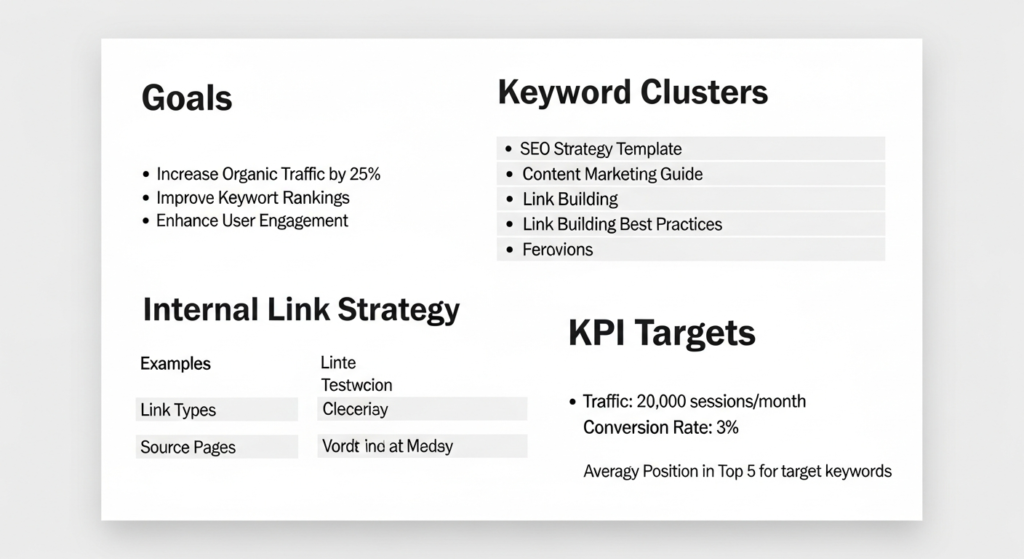
2) The SERP reality check
Write down what you’re actually up against:
- Is it dominated by brands?
- Is Google rewriting titles because your niche is spammy?
- Are AI Overviews or SERP features eating clicks?
CTR is not stable across queries, devices, or industries. Advanced Web Ranking’s CTR reports show CTR varies significantly and shifts over time, meaning “position 3” is not a universal traffic guarantee. :contentReference[oaicite:1]{index=1}
3) The intent statement (one sentence)
This is where most people lie to themselves.
Intent statement example: “Searchers want a fast, printable framework to plan SEO work, with clear KPIs and a 30-day execution plan.”
Everything you publish should make that statement more true.
4) The page architecture (pillar + support, or one page only)
If you’re building topical authority, show it as a tiny map:
- Pillar page: One-page brief guide + downloadable template
- Support posts: GA4/GSC measurement setup, internal linking playbook, CTR/title testing, etc.
And yes, internal linking is a real lever. Google’s own guidance is blunt: descriptive anchor text helps both users and Google understand what the linked page is about. :contentReference[oaicite:2]{index=2}
If you want a practical internal-linking and execution framework, steal patterns from this hub: the Traffic & SEO systems guide. It’s the kind of “do this next” content most SEO blogs pretend they’re above.
5) Measurement stack + KPIs (3–5 max)
If you track 27 metrics, you track zero metrics. Pick a handful with a job to do:
- Search Console: impressions, clicks, CTR, average position
- GA4: organic landing page engagement + conversions
- Business metric: leads, sales, email signups, RPM, whatever matters
If your analytics is a mess, fix it before you “optimize content.” Start here: GA4 + Search Console configuration checklist for clean SEO.
How to Build It in 90 Minutes
Fast forward to the part where you stop “planning” and start producing a brief that holds up in real life.
Step 1: Write the one-line target
“We will rank for X by publishing Y and improving Z, measured by A and B.”
Example:
“We will win ‘one-page SEO strategy brief’ by publishing a template-driven guide, building supporting pages for measurement + internal linking, and improving CTR via tighter title/intro alignment, measured by Search Console clicks and assisted conversions.”
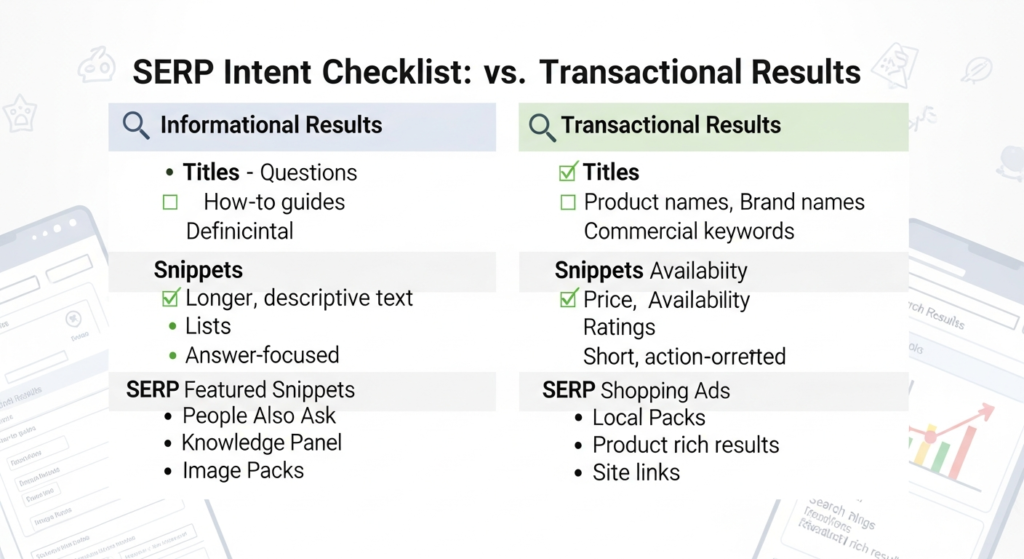
Step 2: List the keyword cluster (5–12 terms, max)
Don’t stuff the page. Map the semantic territory:
- one-page SEO strategy brief
- SEO strategy template
- SEO planning framework
- SEO brief for stakeholders
- 30-day SEO plan
- SEO KPI dashboard basics
Optional but smart: add a “kill list” of terms you’re not targeting so you don’t drift into nonsense.
Step 3: Define the winning angle
Most content loses because it’s interchangeable. Your angle is the differentiator that makes the click feel inevitable.
Here are angles that work:
- The “operating system” angle: brief = decisions + shipping cadence
- The “anti-deck” angle: one page beats 40 slides
- The “measurement-first” angle: strategy without clean data is cosplay
And tighten your titles. Google explicitly documents how title links are generated and what you can do to influence them. Translation: write titles like a human, not a keyword blender. :contentReference[oaicite:3]{index=3}
Step 4: Write the internal linking plan (yes, in the brief)
This is where grown-up SEO lives.
In your brief, include:
- 3–5 internal links you will add (from which pages, using what kind of anchors)
- 1–2 “hub” pages that will point to the new page consistently
- Anchor text rules (no “click here,” no exact-match spam)
If you don’t have a linking habit, you don’t have a site architecture—just a pile of posts with vibes.
Need a clean execution pattern? Use this as a reference point for your linking and traffic moves: internal linking and traffic system workflows.
Step 5: Add a “definition of done”
This is the part most people skip, then wonder why projects never end.
- Page published with snippet-ready intro and FAQ
- 3 supporting pages drafted (or at least outlined)
- Internal links added from existing pages
- Search Console annotation date noted
- Title/intro tested after 14 days (CTR vs baseline)
Execution: Your 30-Day Shipping Plan
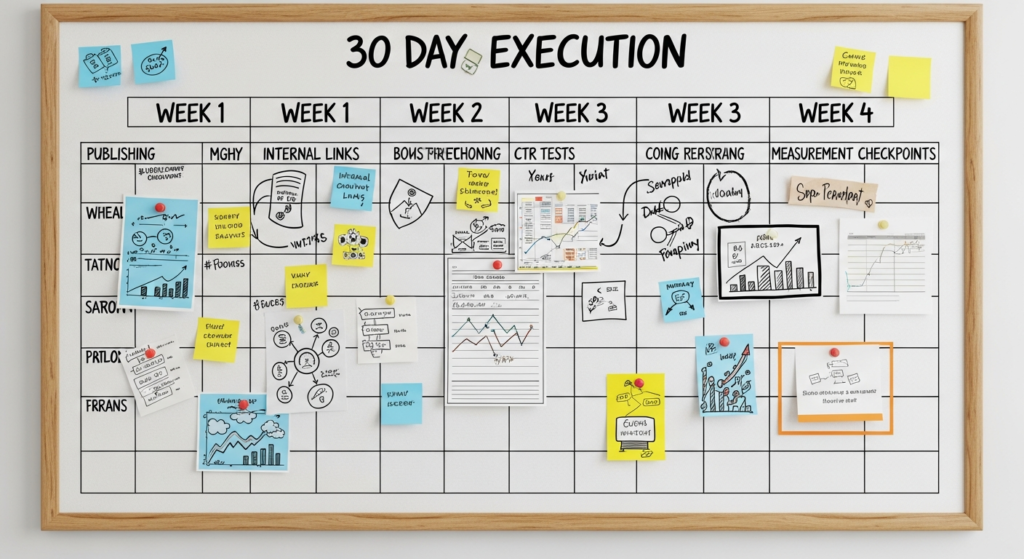
Bottom line: the brief is worthless unless it creates motion. Here’s a simple 30-day execution model that doesn’t require a project manager with a whistle.
Week 1: Build the asset that deserves to rank
- Publish the main page with the template and a “how to use it” walkthrough
- Add the first round of internal links
- Ensure your tracking is clean (events, conversions, GSC ownership)
If your measurement stack is shaky, you’re basically driving at night with sunglasses. Fix it using this: GA4 + GSC configuration checklist.
Week 2: Publish support content that feeds the hub
- Internal linking guide (practical rules, not theory)
- CTR/title testing guide (what to change, what to leave alone)
- Measurement primer (Search Console + GA4 basics for SEO decisions)
Week 3: Optimize what the SERP is telling you
Look at Search Console queries for the page:
- Queries with high impressions + low CTR = title/description misalignment
- Queries with clicks but low engagement = intent mismatch or weak above-the-fold
- Queries that are “almost relevant” = add a section, don’t rewrite the universe
Week 4: Add authority and consolidate
This is where you stop chasing shiny objects and start compounding:
- Update internal links again based on what’s ranking
- Improve snippet sections and FAQ based on queries
- Layer light outreach if the SERP is link-heavy
Want a mental model for why links still matter? PageRank is old, but the concept—importance flowing through links—still informs how the web works. :contentReference[oaicite:4]{index=4}
Mistakes That Kill a One-Page Brief
These are the common ways people sabotage a good idea with bad habits.
Turning it into a mini novel
If it becomes two pages, you’re already slipping.
One page forces prioritization. That’s the whole point.
Writing goals that can’t be measured
“Increase visibility” is not a goal. It’s a feeling.
Use numbers, time frames, and a clear measurement source (Search Console/GA4). If you can’t trace a KPI back to a decision, it’s noise.
Ignoring the SERP and assuming your content is “better”
Being better doesn’t matter if you’re different in the wrong direction.
Match intent first. Then out-execute with structure, clarity, and distribution.
Not planning internal links up front
This is where most content strategies quietly die.
You publish, you celebrate, you move on—then wonder why Google ignores the page. Internal links are your cheapest distribution channel. Treat them like it.
Tools & Templates That Make This Painless
You don’t need a fancy stack. You need a repeatable workflow and a place to write the brief.
- Template-friendly doc tool: Google Docs / Notion / a simple WordPress draft
- Measurement: Search Console + GA4
- Tracking discipline: a weekly 15-minute review cadence (yes, put it on a calendar)
And if you want physical reminders because you’re tired of browser tabs eating your brain, here are a few Amazon search links that actually make sense for this workflow:
1) “SEO planner” style notebook (for KPI targets, weekly checks, and quick SERP notes)
2) Whiteboard for a 30-day shipping plan (because visibility beats “I’ll remember it”)
3) Keyword research sticky notes / desk pads (for clustering terms and mapping internal links fast)
One more practical move: keep your internal execution playbook close. This page is a solid anchor for ongoing optimization work: Traffic & SEO workflow hub.
Frequently Asked Questions
How long should a one-page SEO strategy brief take to create?
If your measurement stack and keyword inputs are ready, you can draft a solid one-page brief in 60–90 minutes. The mistake is polishing formatting for three hours instead of validating intent, competition, and the exact pages you’ll ship in the next 30 days.
What’s the difference between a content brief and a one-page SEO strategy brief?
A content brief tells a writer how to build one page. A one-page SEO strategy brief tells your whole team what you’re building, why it will win, how pages connect, and how you’ll measure success. One is tactical; the other is the operating system.
Do I need backlinks for this to work?
Sometimes yes, sometimes no. If you’re competing in a high-authority SERP, links matter. But a one-page brief often wins faster by fixing intent match, internal linking, and CTR first—then layering link acquisition where the math says it’s necessary.
How do I measure success without drowning in GA4 dashboards?
Pick 3–5 KPIs that reflect the funnel: impressions and average position (Search Console), organic clicks/CTR, landing-page engagement, and conversions (lead or revenue). If you can’t name the decision each metric informs, delete it.
Closing Thought
Here’s the truth: SEO doesn’t need more “strategy.” It needs more decisions. A one-page brief is the simplest way to force those decisions, align the work, and ship on schedule.
Insider takeaway: If you can’t fit the plan on one page, you’re hiding from trade-offs—usually intent, architecture, or measurement.
Now go write the brief. Make it uncomfortable. Make it specific. Then ship the page and let the SERP argue with you in public. That’s how this game is actually played.
As an Amazon Associate, I earn from qualifying purchases.