
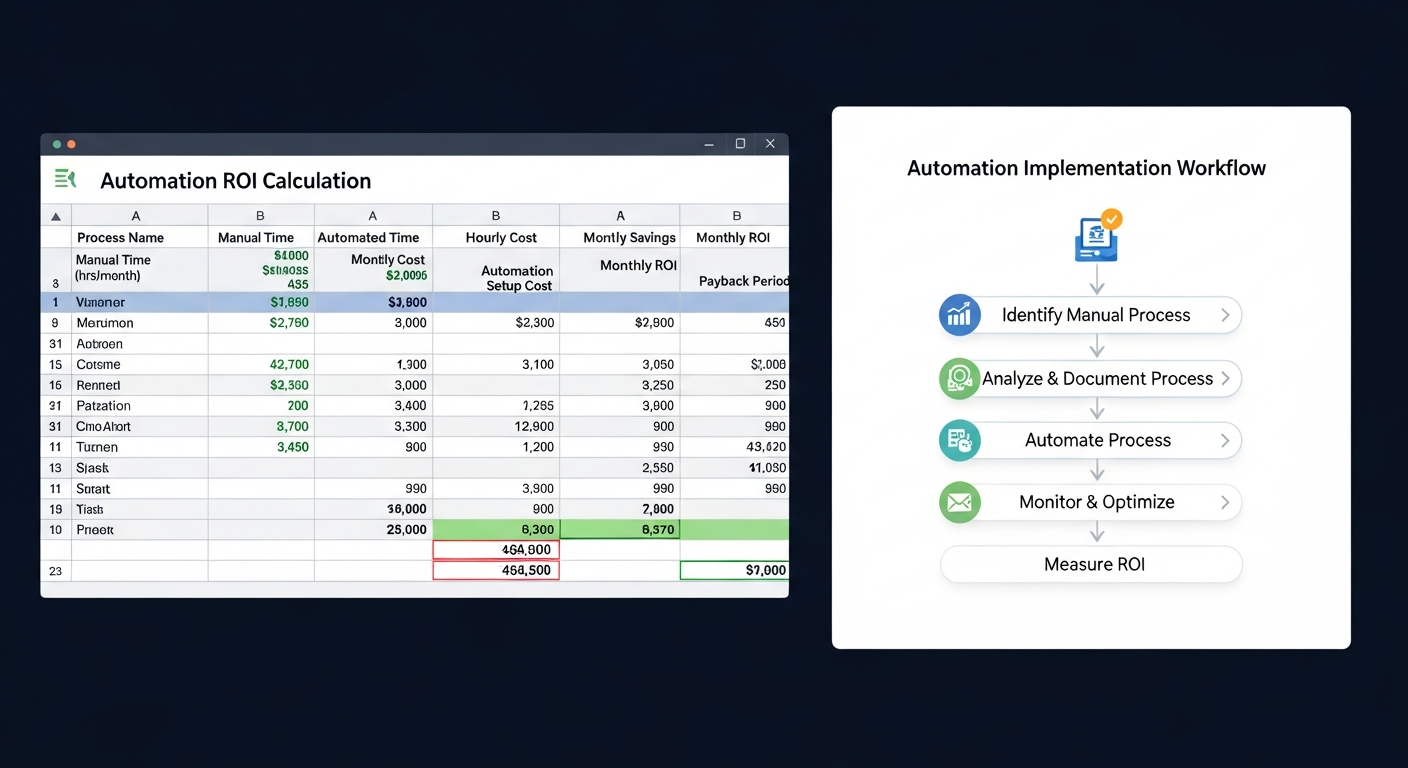
How to Calculate Automation ROI Without Lying to Yourself
How to calculate automation ROI without lying to yourself is basically the adult version of “show your work.” The problem is most ROI spreadsheets are performance art: optimistic inputs, selective math, and a heroic assumption that automation never breaks on a Friday night.
Here’s the truth: if you can’t explain the ROI to a skeptical CFO and a burned-out operator in the same meeting, you don’t have ROI—you have vibes.
Table of Contents
- Why Most Automation ROI Is Fake
- The Honest Automation ROI Formula
- Step 1: Measure the Baseline Like a Grown-Up
- Step 2: Price the Real Costs (Not the Fairytale Costs)
- Step 3: Value Benefits Conservatively (Or Don’t Bother)
- Step 4: Add Risk, Friction, and Maintenance
- Step 5: Choose Metrics That Prevent Self-Deception
- The Fastest Sanity Checks
- Frequently Asked Questions
- Recommended Tools & Books (Amazon)
- Final Takeaway
Why Most Automation ROI Is Fake
To calculate automation ROI honestly, you need three things: accurate baseline measurement, full cost accounting, and conservative benefit estimates. ROI is positive when expected benefits (probability-weighted) exceed build + run + maintenance costs, with payback inside a timeframe you can live with.
Most teams fail at this because they treat automation like a one-time purchase instead of a living system. Automation is software. Software decays. APIs change. People change the process. Edge cases multiply like rabbits.
And let’s be blunt: “We saved 30 hours/week” is usually code for “We stopped tracking after launch and nobody wanted to ruin the success story.”
ROI also gets inflated by a classic trick: valuing time saved as if it automatically becomes money. Time saved only becomes money if it is actually converted into revenue, retained customers, fewer refunds, fewer incidents, faster delivery, or avoided hires.
If you want a practical framework for automation that’s built to survive reality (not demos), read this practical AI automation playbook. It’s the difference between “we automated a thing” and “we built a system that keeps paying rent.”
The Honest Automation ROI Formula
Let’s keep it simple and usable. The core equation is:
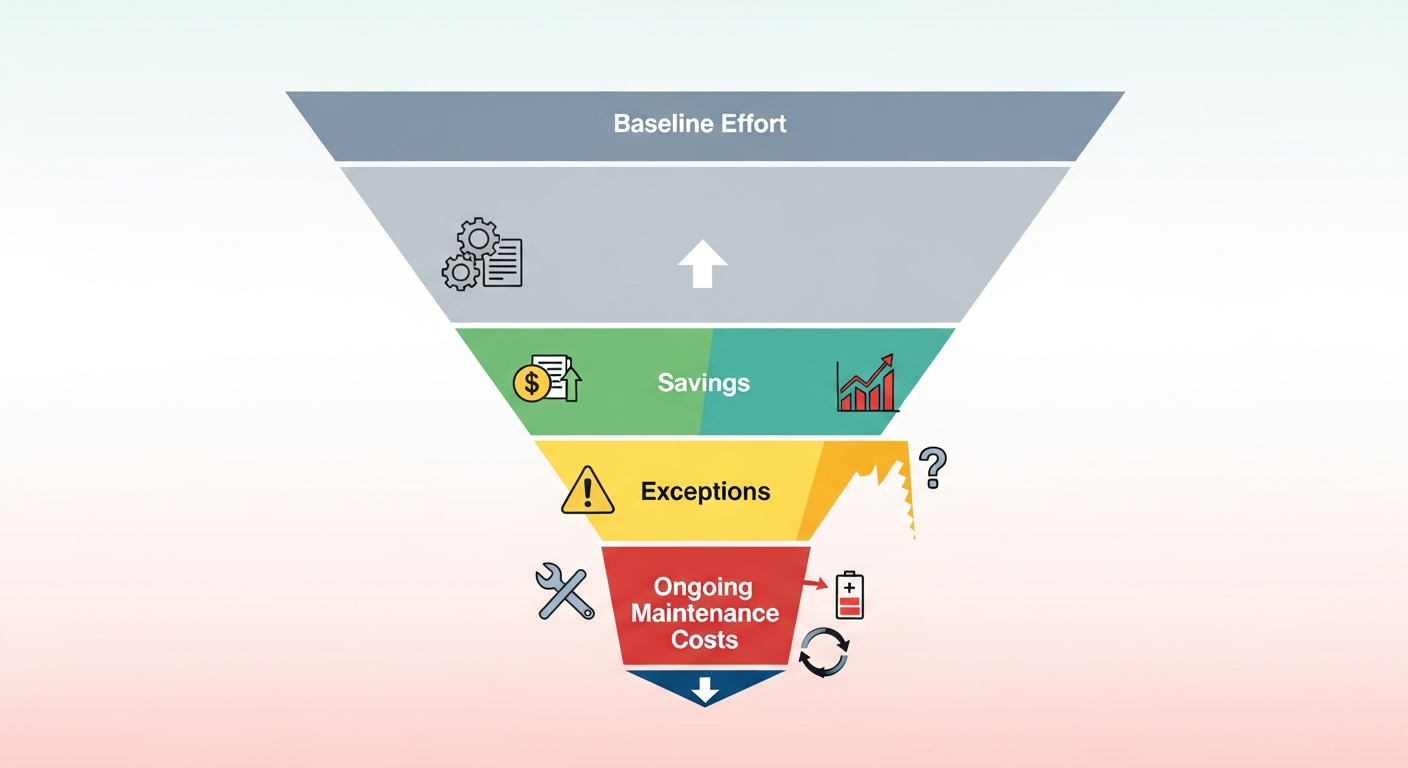
Expected ROI = (Expected Annual Benefits − Expected Annual Costs) ÷ Upfront Investment
And “expected” is doing a lot of work there. It means you’re not allowed to assume perfect adoption, zero downtime, and magical compliance. You probability-weight benefits and costs based on reality.
What counts as benefits?
- Cost reduction: fewer labor hours, fewer contractors, fewer tool licenses, fewer support tickets.
- Revenue lift: faster lead response, more conversions, better retention, more upsells.
- Risk reduction: fewer errors, fewer chargebacks, fewer compliance mistakes.
- Speed: shorter cycle times (which can convert to revenue or capacity if you actually use it).
What counts as costs?
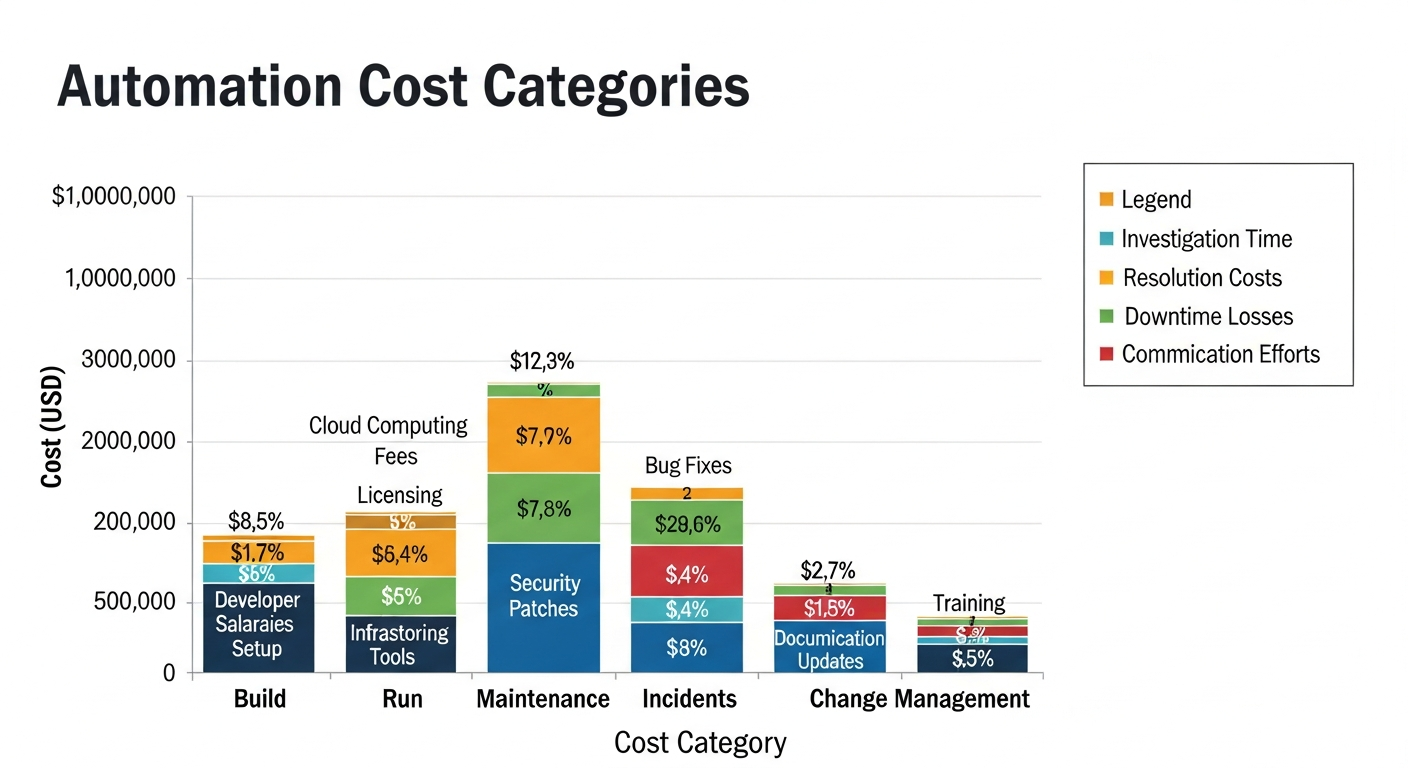
- Build cost: engineering time, setup, integrations, data cleanup, testing, documentation.
- Run cost: software fees, API usage, compute, monitoring, logs.
- Maintenance cost: bug fixes, updates, retraining, exception handling, onboarding.
- Failure cost: incidents, rework, reputational damage, rollback time.
If you want formal definitions for the finance-y terms, start with ROI basics on Wikipedia’s ROI overview and the idea of discounting future value via time value of money. Not sexy, but it prevents some truly dumb decisions.
Step 1: Measure the Baseline Like a Grown-Up
Bottom line: you can’t claim savings if you never measured the original cost. “We think it takes about 10 minutes” is not a baseline. It’s a guess wearing a tie.
Baseline measurement checklist
- Define the unit of work: one invoice processed, one lead qualified, one report generated.
- Measure cycle time: start-to-finish elapsed time (not just “hands-on”).
- Measure touch time: how many human minutes are actually spent.
- Measure volume: per day/week/month (and seasonality if it exists).
- Measure error rate: rework minutes matter more than you think.
Do this for at least a week. Two weeks is better. If your process is spiky (end-of-month reporting, promo cycles), you need a sampling window that captures the spikes. Otherwise you’re optimizing the calm and getting blindsided by reality.
Fast forward to the part everyone skips: include the hidden “coordination tax.” How many Slack messages, approvals, and “hey can you check this?” moments happen per unit of work? That’s labor too.
For wage references and the boring-but-necessary “what does a labor hour cost?” conversation, you can use public data like the U.S. Bureau of Labor Statistics as a sanity anchor for wage assumptions: bls.gov. You’ll still need to load in your true fully loaded cost (salary + benefits + overhead), but at least you’re not inventing numbers.
Step 2: Price the Real Costs (Not the Fairytale Costs)
The problem is most ROI models treat automation like buying a toaster. You pay once, it works forever, and nobody needs to maintain it. That’s adorable.
Here’s a cost model that won’t embarrass you later:
Upfront investment
- Build hours: design + implementation + testing + security review.
- Process cleanup: standardizing inputs is often the real work.
- Change management: training, documentation, new SOPs.
Ongoing costs (annualized)
- Tools & licenses: automation platforms, connectors, monitoring.
- Maintenance: 10–30% of build cost per year is a common reality band for operational systems (depends on volatility).
- Ops load: incident response, retries, exception review.
One more thing: if you’re using “AI automation,” budget for evaluation and drift. Models change. Inputs change. Your business rules change. If you treat this like set-and-forget, you’re not automating—you’re just deferring pain.
If you’re building content and ops systems that need to scale across your projects, keep an eye on how you structure the work in the first place. The homepage at MakeMoneyQ is basically a reminder that systems beat heroics every time.
Step 3: Value Benefits Conservatively (Or Don’t Bother)
This is where the lying happens. People take best-case time savings, multiply by top-of-band hourly rate, and call it “savings.”
Here’s the truth: time saved is only valuable if it becomes something else. Otherwise it turns into meetings and “quick questions.”
Three benefit buckets (pick the one you can prove)
- Hard savings: you actually reduce spend (fewer contractor hours, fewer support hires, lower tool costs).
- Capacity: the same people produce more output or higher-value work. You must define what that output is.
- Risk/quality: fewer mistakes, less rework, fewer refunds, fewer compliance issues.
To keep yourself honest, use a conservative “realization rate.” Example: you estimate 10 hours/week saved, but only 50% gets realized into meaningful output. So you value 5 hours/week, not 10.
If you want a mental model for “benefits now are worth more than benefits later,” read the basics of discounted cash flow and net present value (NPV): NPV overview. You don’t need a finance degree—you just need to stop pretending a dollar next year is identical to a dollar today.
Step 4: Add Risk, Friction, and Maintenance
Automation that fails quietly is worse than manual work. Manual work fails loudly—people notice. Silent automation failures are where you get chargebacks, compliance issues, and angry customers with screenshots.
So you add risk explicitly.
A simple risk-adjusted model
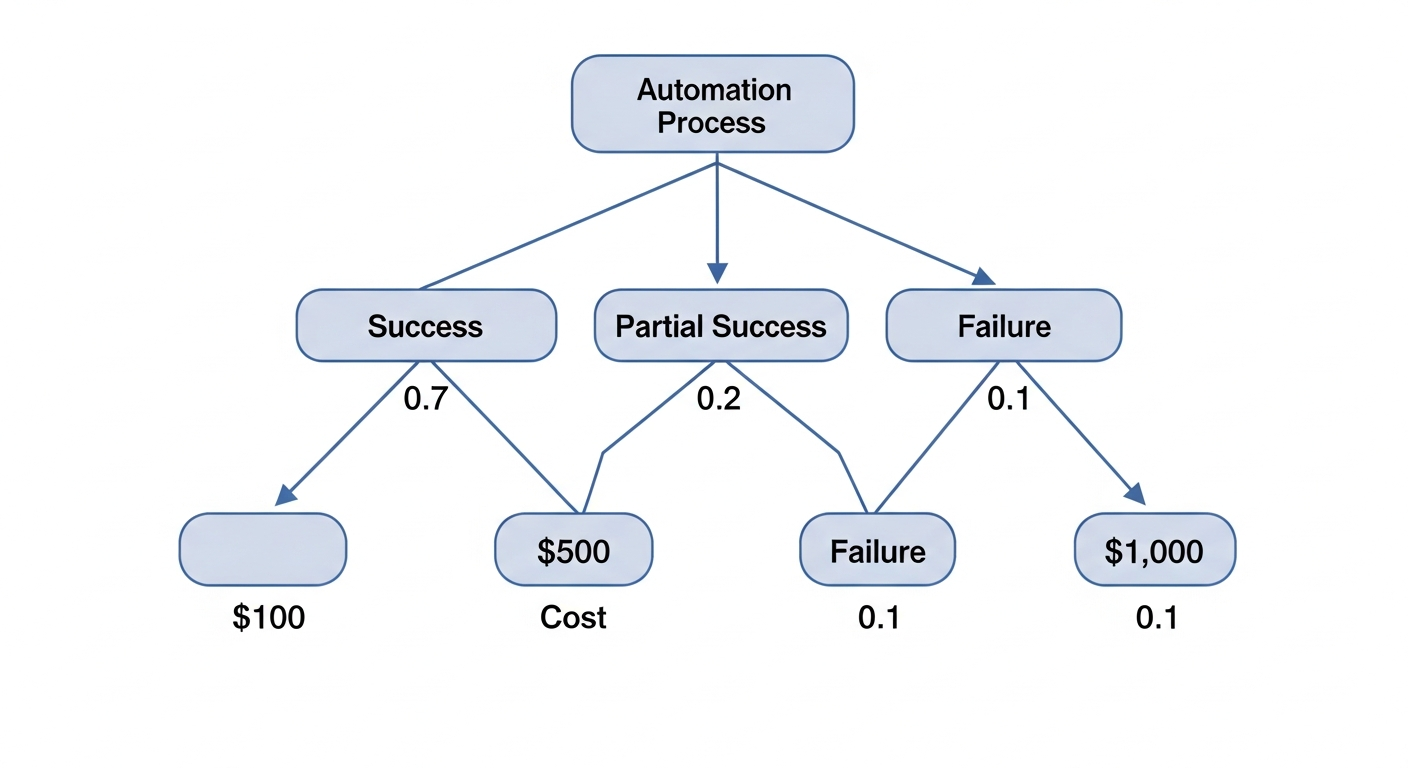
- Success probability: what’s the realistic chance this works end-to-end in production?
- Adoption probability: what’s the chance humans actually use it instead of “just doing it the old way”?
- Incident cost: average time to detect + fix + communicate + recover.
Then do:
Expected Benefits = Gross Benefits × Success Probability × Adoption Probability
This is also why “automate the mess” is a terrible strategy. If the process changes weekly, your automation becomes a weekly maintenance chore. If someone sells you a tool that promises “instant automation of any workflow” without process clarity, it sucks. Not because the tool is evil—because physics.
Step 5: Choose Metrics That Prevent Self-Deception
Pick metrics that are hard to manipulate and easy to measure. The goal is to trap your future self before they start “explaining” disappointing results.
ROI metrics that actually work
- Payback period: months until benefits cover upfront cost. Simple, brutal, effective.
- Net benefit (annual): benefits minus ongoing costs, after risk adjustment.
- Cost per unit: $ per invoice, $ per lead, $ per report. Before vs after.
- Defect rate: errors per 100 units, plus rework minutes.
- Cycle time: elapsed time from request to completion.
Also: define what “done” means. If you can’t specify acceptance criteria (accuracy threshold, latency, exception handling), you’re not building automation—you’re building a demo.
For operational quality thinking that maps nicely to automation, the concept of “special cause vs common cause variation” is worth learning (it’s old-school quality engineering, still undefeated). A decent starting point is a quick overview of statistical process control: SPC basics.
The Fastest Sanity Checks
If you’re busy (and you are), run these quick checks before you spend a week in spreadsheet land:
- Rule of 10: if the task happens fewer than ~10 times per week, automation better be trivial or it’s probably not worth it.
- Exception rate: if more than ~20% of cases are weird exceptions, you’re automating the wrong layer (fix the inputs/process first).
- Process volatility: if rules change monthly, budget maintenance like a subscription, not a one-off.
- Human-in-the-loop reality: if humans must review everything anyway, you’re doing assistive automation, not full automation. Value it accordingly.
Bottom line: if the ROI only works when you assume perfection, it doesn’t work.
Frequently Asked Questions
What’s the biggest mistake people make when calculating automation ROI?
They count best-case time savings as guaranteed, ignore ongoing maintenance, and pretend exceptions and edge cases don’t exist. If you don’t price reality, your ROI is fiction.
Should I include the time value of money in automation ROI?
Yes, if the project is more than a few months or requires meaningful upfront cost. Discount future benefits (or at least use payback + conservative assumptions) so you don’t overrate long-tail savings.
How do I value “time saved” if headcount won’t change?
Treat it as capacity ROI: what higher-value work will that time fund (revenue, retention, quality, speed)? If the freed time gets re-absorbed by meetings, value it at $0 and move on.
How do I account for risk and failure rates?
Use probability weighting. Multiply benefits by a conservative success probability and add explicit costs for monitoring, rollback, and incident response. Automation that breaks silently is negative ROI with extra steps.
When is automation ROI not worth calculating?
When the task is rare, constantly changing, or mostly exceptions. If you can’t keep the rules stable, you’re not automating—you’re building a maintenance subscription for yourself.
Recommended Tools & Books (Amazon)
If you’re building automation ROI models, you’ll end up doing two things a lot: measuring work honestly and designing systems that don’t collapse under edge cases. These are solid, practical picks to support that workflow.
1) “Measure What Matters” (OKRs done properly)
Helpful if your “ROI” is really “we need measurable outcomes and accountability.”
2) “The Phoenix Project” (systems thinking for ops + automation)
Great for understanding why “automate chaos” fails and how bottlenecks kill ROI.
3) “Lean Analytics” (turning activity into measurable impact)
Useful for choosing the few metrics that actually reflect value, not vanity.
4) Time tracking basics (because “we think it takes 10 minutes” is not data)
Even a simple physical Pomodoro timer can help teams measure touch time without overthinking it.
Final Takeaway
Here’s the truth: honest automation ROI is less about clever math and more about refusing to fantasize. Measure the baseline, count the full costs (including maintenance), value benefits conservatively, and risk-adjust everything like you’ve been burned before—because you will be.
Bottom line: if you can’t defend your assumptions to a skeptic, rewrite them. And if your spreadsheet only works in a universe where nobody makes mistakes… congratulations—you’ve discovered fiction writing.
As an Amazon Associate, I earn from qualifying purchases.






2 Comments
Comments are closed.