
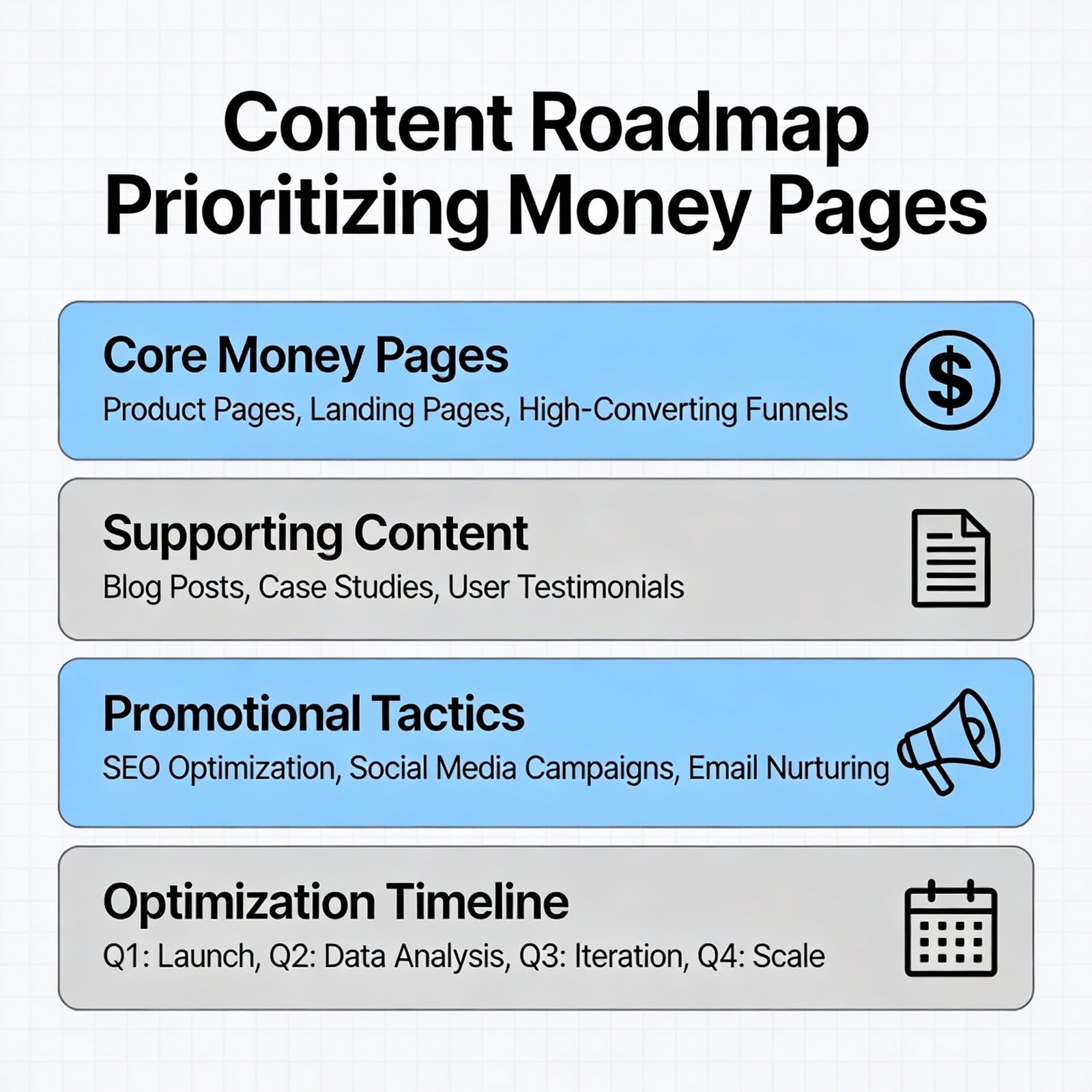
Content Roadmap that Prioritizes Money Pages in 7 Steps
Here’s the truth: most content plans are just busywork with a calendar. A content roadmap that prioritizes money pages is the opposite—it’s a revenue system with content attached.
The problem is people treat content like a hobby project: publish random “helpful” posts, pray for traffic, then wonder why the site makes $17.42 a month and a mild sense of regret.
If you want income, you need money pages first, then the support content that makes those pages rank and convert. Not the other way around.
Table of Contents
- Why most content roadmaps fail (and keep failing)
- The money-pages-first model (the part people avoid)
- Map keywords to revenue, not ego metrics
- Build the roadmap: a practical 4-layer structure
- Internal linking that actually pushes money pages up
- Production + QA: the system that prevents “content debt”
- Tools & resources (stuff that makes execution faster)
- Frequently Asked Questions
- Final takeaway
Why Most Content Roadmaps Fail (and keep failing)
A money-first content roadmap starts with revenue targets, then builds content to support the pages that produce revenue. Publish the money pages early, surround them with buyer-adjacent support articles, and use internal linking to funnel authority and intent. If your roadmap doesn’t name your money pages up front, it’s a blogging diary.
Most roadmaps are built backwards: “Let’s publish 50 informational posts to get traffic.” Fast forward to month three: traffic is trickling in, but it’s the wrong traffic—people who want definitions, not decisions.
Then the site owner panics and slaps together a “Best X” post with thin comparisons and zero trust signals. That page doesn’t rank. Or worse: it ranks for garbage queries that don’t convert.
This is why “content marketing” has a reputation for being slow. It’s not inherently slow. Bad planning is slow.
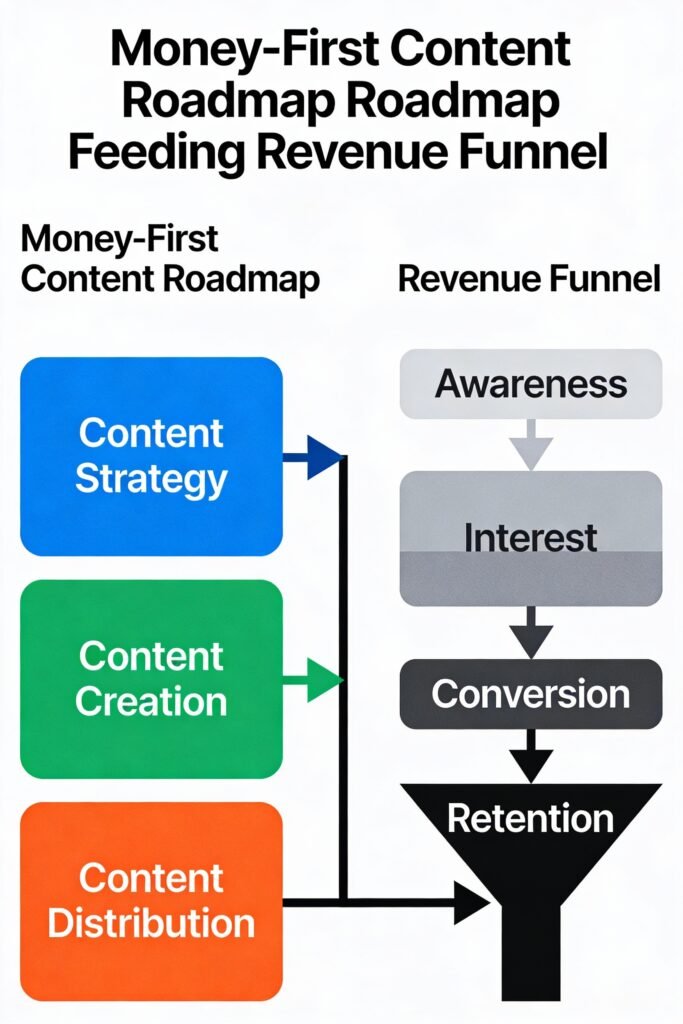
If you want the grown-up version of this conversation, read this breakdown on blogging for profit as an actual business model and notice the theme: traffic is a means, not the end.
Also, Google isn’t “anti-affiliate.” Google is anti-trash. Their documentation is pretty clear that good structure and helpful content matter more than vibes. Start with their own guidance on site architecture and internal linking at Google Search Central.
The money-pages-first model (the part people avoid)
Bottom line: a money page is any page where a visitor can take a revenue action. That includes affiliate “best” lists, product comparisons, product reviews with real testing, service pages, pricing pages, and lead-gen landing pages.
What it’s not: “10 Interesting Facts About [Thing].” That’s a fun post. It’s also a financial liability.
Here’s the part most people hate: money pages require decisions. You have to pick what you recommend, define selection criteria, and stand behind it.
If your money page reads like a politician wrote it, it will convert like a politician’s apology.
When you build money pages first, you gain three strategic advantages:
- Keyword intent alignment: you target “ready-to-buy” queries immediately.
- Support content clarity: every supporting article knows exactly where to link.
- Faster iteration: you can improve conversion while SEO matures.
And yes—competition is real on “best” queries. That’s why the roadmap matters. If you haven’t picked a niche that can support buyer intent, you’re building on sand. If you need a reality check, use this niche monetization framework to stop guessing and start validating.
For the theory heads: the idea that authority flows through links isn’t new. It’s been studied and debated for decades; start with the foundational concept on Wikipedia’s PageRank overview and you’ll immediately see why internal linking is not “SEO garnish.” It’s plumbing.
Map keywords to revenue, not ego metrics
The problem is keyword research is often treated like a scavenger hunt for high volume. Volume is nice. Revenue is nicer.
A money-first roadmap uses a simple filter:
- Intent: does the query suggest a decision is coming? (“best,” “vs,” “review,” “price,” “worth it,” “alternatives”)
- Monetization strength: can you earn meaningful commission or lead value?
- Competitive reality: can you outrank what’s there with better structure, depth, and credibility?
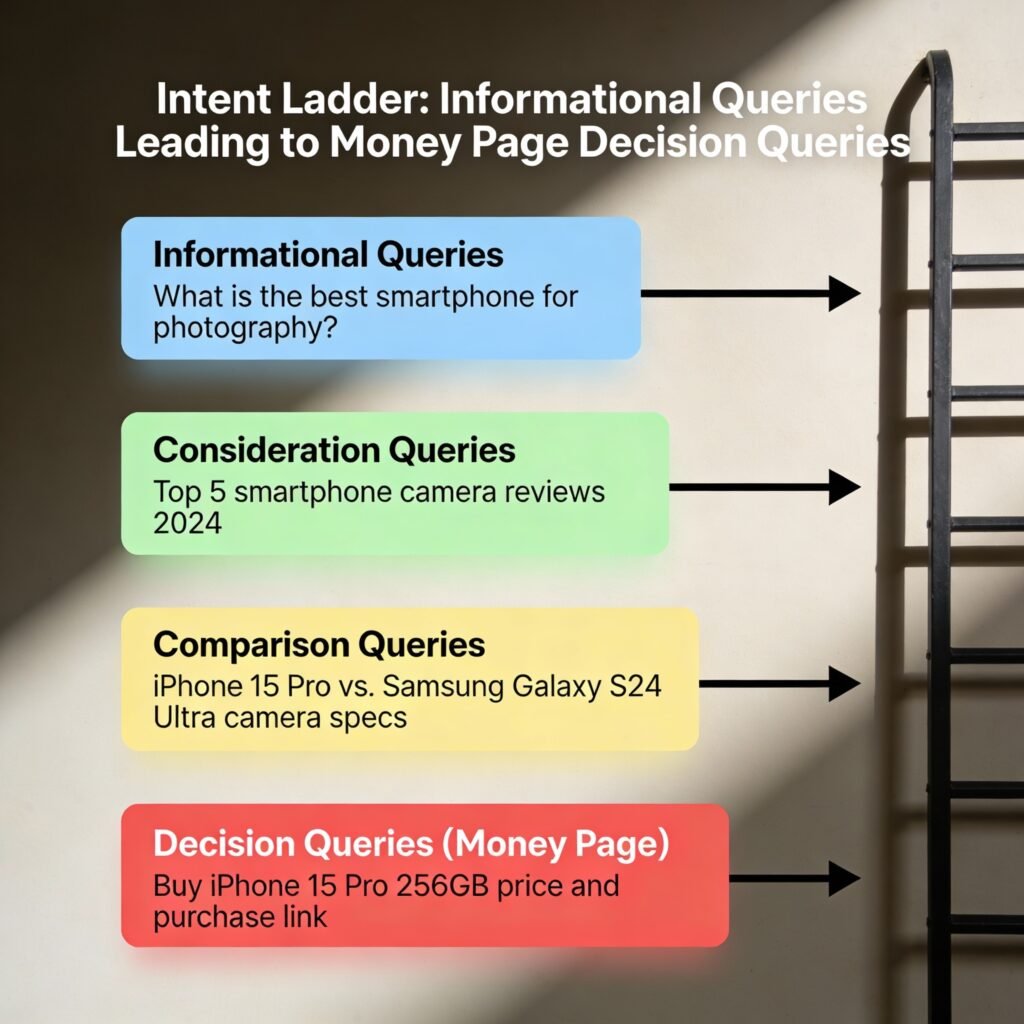
Here’s a quick intent ladder you can apply in five minutes:
- Decision intent (money pages): “best X,” “X vs Y,” “X review,” “X alternatives”
- Pre-decision intent (support content): “how to choose X,” “what size X do I need,” “is X worth it for [use case]”
- Problem intent (support content): “X not working,” “fix X issue,” “X troubleshooting”
- Education intent (optional): definitions and history—use sparingly unless your niche needs it
One more truth bomb: not all traffic is equal. If you want a credible framework for measuring value per visitor, look up “customer lifetime value” and related concepts; the basic definition is widely documented, including on Wikipedia’s CLV entry. Even if you’re doing affiliate, the mindset still applies: optimize for valuable sessions, not vanity sessions.
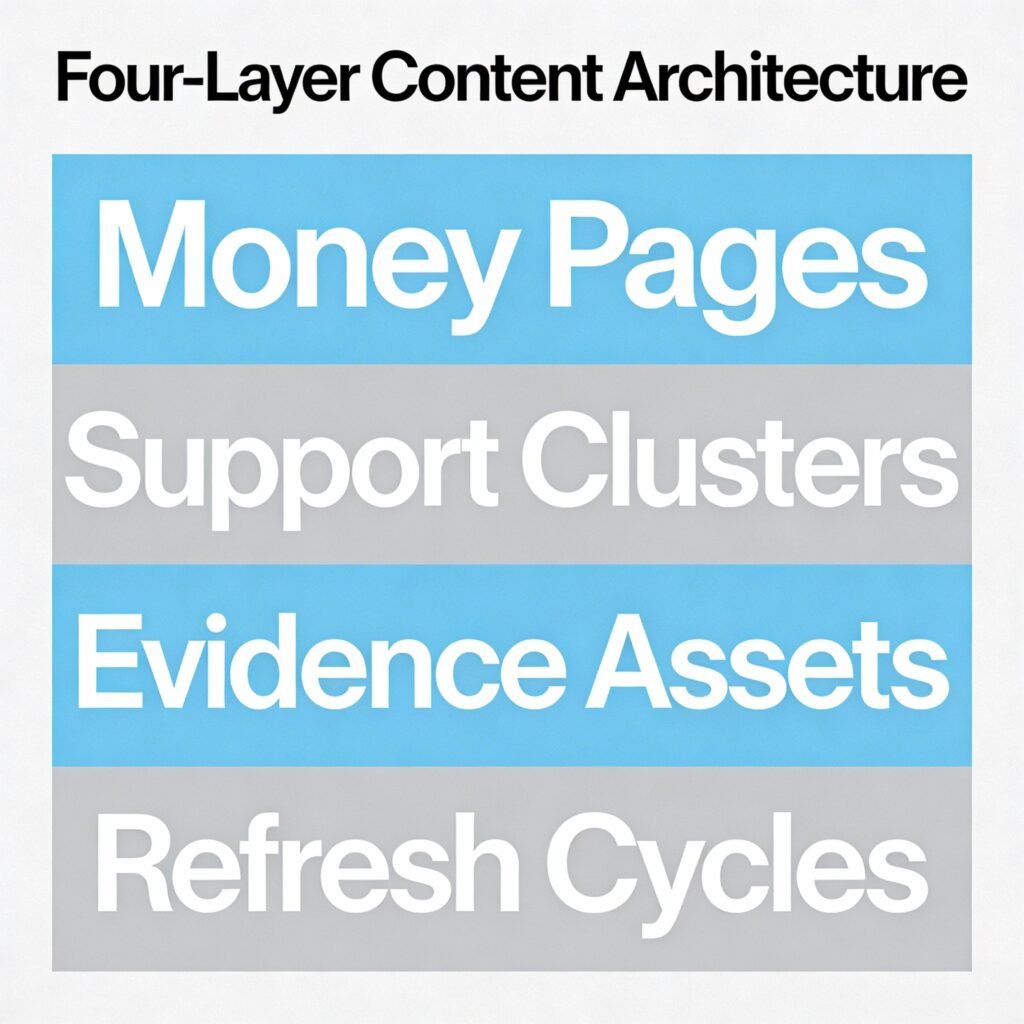
Build the roadmap: a practical 4-layer structure
Here’s the structure I’ve seen work across boring niches, sexy niches, and “why does this niche even exist” niches.
Layer 1: Money pages (your inventory)
Start with 3–7 money pages. Not 30. You’re building a small set of pages you can actually improve.
Examples (pick what matches your site type):
- Best-of: “Best [Category] for [Use Case]”
- Comparison: “[Product A] vs [Product B]”
- Review: “[Product] review: who it’s for, who should skip it”
- Alternatives: “Best alternatives to [Product/Brand]”
Layer 2: Support clusters (rank fuel)
For each money page, plan 6–12 support posts that answer the questions people ask right before buying. This is where you earn trust and topical relevance.
Layer 3: Evidence assets (credibility boosters)
These are “proof pages”: test methods, buyer guides, glossary, comparison criteria, and “how we evaluate” pages. They reduce skepticism and give your money pages something solid to point at.
Layer 4: Distribution and refresh (the part everyone forgets)
Every roadmap needs maintenance cycles. Money pages are not “publish and done.” You refresh them monthly or quarterly based on new products, price changes, and SERP shifts.
If you’re building a site and still haven’t decided what your “inventory” is, go back and define your monetization model. This is why building a blog that actually makes money starts with a revenue plan, not a content calendar.
And if you want an external sanity check on why “helpful content” matters, Google has been blunt about the direction they want publishers to move in. Major industry coverage and guidance around helpful, people-first content is widely discussed in SEO circles; anchor yourself in primary docs from Google Search Central’s helpful content guidance instead of Twitter panic.
Internal linking that actually pushes money pages up
Internal linking is where most sites accidentally sabotage themselves.
They write 80 posts, sprinkle random links, and wonder why the money pages sit on page two forever. That’s not linking. That’s confetti.
Here’s a clean, repeatable approach:
- Support posts link up to the money page using descriptive anchors that match intent (“best options for…”, “top choices for…”, “compare models…”).
- Money pages link down to support posts for depth (“how to choose,” “sizing,” “common mistakes”). This improves UX and reduces pogo-sticking.
- Support posts cross-link laterally only when it truly helps the reader complete a decision.
One sentence rule: every support post should have at least one “up-link” to a money page. If it doesn’t, it’s orphaned labor.
Don’t use exact-match anchors like a spam bot. Write like a human who wants the reader to click, not like someone trying to cast a spell on Google.
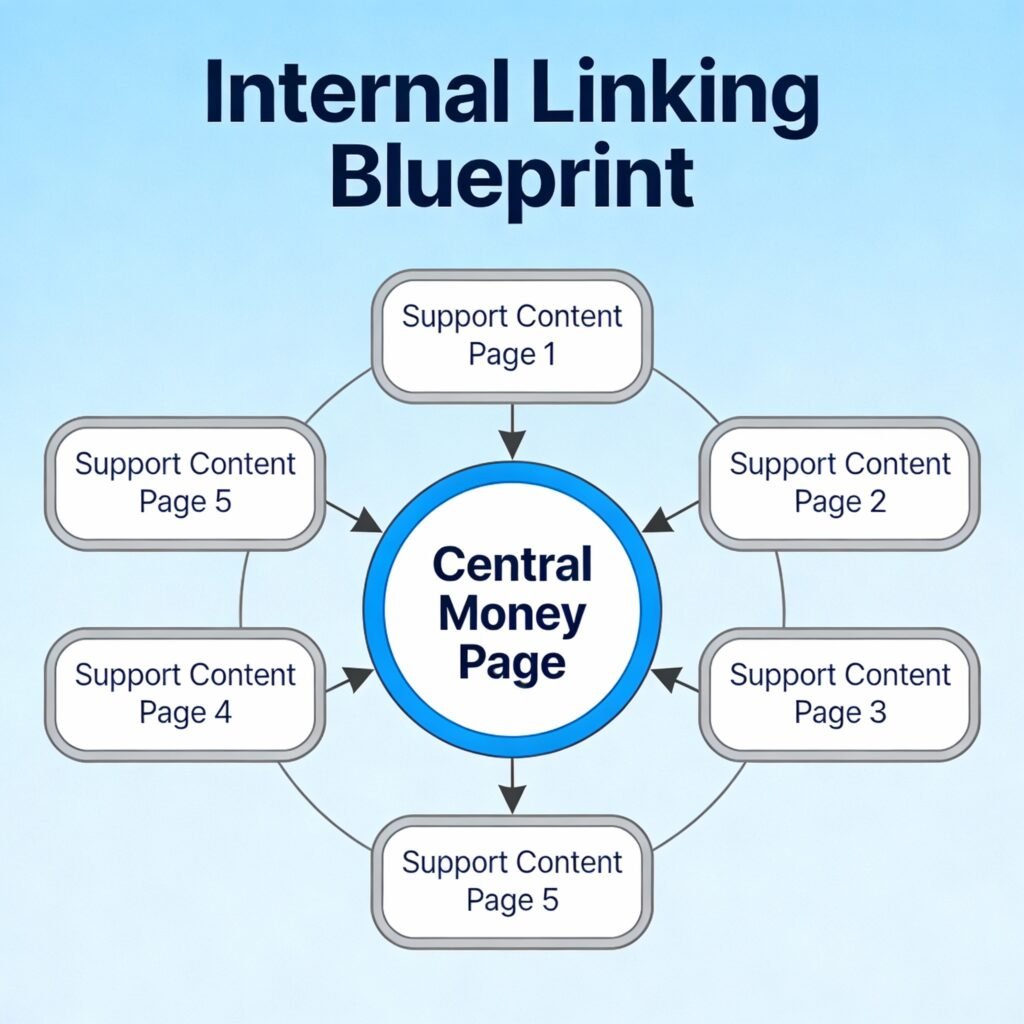
Want a practical reason this matters? Because the web is essentially a graph of linked documents, and search engines use links (internal and external) as signals. The basics are well documented—again, PageRank is a fine starting point for understanding the “why,” even if modern ranking is far more complex.
Also: don’t ignore navigation and structure. If your money pages are buried, you’re telling crawlers (and users) they’re not important. Fix your architecture before you write your 51st post.
Production + QA: the system that prevents “content debt”
Here’s the truth: execution kills more sites than competition.
People build a beautiful roadmap, then ship content inconsistently, forget updates, and end up with a graveyard of “almost good” pages.
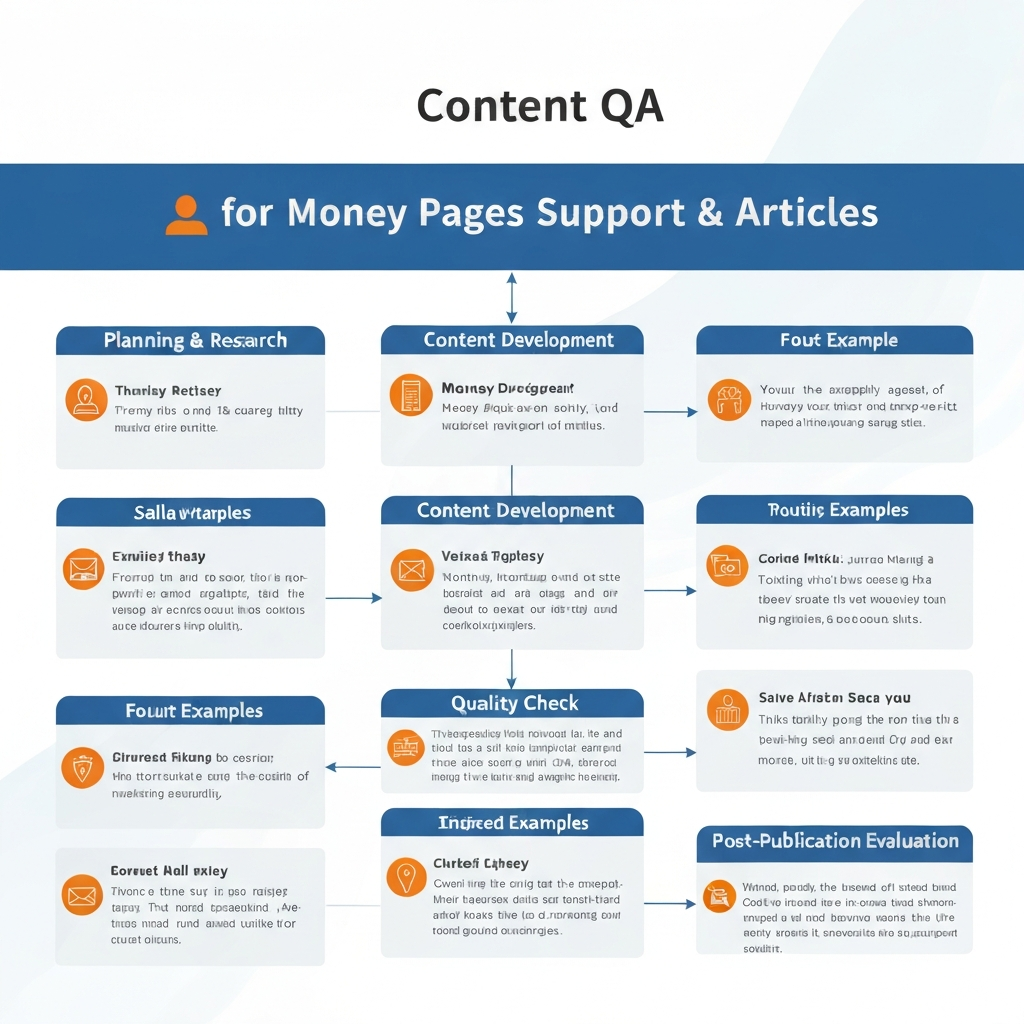
Use a lightweight production pipeline:
- Define templates: money page template, review template, comparison template, support post template.
- Set acceptance criteria: required sections, proof elements, internal links, and CTA placement.
- QA like an adult: check intent match, link placement, and whether the page answers the decision question.
One-sentence QA test: can a reader make a confident decision after reading this?
If not, the page isn’t done. It’s just published.
And yes, niche choice still matters here. If your niche can’t support multiple money pages with clusters around them, it’s probably not a good niche. That’s exactly why the “pick a niche” step needs to be monetization-first, not passion-first; use this niche selection method to avoid building a site that can’t pay you back.
Tools & resources (stuff that makes execution faster)
You don’t need a fancy tool stack. You need a consistent system.
That said, a few practical items can reduce friction—especially if you’re building roadmaps, content briefs, and review standards.
1) A physical planning board (so your roadmap is visible)
2) Content strategy books that don’t waste your time
Look for frameworks you can apply, not motivational fluff.
3) A simple notebook for repeatable testing notes
If you review products, you need a place to track criteria, pros/cons, and real observations so your pages don’t sound like recycled spec sheets.
Frequently Asked Questions
What counts as a “money page” in an affiliate or service site?
A money page is any page designed to trigger a revenue action: affiliate comparisons, best-of lists, product-led reviews, pricing pages, service pages, and high-intent landing pages. If a visitor can reasonably buy, subscribe, or contact you from that page, it’s a money page.
How many informational posts do I need before publishing money pages?
Publish money pages first, then build supporting content immediately around them. If you wait for “enough” informational posts, you’re just delaying revenue. Aim for 1 money page supported by 6–12 tightly related articles that target buyer-adjacent questions and link back with intent.
Will Google penalize a site if I start with affiliate content?
Google doesn’t penalize you for monetizing. It punishes thin, unhelpful pages and fake expertise. Build real comparisons, clear criteria, and supporting content that answers the questions people ask before buying, and follow Google’s guidance on site structure and helpful content.
What’s the fastest way to decide which money page to build first?
Pick the page with the best mix of purchase intent, manageable competition, and monetization strength (commission, conversion rate, or lead value). If two pages are tied, choose the one that can spawn the most supporting articles and internal links.
How do I avoid cannibalizing keywords across money pages and blog posts?
Assign one primary query to one primary page. Money pages own “best,” “top,” “vs,” and “review” intent; supporting posts own questions, use-cases, and problem-solving intent. Then link upward to the money page using descriptive anchors and consistent page purpose.
Final takeaway
Bottom line: if your roadmap doesn’t start with money pages, it’s not a roadmap—it’s a content mood board.
Build 3–7 money pages first. Wrap each with 6–12 support articles that answer buyer-adjacent questions. Link upward like you mean it. Refresh the pages on a schedule. Measure outcomes that matter (clicks, leads, revenue), not just pageviews.
Fast forward six months and you’ll have something rare: a site that doesn’t just “get traffic,” it earns. And you can keep your dignity while doing it.
As an Amazon Associate, I earn from qualifying purchases.




2 Comments
Comments are closed.