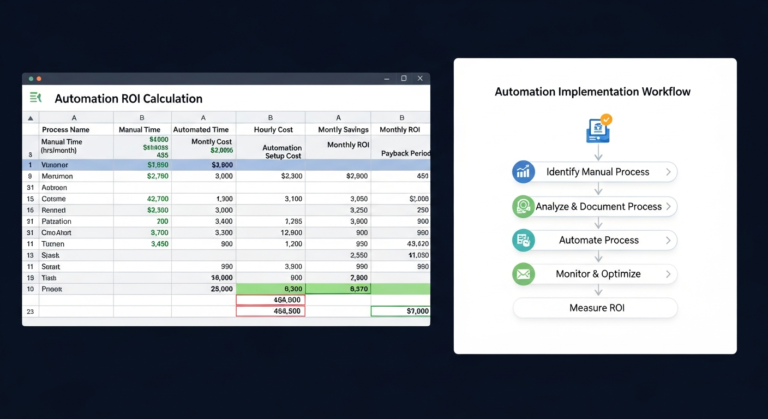

How Does AI and Automation work for Online Business
What if your online venture could operate 24/7, making smart decisions even when you’re offline?
This isn’t science fiction. It’s the reality powered by the fusion of artificial intelligence and sophisticated automation. This technology represents a fundamental shift in how modern businesses function.
At its core, these systems are programmed to review vast amounts of data, recognize patterns, and execute logical choices. They handle the repetitive tasks that consume valuable hours—from customer invoicing to complex inventory management.
The result is a dramatic boost in efficiency. Owners and teams are freed from mundane processes. This allows a focus on creative strategy and growth-driven innovation.
Understanding this powerful combination is now essential. For any online business, leveraging these tools is the key to staying competitive and thriving in a digital-first world.
Table of Contents
Key Takeaways
- AI and automation combine to create self-managing systems for online operations.
- These technologies handle repetitive tasks by analyzing data and making logical decisions.
- The primary benefit is increased efficiency, freeing human effort for strategic work.
- This shift is transforming core business processes like customer service and inventory management.
- Adopting these tools is becoming crucial for maintaining a competitive edge.
- Implementation ranges from simple data entry automation to complex, AI-driven pricing strategies.
- The goal is to build a smarter, more responsive, and resilient business model.
Introduction: The Rise of AI in Online Business
The digital landscape is no longer just evolving; it’s being fundamentally rewritten by intelligent technologies. This transformation turns complex challenges into streamlined opportunities.
It empowers owners to focus on growth, not grind.
Understanding the Digital Transformation
Human teams are stretched thin. This reality fuels the widespread adoption of artificial intelligence.
These tools revolutionize daily operations. They help businesses streamline intricate workflows with stunning precision.
Consider this: employees spend about 41% of their time on repetitive tasks. This is a massive drain on creativity and strategic potential.
Automation reclaims this lost resource. It redirects human talent toward innovation.
The Need for Automation in a Fast-Paced World
Market speed and data volume demand new solutions. Manual processes simply cannot keep up.
Embracing automation isn’t about replacement. It’s about empowerment.
In fact, 65% of desk workers believe generative AI will free their time for more strategic work. This shift is already changing the future of work.
Intelligent systems handle the routine. This unlocks human capacity for relationship-building and creative problem-solving.
The rise of these technologies represents an unprecedented chance to boost efficiency. It’s the key to building a resilient, modern business. Explore powerful AI automations to start your journey.
How Does AI and Automation Work in Modern Enterprises
A new breed of enterprise systems combines artificial intelligence with robotic precision. This fusion creates technologies that perform tasks and make decisions autonomously.
At its foundation are complex algorithms. These sets of rules enable systems to analyze data, learn patterns, and act without constant human input.
Exploring Core Technologies and Models
Foundational models are a key innovation. Trained on massive datasets, they power diverse tasks like language translation and image generation.
Robotic process automation (RPA) handles repetitive, rule-based work. When integrated with AI, it creates smarter automation.
Scaling these technologies requires robust infrastructure. Foundational models provide the brainpower, while cloud services deliver the capabilities.
The evolution is clear. Traditional automation follows fixed scripts. Intelligent automation adapts and improves through continuous learning.
| Feature | Traditional Automation | AI-Powered Automation |
|---|---|---|
| Decision Basis | Pre-set, rigid rules | Machine learning & data patterns |
| Adaptability | Static, requires manual updates | Dynamic, improves over time |
| Primary Task | Structured process automation | Complex analysis and prediction |
Understanding these core models empowers businesses. They can architect automation strategies for maximum impact and operational excellence.
Harnessing Artificial Intelligence and Natural Language Processing
The most advanced systems move beyond rigid commands. They comprehend context and intent through sophisticated language processing.
This capability transforms how businesses interact with information and customers.
Machine Learning and Data Pattern Recognition
Machine learning provides the engine for intelligent adaptation. Algorithms analyze historical data to find patterns and predict outcomes.
They improve their performance continuously without manual reprogramming. This learning turns raw information into actionable intelligence.
For example, an AI agent uses natural language processing to interpret a vague customer query. It understands the sentiment and context, not just keywords.
The system can then provide a helpful, human-like response. This is the synergy of communication and cognition in action.
Combining these models allows for automating complex tasks. Businesses can integrate AI and machine learning to handle document analysis, sentiment tracking, and more.
Establishing a simple AI policy guides the responsible use of these powerful tools. The result is a dynamic system that learns and evolves with every interaction.
Streamlining Business Processes with Intelligent Automation
The true power of modern technology lies in its ability to streamline complex workflows autonomously. This transformation turns clunky, manual business processes into smooth, efficient sequences.
Intelligent systems execute series of actions automatically. They eliminate bottlenecks and accelerate operations from start to finish.
Automating Repetitive Tasks and Data Workflows
Automation takes over repetitive tasks that drain human hours. This includes simple tasks like data entry and complex inventory management.
Shifting these duties to software agents gives teams more time for strategic work. Robotic process automation (RPA) handles rule-based data workflows across systems.

When combined with artificial intelligence, it creates intelligent process automation. This ensures accuracy and consistency while processing information at machine speed.
Business Process Management (BPM) strategically improves these workflows. It designs end-to-end processes that flow without manual stops.
| Aspect | Traditional Process Handling | Intelligent Automation |
|---|---|---|
| Speed | Slow, human-dependent | Fast, continuous operation |
| Accuracy | Prone to human error | High, consistent output |
| Adaptability | Rigid, hard to change | Learns and adjusts dynamically |
| Human Role | Performs repetitive tasks | Focuses on creativity and strategy |
Intelligent Automation (IA) blends RPA, AI, and BPM. This powerful combination drives significant business value and operational efficiency.
An example is automatically routing customer requests and updating records. This automation liberates human potential for innovation.
Enhancing Customer Service and Personalization
Gone are the days of generic, slow responses. Today’s customers expect immediate, relevant assistance that makes them feel uniquely valued. This shift transforms customer service from a cost center into a powerful competitive advantage.
Using AI for Real-Time Response and Engagement
Intelligent systems provide instant support 24/7. They eliminate frustrating wait times and ensure every customer receives immediate attention.
Automation handles routine tasks like ticketing and case routing. This frees human representatives to focus on complex issues requiring empathy and nuanced problem-solving.
For example, service reps at a telecom company improved issue resolution time by 67%. Their AI agent analyzes language to understand context and deliver relevant solutions.
These tools also analyze customer data and feedback. They provide teams with actionable insights to continuously improve service strategies.
This creates a virtuous cycle. Customers enjoy better experiences, reps find more satisfaction, and businesses build stronger loyalty. Discover more about this transformative AI and automation impact on customer.
Implementing AI Tools: From Strategy to Execution
Implementation is the critical bridge between the promise of automation and tangible business results. The key is selecting a unified platform, not a collection of scattered tools.
A comprehensive solution combines robotic process automation with advanced AI capabilities. This includes machine learning, natural language processing, and document understanding.

Selecting Platforms and Integrating Systems
Your chosen software must work seamlessly with existing systems like CRMs and ERPs. Look for robust integration via UI and API connections.
Governance features are non-negotiable. Ensure role-based access, audit trails, and model transparency are built-in.
Every business faces the build or buy decision. In-house teams can develop custom models. Most businesses benefit from vendor platforms with pre-trained solutions and low-code capabilities.
Effective tools must connect to your data sources. This seamless connectivity is paramount for any successful plan to automate admin tasks.
Best Practices for Deployment
Start small with a pilot program in a low-risk department. This tests accuracy, user adoption, and integration pain points.
Establish clear success metrics from the beginning. Involve end-users early and provide comprehensive training.
This approach minimizes risk while maximizing value. It turns a strategic vision into operational reality, much like a structured workflow automation experiment.
Balancing technological capabilities with organizational readiness is essential. With the right platform and plan, the journey from strategy to execution is entirely achievable.
Overcoming Challenges in AI and Workflow Automation
Forward-thinking businesses view data and integration issues not as dead ends but as opportunities for systemic improvement. Each hurdle in automation is a chance to strengthen your operational core.
With strategic planning, common obstacles become stepping stones to greater workflow resilience and value.
Tackling Data Quality and Integration Issues
Inconsistent or outdated data cripples intelligent systems. Investing in data cleansing and governance ensures your automation runs on accurate, reliable information.
This upfront work pays massive dividends in performance.
Legacy system incompatibility is another major barrier. Modern platforms use APIs and middleware to bridge these gaps seamlessly.
This allows automation to span old and new applications without costly replacements.
Algorithm bias and upfront costs are real concerns. Diverse training data and regular audits promote fairness.
Scalable, cloud-based solutions make advanced process automation accessible for businesses of all sizes.
| Common Challenge | Direct Impact | Strategic Solution |
|---|---|---|
| Poor Data Quality | Unreliable outputs and flawed decisions | Implement data validation and governance frameworks |
| System Integration | Broken workflows and manual workarounds | Leverage integration platforms (iPaaS) and APIs |
| Algorithmic Bias | Unfair or inaccurate outcomes | Use diverse datasets and conduct regular bias audits |
| High Initial Cost | Barrier to entry for smaller teams | Adopt phased implementation and SaaS models |
The key is to start with well-defined tasks. Ensure your data is ready and choose tools built for integration.
Following a structured AI automation roadmap turns these challenges into a clear path for growth. You build a robust, future-proof system.
Exploring Future Trends: Agentic AI and Beyond
Beyond today’s reactive tools lies a future of self-directed agents capable of orchestrating entire business workflows. This represents the next quantum leap in intelligent systems.

Agentic intelligence moves past simple rule-following. These systems are trained to mimic human decisions and take autonomous action toward clear goals.
Next-Generation AI for Enhanced Decision-Making
These advanced agents can break down complex objectives. They plan, execute, and adapt strategies in dynamic environments with minimal oversight.
Their capabilities include monitoring progress and course-correcting based on outcomes. This continuous learning cycle drives constant improvement.
Future technologies will handle tasks requiring perception and complex reasoning. Machine learning models empower this shift, turning raw data into strategic insight.
This evolution creates powerful partnerships. Automation handles data-intensive coordination, freeing human creativity for vision and innovation.
The result is a smarter, more resilient enterprise. Forward-thinking businesses gain a decisive edge through these autonomous, goal-driven systems.
Strategic Steps to Embrace AI Automation in Your Business
The journey to smarter operations begins with a strategic plan, not a software purchase. Transforming your company requires aligning powerful tools with your core operational needs.
This approach ensures you solve real problems and achieve lasting efficiency gains.
Identifying Key Business Needs
Start by looking inward. Ask critical questions about your current workflows.
- Where are the inefficiencies costing us time?
- Which processes are error-prone or difficult to scale?
- Where do customers or team members report consistent friction?
Investigate these pain points thoroughly. Leverage customer feedback, employee insights, and data analytics. This helps isolate the true bottlenecks your current tools cannot fix.
Creating a Roadmap for Successful Adoption
Once needs are clear, research available technologies. Understand what specific capabilities can address your challenges. Select tools that are both scalable and secure for long-term growth.
Implementation should start small. Launch a pilot program in a low-risk department. This tests integration and user adoption before a wider rollout.
Remember, this is an ongoing journey. Building internal literacy and establishing governance frameworks are essential. Maintain a feedback loop to adapt and optimize continuously. This strategic roadmap turns potential into sustained competitive advantage.
Conclusion
Adopting intelligent automation is a decisive leap forward for any business. This journey fundamentally transforms organizational operations and elevates customer experiences.
The ability to manage tasks like data processing and content generation is transformative. Automation handles repetitive tasks, freeing valuable time for strategic work and creative content.
These technologies boost efficiency across complex workflows. They build smarter, more adaptive systems for sustained success.
Forward-thinking businesses that embrace these technologies secure a durable advantage. They unlock unprecedented efficiency and scale, thriving in today’s dynamic digital economy.